Options
We build every strainer for the situation in which it will operate. The following pages show what can be specified – from the mesh size and the cover closure to the certificates. Tell us what you need; we take care of the design.

Up to 17 options
Basket · Simplex · Duplex · T-type · Pot type · Y
Drawing for approval
PED 2014/68/EU · AD 2000
A strainer housing is a pressure vessel. Everything attached to it – a nozzle for the pressure gauge, a lug on the cover, a jacket for heating – affects the pressure-bearing wall and has to be calculated beforehand. That is why these decisions are made in the design, not by putting items together from a list.
This is where we start: you describe the medium, operating data and installation situation, we derive the design from this and set it out in a drawing. The drawing is sent to you before production starts – manufacturing begins only after your approval. We incorporate your own drawings, company standards and documentation requirements.
The options can be combined freely. We tell you what makes sense together and what is mutually exclusive. A heated strainer, for example, needs extensions on the valves so that they can still be operated above the insulation.
Where every design begins: what is retained, what the strainer is made of and how it connects to your line.
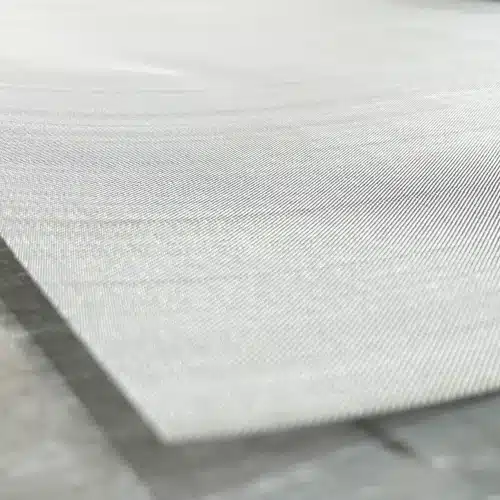
From coarse perforated plate to fine wire mesh – derived from the component to be protected, not from a rule of thumb.
View option →
Housing and strainer element are selected separately; for aggressive media duplex, Monel or Hastelloy.
View option →
Also dairy pipe fittings and clamp connections, to DIN, ANSI or your company standard.
View option →What makes operation visible and controllable – and how the strainer is isolated from the process.

The only reliable indication of the degree of fouling – from the local gauge to the signal to the control system.
View option →
Bursting disc, magnetic rods, thermometer in a thermowell, pressure transmitter, sight glass – and nozzles for later use.
View option →
Ball valves, butterfly valves and gate valves, changeover on the duplex strainer, pneumatic or electric actuator.
View option →Everything that matters when the strainer is opened, cleaned and closed again.

Hinged eye bolts, eye bolts with ring or wing nuts, clamping claws, clamp connections.
View option →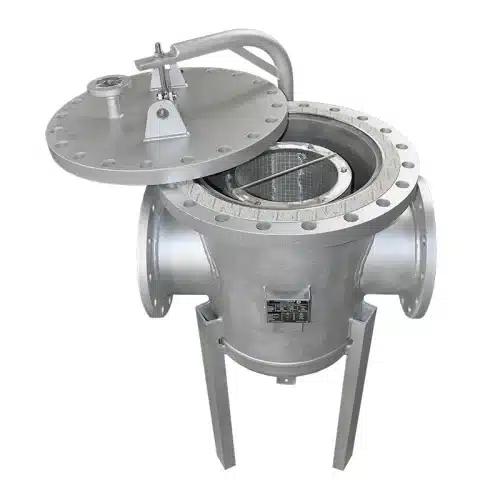
Hinge, swivel arm, handles or lifting lug for the crane – depending on the weight of the cover.
View option →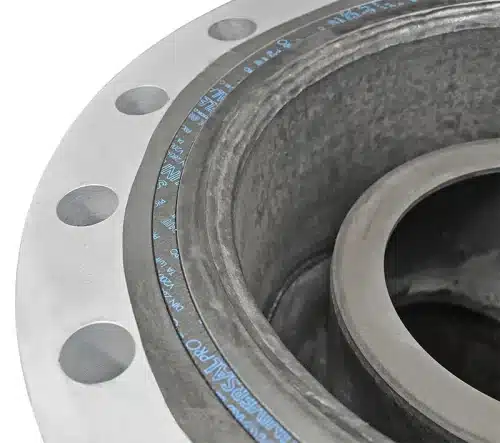
Graphite with tanged steel insert, EPDM, Viton, PTFE, spiral wound and kammprofile gaskets – this is often where the strainer reaches its limit.
View option →What has to happen before opening and what the strainer stands on.
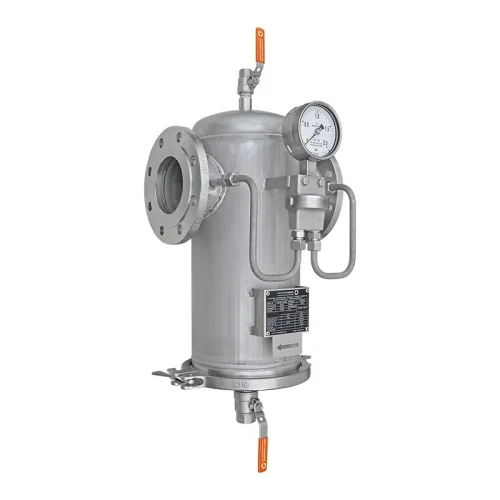
Socket, flange or ball valve on cover and bottom – so that the strainer is empty when you open it.
View option →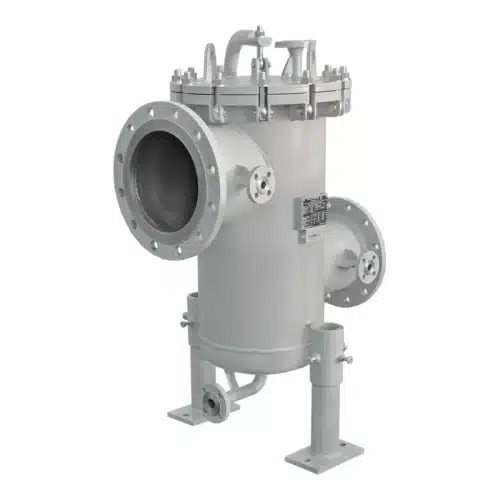
Two, three or more support points, height-adjustable, angle foot for bolting down, support brackets and lifting lugs.
View option →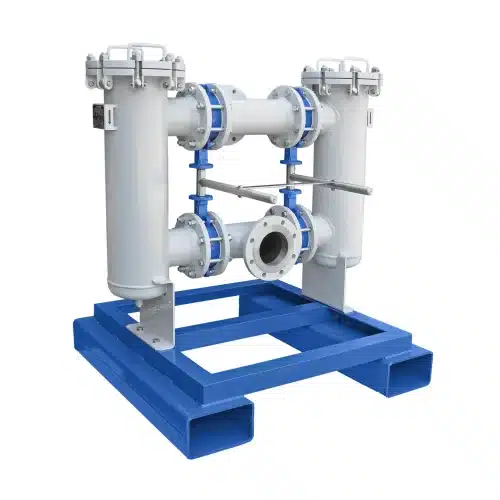
Strainer, valves and piping on one frame – also mobile, as a trial or rental strainer.
View option →What keeps the strainer at temperature in operation and what protects it from the environment.
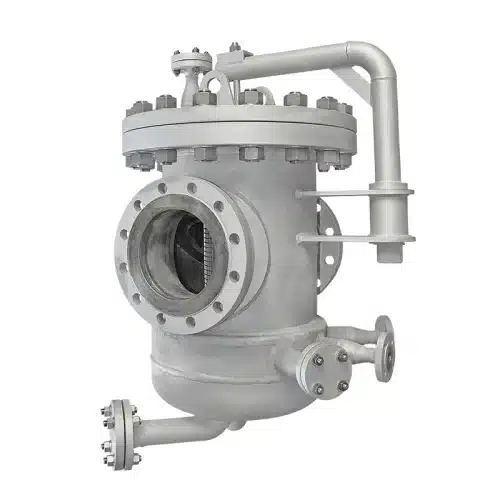
For media that become viscous or solidify when they cool down – also as a leakage jacket with sensor.
View option →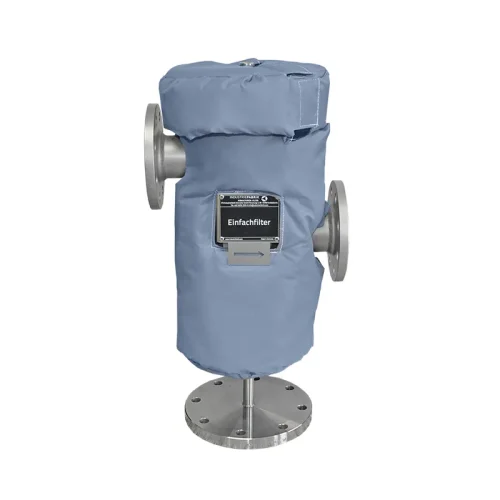
Made-to-measure insulation jackets and pipe sections – the cover remains accessible.
View option →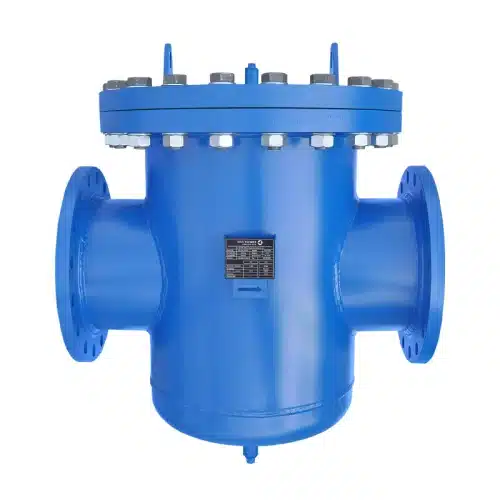
Carbon steel primed and painted, stainless steel pickled and passivated, coating system by corrosivity category, special colours.
View option →Where the standard ends – and what is supplied at the end.
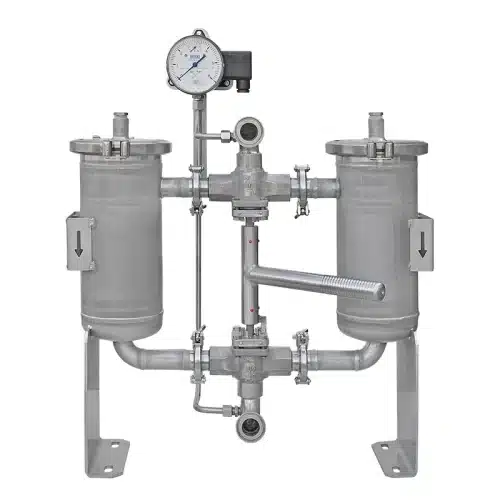
Face-to-face length to measure, pressure and temperature above the standard, different geometry, design to your code.
View option →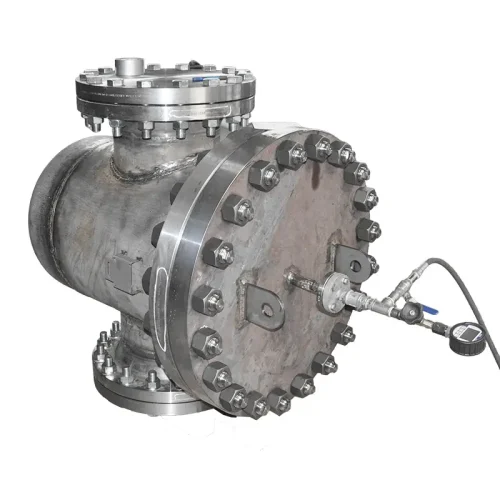
Inspection certificate, TÜV inspection, declaration of conformity, data sheet and operating instructions.
View option →The options follow the application. Which mesh size, which material and which attachments make sense depends on the industry and the medium – which is why this is the overview from which we derive the design. Details for each medium are given under Applications and media, the types themselves under Industrial strainers.
Almost every option affects the design. A nozzle belongs in the strength calculation, a lug at a calculated position, a jacket changes the accessibility of the valves. As long as this is done in the drawing, it involves no additional effort. Afterwards it means welding on the finished pressure vessel, renewed testing, renewed documentation and downtime.
Certificates are part of this too: an inspection certificate 3.1 requires batch traceability from the start. Tell us early what is required – the easiest way is via the enquiry form.
Yes. Before production starts you receive the design drawing for approval – with all selected options, dimensions and materials. Only once you have confirmed the drawing does the order go into production.
Certainly. Drawings, company standards, specifications, inspection and test plans or the data sheet of the previous strainer are the best basis. Our design engineers adopt your requirements and adapt them where manufacturing or the applicable code requires it – we agree any deviations with you beforehand.
As a rule yes, and we tell you what to look out for. Some options interact: a heating jacket with insulation adds bulk, so the valves need stem extensions; a quick-opening closure reaches its limit at large nominal sizes and high pressure, where the swivel device makes handling easier instead.
Basket strainers from DN50 to DN1000, screens and blinds from DN10 to DN1200. Pressure ratings PN6 to PN40 as standard, above that the high-pressure design up to PN63. Larger nominal sizes and different geometries are manufactured as special designs – the limits are then determined by the design.
Yes, also on units that were not made by us. Differential pressure gauge, drain, vent, quick-opening closure, swivel device, heating jacket, gasket replacement and replacement screens are common retrofits. We check beforehand whether material and wall thickness permit this.
We work that out for you. Tell us the medium, operating pressure, temperature, flow rate, the component to be protected and the installation situation – most of it follows from that. For the rest, we will ask.
Describe your application – medium, operating data, installation situation and what else the strainer needs to do. You will receive a draft design with all options.