Home › Applications › Fuels and tank farms
Applications
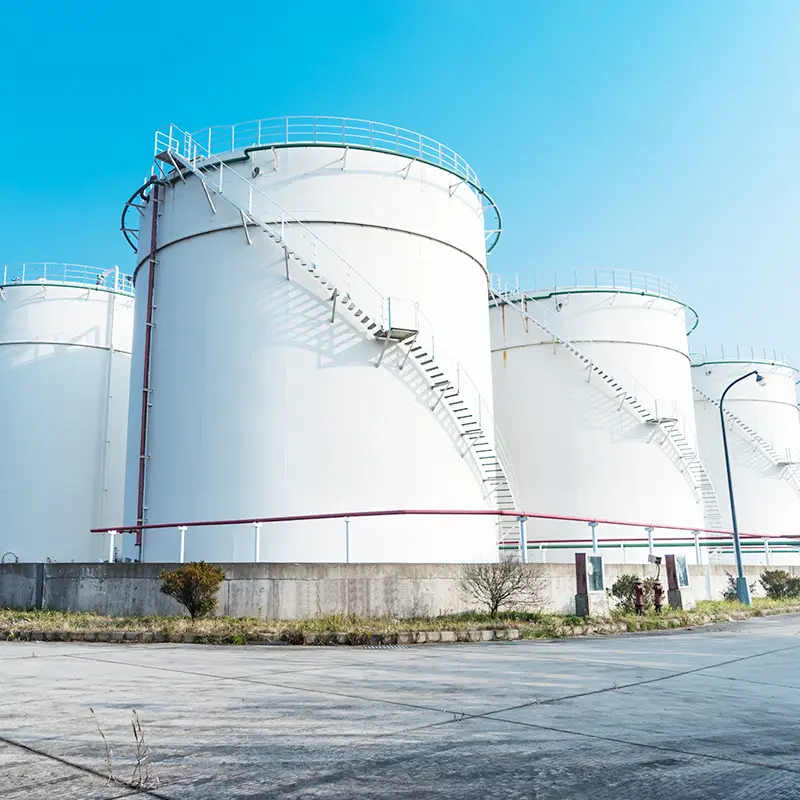
In tank farms and fuelling installations, two things count. No particle may reach the injection system or the burner, and the installation has to meet the requirements for tightness and earthing. We design both into industrial fuel strainers and diesel strainers.
80 – 300 µm
to TA Luft
Earthing lug
Carbon steel RAL 5010 or 1.4571
Fuels carry little dirt, but it is effective: rust from the tank and the line, water with flocculation, residues from loading and unloading. Whatever reaches an injection pump or a burner causes damage that costs many times more than the strainer. The filtration grade is therefore in the range of a few hundred micrometres – fine enough for protection, coarse enough for the flow.
Two other points matter more here than the filtration grade. First, emission tightness: gaskets are selected to TA Luft so that the installation meets the requirements for volatile hydrocarbons. Second, earthing – flowing fuels build up an electrostatic charge, so the housing is given an earthing lug.
Then there is the pressure loss. In fuelling installations every minute counts, and an undersized strainer slows down the transfer. We state the pressure loss against the flow rate so that the design can be traced.
Fuel strainers almost always sit upstream of a component with very tight tolerances.
Carbon steel or stainless steel, simplex or changeover – the choice follows the medium and the transfer volume.
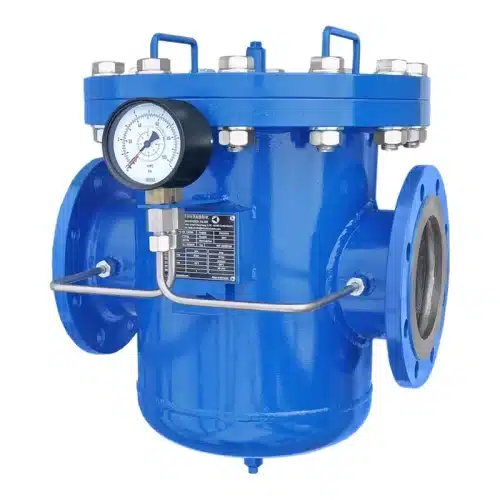
Design range: DN50 to DN200 in PN16, carbon steel P235GH primed and painted in RAL 5010, mesh size 100 to 300 µm, gasket in graphite with tanged steel insert to TA Luft, with earthing lug. Designed for −20 to +50 °C and 10 to 16 bar.
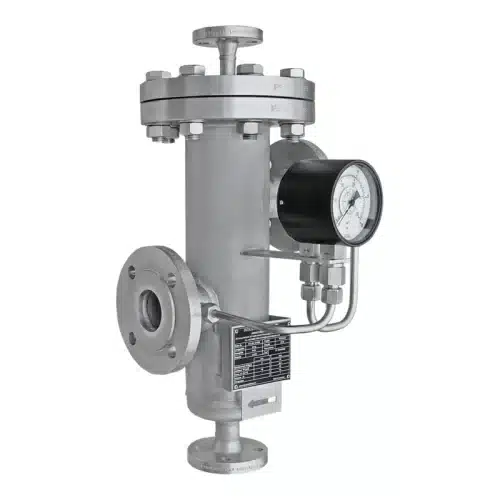
More compact, for smaller flow rates: DN50 to DN150 in PN16, stainless steel 1.4571, mesh size 80 to 240 µm, Viton gasket to TA Luft. Designed for −10 to +60 °C and up to 16 bar, with additional connections for pressure measurement and safety valve.
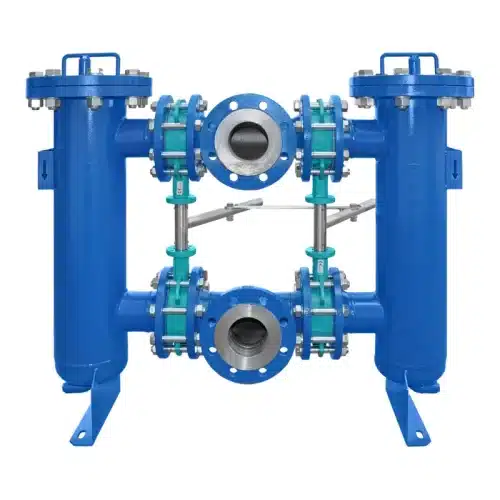
For installations in which dispensing must not stop: DN100 in PN16, carbon steel in RAL 5010, perforated plate 3 to 10 mm. Changeover is by two 3-way ball valves or four butterfly valves with NBR liner. The range is designed for −10 to +50 °C and 10 bar.
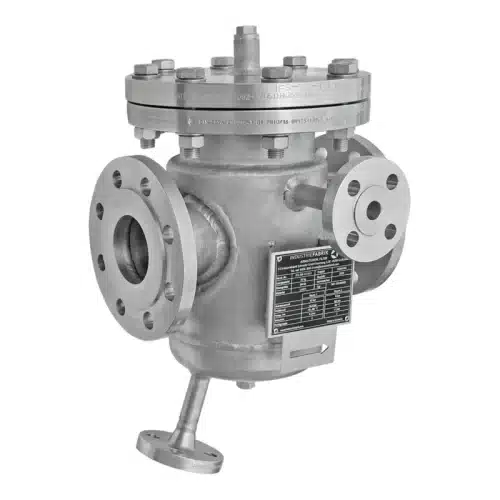
Heavy fuel oil only flows when warm. A welded heating jacket holds the temperature so that the strainer does not block at the next start-up. Heating is by thermal oil, steam or hot water.
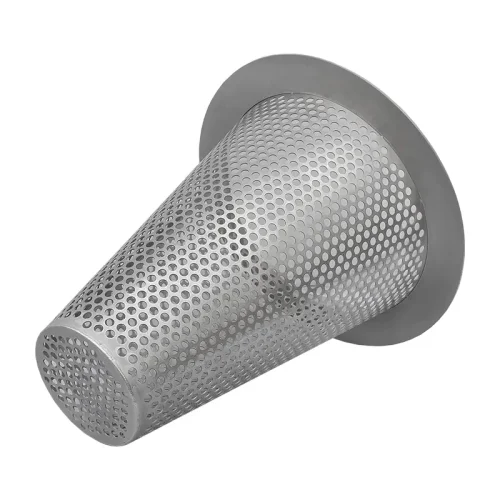
New or modified lines contain dirt that does not come from the fuel: weld spatter, scale, chips. A witch hat strainer between the flanges catches it and is removed again after the start-up phase.
Ranges and examples from our production for fuels and tank farms.
| Feature or example | Value | Note |
|---|---|---|
Basket strainer for tank farms | ||
| Nominal size | DN50 – DN200 | PN16 |
| Material | P235GH, RAL 5010 | primed and painted |
| Mesh size | 100 – 300 µm | to suit the protected component |
| Gasket | Graphite with tanged steel insert | to TA Luft |
| Special feature | Earthing lug | against static charge |
| Design conditions | −20 … +50 °C · 10 – 16 bar | range of designs built |
Simplex strainer for fuels | ||
| Nominal size | DN50 – DN150 | PN16 |
| Material | 1.4571 | stainless steel |
| Mesh size | 80 – 240 µm | finer than in the tank farm |
| Gasket | Viton | to TA Luft |
| Connections | Pressure measurement · safety valve | provided in addition |
| Design conditions | −10 … +60 °C · up to 16 bar | range of designs built |
Duplex strainer for refineries | ||
| Nominal size | DN100 | PN16 |
| Strainer element | Perforated plate 3 – 10 mm | coarse separation |
| Changeover | 2 × 3-way ball valve | or 4 × butterfly valve, NBR liner |
| Design conditions | −10 … +50 °C · 10 bar | range of designs built |
Pressure loss as a design parameter | ||
| DN50 | approx. 0.05 bar | at about 10 m³/h |
| DN200 | approx. 0.1 bar | at about 180 m³/h |
| Principle | low when clean | a rising value indicates clogging |
With fuels, two requirements are just as important as the filtration grade but are rarely mentioned. Flowing hydrocarbons build up an electrostatic charge. Without a conductive connection to the earthing system, this charge can discharge at the most unfavourable point. That is why the housing is given an earthing lug.
The gaskets are selected to TA Luft so that the installation meets the requirements for volatile emissions. Both can only be added later with considerable effort – tell us with your enquiry, and it will be in the drawing.
In our designs the range is between about 80 and 300 µm – coarser in the tank farm, finer upstream of burners and injection pumps. The deciding factor remains the component downstream: tell us its smallest opening or the manufacturer’s specification.
The German Technical Instructions on Air Quality Control (TA Luft) set requirements for the tightness of installations that carry volatile organic compounds. For the strainer this means: gasket material and closure are selected so that the requirements are met – in our case graphite with tanged steel insert or Viton.
Because flowing fuels build up an electrostatic charge. The lug provides the conductive connection to the earthing system of the installation. It is welded on and therefore belongs in the design, not at the end of installation.
Less than is often feared – if it is sized correctly. In our designs, the pressure loss when clean is about 0.05 bar for DN50 at around 10 m³/h and about 0.1 bar for DN200 at around 180 m³/h. If it rises significantly in operation, the screen is clogged.
For diesel, heating oil and heavy fuel oil, carbon steel primed and painted in RAL 5010 is generally sufficient – this is how we build the tank farm strainers. Stainless steel 1.4571 is used with additives, biofuel blends and wherever corrosion in the tank is an issue.
Yes. Before production starts, you receive the design drawing for approval – with design data, materials, mesh size and attachments. Only after your confirmation does the order go into production.
Tell us the fuel, flow rate, nominal size and the requirements for tightness and earthing – you will receive a design with type, filtration grade and options.