Home › Applications › Water and process water
Applications
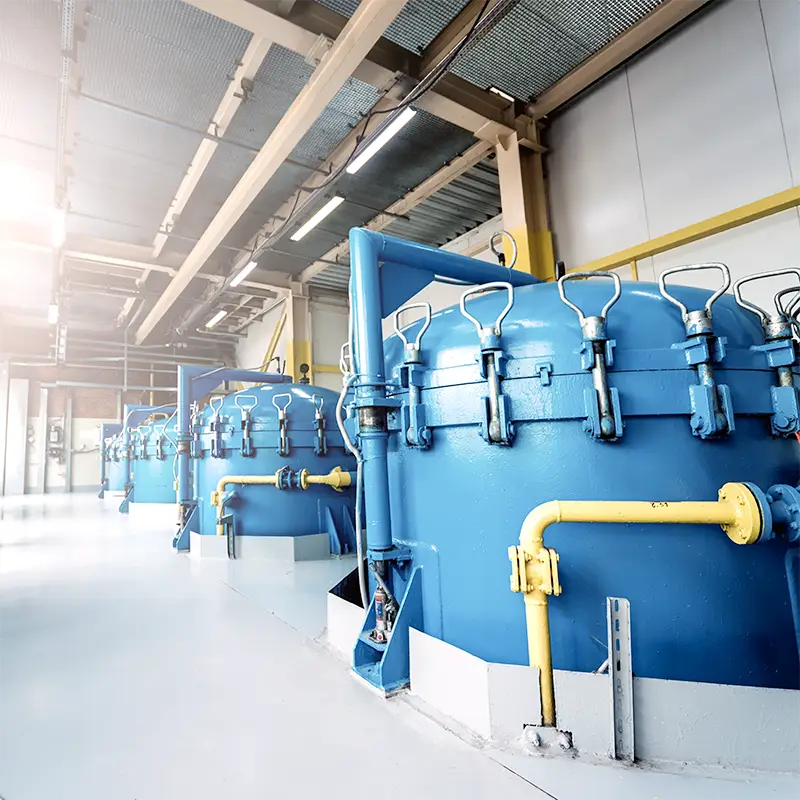
Water is the most common medium in strainer manufacturing and the one with the widest range. It extends from pre-filtration upstream of reverse osmosis in water treatment to the coarse protection of a pump in a service water line. For your industrial water strainer, we design the strainer type, mesh size and material to suit your circuit.
DN25 – DN400 and larger
100 µm to 1 mm
1.4571 or carbon steel RAL 5010
Basket · simplex · duplex · pot type
Boiler feedwater, well water and a cooling circuit are worlds apart – not in the chemistry of the medium, but in what it carries along. Well water and river water bring sand and organic load, circulating water brings corrosion products, drinking water practically nothing, but with strict requirements for the wetted materials.
The second factor is the nominal size. Water applications lead to the largest strainers we build. Everything changes with the nominal size: the cover becomes too heavy for one person, the housing needs its own legs, and cleaning has to be prepared.
The most sensitive point is the suction side of a pump. There, the strainer may cost almost no pressure, otherwise the pump cavitates. Screen area counts for more than filtration grade here: better a larger housing with a coarser screen than a tightly sized one with a fine screen.
The mesh size depends on the component downstream of the strainer. These are the most common points of use in water circuits.
What fits is decided by the dirt load and by whether cleaning has to take place during operation.
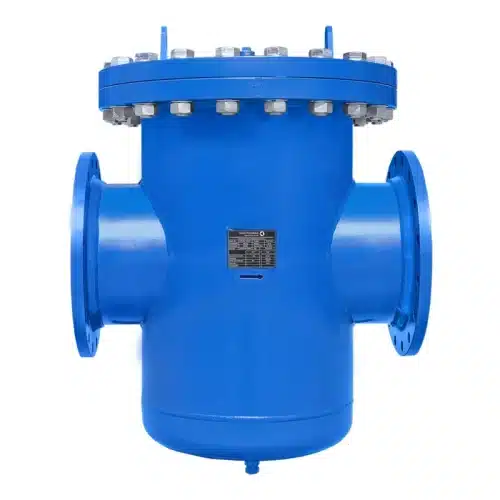
The pot shape offers many times the screen area of a Y shape. Scope of the design: DN50 to DN400, PN10 or PN16, stainless steel 1.4571 or carbon steel in RAL 5010, mesh sizes from 100 to 1,000 µm. Support basket in 1.4301, fine mesh screen in 1.4401.
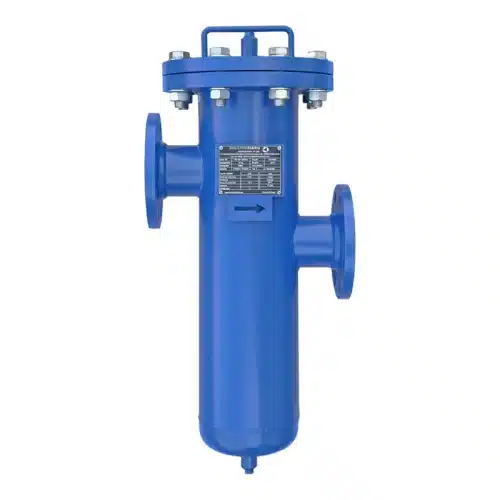
For smaller nominal sizes and moderate dirt loads. Scope: DN50 to DN150, PN10 or PN16, mesh sizes from 0.1 to 1 mm, designed for −10 to +95 °C and 5 to 16 bar. Face-to-face lengths to EN 558.
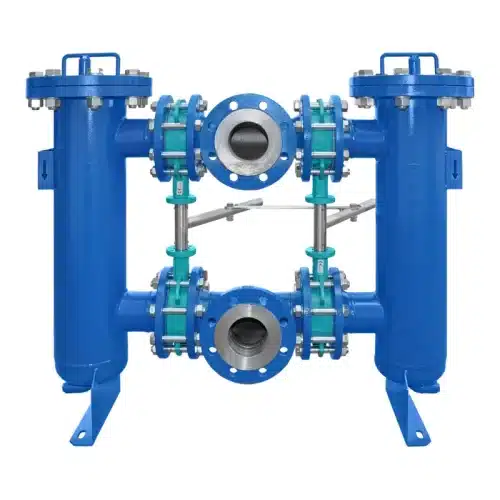
Two chambers, one in operation, one on standby. Scope: DN50 to DN200, mesh sizes from 200 to 500 µm, changeover via four butterfly valves with EPDM liner. The right choice where an interruption costs more than the additional price.
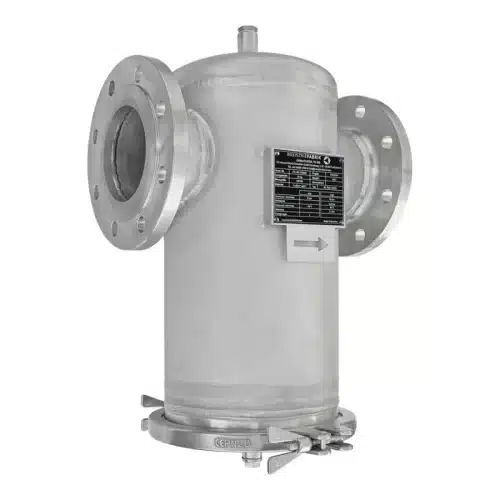
The compact range from DN25 to DN100 in PN10, stainless steel 1.4571, with aseptic clamp connection as quick-opening closure. Mesh sizes from 20 µm to perforated plate 10 mm, installed suspended.
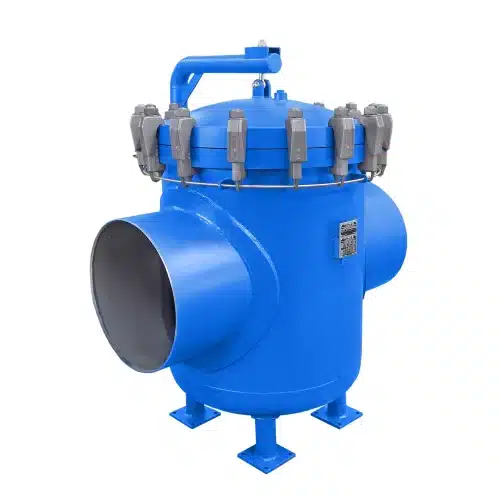
From DN300 to DN700 in carbon steel or stainless steel, with support legs, hinged eye bolts as quick-opening closure and cover lifting and swivel device. At DN400 the housing is made from a pipe with a diameter of 508 mm.
The following data outline the scope within which we design for water.
| Feature or example | Value | Note |
|---|---|---|
Basket strainer | ||
| Nominal size | DN50 – DN400 | larger as a custom build |
| Pressure rating | PN10 · PN16 | higher on request |
| Mesh size | 100 – 1,000 µm | according to the protected component |
| Material | 1.4571 or P235GH | carbon steel painted in RAL 5010 |
| Temperature | −10 … +80 °C | above that, a separate design |
| Operating pressure | 5 – 16 bar | according to the plant |
Simplex strainer | ||
| Nominal size | DN50 – DN150 | compact design |
| Mesh size | 0.1 – 1 mm | wire mesh or perforated plate |
| Temperature | −10 … +95 °C | for hot water and service water |
| Face-to-face lengths | to EN 558 | 265 · 340 · 455 · 500 mm |
Duplex strainer | ||
| Nominal size | DN50 – DN200 | with changeover |
| Mesh size | 200 – 500 µm | according to the protected component |
| Changeover | 4 × butterfly valve | stainless steel disc, EPDM liner |
| EPDM liner | up to 110 °C | also for hot water |
Options that belong with it | ||
| Vent | in the cover | socket ½″ and larger |
| Drain | in the torispherical head | socket ½″ to 1½″ |
| Differential pressure gauge | recommended | shows the degree of fouling |
| Support legs | for large nominal sizes | the line does not carry the operating weight |
Upstream of a pump, the strainer may cost almost no pressure. Every millibar is deducted from the inlet head, and if the pressure falls below the vapour pressure, the pump cavitates. The remedy is not a coarser screen but a larger housing: more screen area lowers the velocity in the mesh and thus the pressure loss, without giving up the protective effect.
A strainer chosen larger also lasts longer before it has to be cleaned. Tell us the flow rate, inlet head and permissible pressure loss – and we will design the area accordingly.
That depends on the component to be protected, not on the water. For a membrane a finer mesh is chosen than for a heat exchanger, for a spray nozzle a finer one than for a pump. Tell us the component and, if known, its smallest opening.
For drinking water, process water and circuits containing chlorides, stainless steel – 1.4571 as standard, duplex for high chloride levels and seawater. For service water and cooling water in closed circuits, carbon steel, primed and painted in RAL 5010, is often sufficient.
As soon as cleaning means a plant shutdown that costs more than the additional price. Rule of thumb from practice: with short cleaning intervals, in continuous operation and wherever there is no bypass line.
There, the wetted materials and their certification are what count. Tell us early which requirements your project has – we will match materials, gaskets and certificates to them.
We build up to DN700, and larger as a custom build; at DN400 the housing is made from a pipe with a diameter of 508 mm. From about DN250, support legs and a cover lifting and swivel device are needed, because otherwise the cover can no longer be handled safely.
Yes. Before production starts, you receive the design drawing for approval – with design data, materials, mesh size and attachments. Only after your confirmation does the order go into production.
Tell us the flow rate, nominal size, water quality and the component to be protected – you will receive a design proposal with strainer type, mesh size and options.