Housing and handling
A filled strainer weighs many times as much as the empty housing. Where this load goes must be settled before manufacturing: onto its own support legs, onto the pipeline or onto a mounting bracket. We place the support where your installation needs it – two legs, three or a completely different solution.
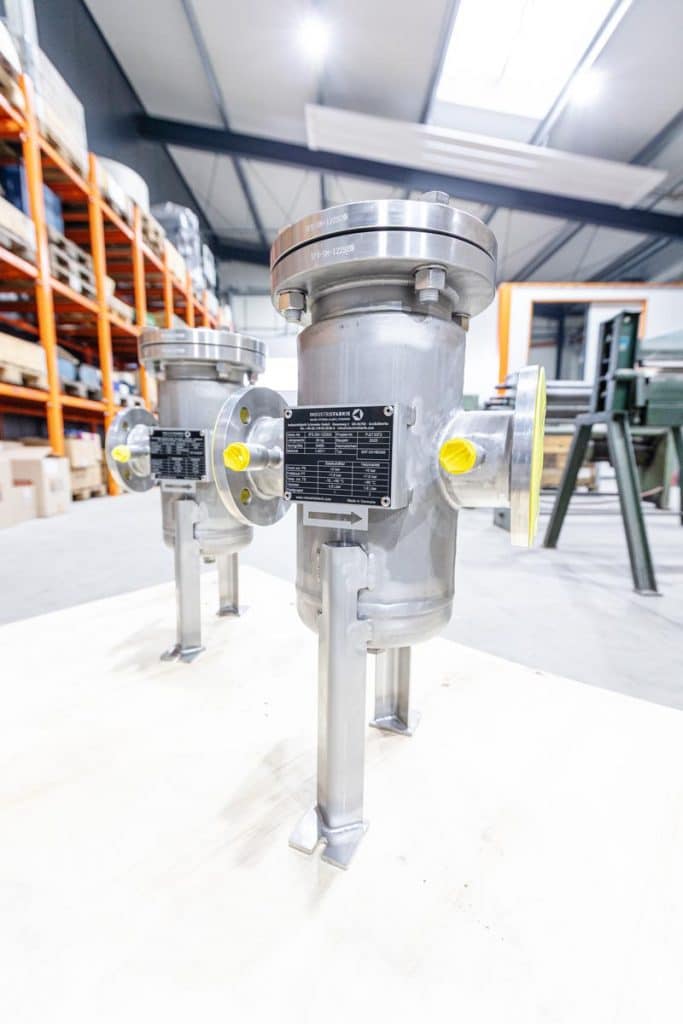
Three-point design
two legs or mounting bracket
height-adjustable
Lifting lugs and support brackets
A basket strainer DN300 holds several hundred litres. When filled, this weight rests on the pipeline if the strainer is not supported – plus forces from thermal expansion and operation. Its own legs take up this load and relieve the flange connection.
The number of legs is not a fixed figure. Three points stand on any surface without wobbling. Two are sufficient if the strainer is also suspended from the line. Where space is tight, a mounting bracket or an angle foot with fixing holes is used instead. What fits depends on your installation – which is why it is on the drawing before manufacturing starts.
Supports and mounting points can be combined freely.

Three legs stand on any surface without rocking – even on a floor that is not completely level. The most common choice for free-standing strainers, available for basket, simplex and duplex strainers as well as for the pot type strainer.

If the pipeline carries part of the load, two support points are sufficient. For long housings or high additional loads, there may also be more. The number depends on weight and installation, not on a fixed scheme.
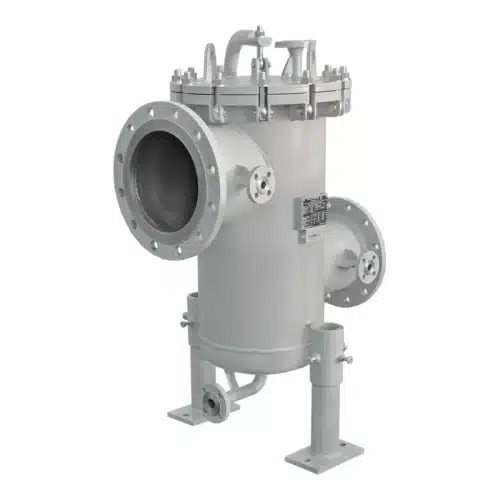
Adjustable legs compensate for unevenness and align the strainer exactly to the height of the pipeline. Useful wherever the strainer is fitted retrospectively into an existing line.

Instead of standing freely, the strainer is bolted to the floor – via angle feet with holes. On the duplex strainer with butterfly valve changeover this design is standard, because the changeover unit adds weight and operating forces.

Welded-on lugs with which the housing rests on a beam, a mounting bracket or a stand. The solution when there is no space for legs under the strainer or when it is mounted at height.

For attaching slings when lifting the whole strainer into place. On large units they are part of the basic equipment, because otherwise the housing cannot be moved safely. A lifting eye on the cover, by contrast, belongs to handling during opening – it is covered under the cover lifting and swivel device.
The design is engineered for each strainer. The following details outline the scope.
| Component or example | Design | Note |
|---|---|---|
| Support | ||
| Three-point support legs | Basket · simplex · duplex · pot type | most widespread design |
| Other number | two or more | according to weight and installation |
| Height-adjustable | for alignment | on uneven floors |
| Angle foot with holes | for bolting down | standard on duplex strainers with butterfly valves |
| Support brackets | resting on a beam | when there is no space under the strainer |
| Mounting points | ||
| Lifting lugs on the housing | for attaching slings | basic equipment on large strainers |
| Lifting eye on the cover | see swivel device | part of handling during opening |
| Material | same as the housing | carbon steel or stainless steel |
There is a simple reason why the three-point design is so widespread: three support points always lie in one plane, four only do so on a perfectly level floor. A fourth leg adds no extra safety but creates stresses in the housing on uneven ground. Where a different number makes sense – because the line carries part of the load or the housing is long – we design accordingly. What matters is not the number but that the load is calculated and the position is recorded on the drawing.
Yes. Before production starts, you receive the design draft for approval – it shows the number, position and height of the legs as well as the mounting points. Only once you have confirmed the drawing does the order go into production.
Gladly. Drawings, specifications, parts lists or the data sheet of the previous strainer are the best basis. Our design engineers adopt your requirements and adapt them where manufacturing or the applicable code requires it – we agree any deviations with you in advance.
No. Three points stand without wobbling on any surface, but if the pipeline carries part of the load, two are sufficient. For long housings or additional attachments there may be more, and support brackets or a mounting bracket can also be used instead of legs.
That is decided by the operating weight, not by the nominal size alone – a filled strainer weighs many times as much as the empty housing. We state the weight on the drawing. From DN250 upwards, experience shows that support legs are almost always ordered as well.
It is designed for your installation – the decisive factors are the height of the pipeline and the unevenness of the floor. Tell us both, and we will define the range and record it on the drawing.
Welded-on lugs with which the housing rests on a beam or a mounting bracket instead of standing on its own legs. Useful where space is tight or when the strainer is mounted in an elevated position.
On large strainers we provide them as standard, because otherwise the unit cannot be lifted into place safely. For smaller nominal sizes they are available on request – also on the cover.
All topics at a glance: Strainer options
Tell us the height of the pipeline, the floor conditions and whether the strainer is to be anchored – this determines the number, type and height of the supports.