Housing and handling
A strainer cover weighs more than it looks – and it is not removed any less often because it is heavy. The lifting and swivel device takes the weight off: lift, swing to the side, remove the basket. The cover is never put down, the sealing face stays clean, and nobody has to carry it.

DN50 to DN1000
Hinge with handle
combined with quick-opening closure
for the screen plate
The area of a cover grows with the square of the nominal size. The wall thickness also increases with the pressure rating. A cover that still sits comfortably in one hand at DN100 is a job for two people or the overhead crane at DN300 – and that at every cleaning.
The swivel device solves this without lifting gear having to be on hand: a hinge holds the cover on the housing, a handle guides it. It is lifted, swung to the side and stays there. Because it is never put down anywhere, the sealing face and gasket stay clean – a side effect that noticeably extends the service life of the gasket.
Which form makes sense depends on the cover weight and the space next to the strainer.

The hinge sits on the housing flange, the handle on the cover. The closure is released, then the cover swings to the side. This is the most widespread design. On the T-type strainer it is standard in the horizontal design. There is no strainer basket there but a screen plate: the opened hinge clears the access so that the plate can be pulled out without jamming.
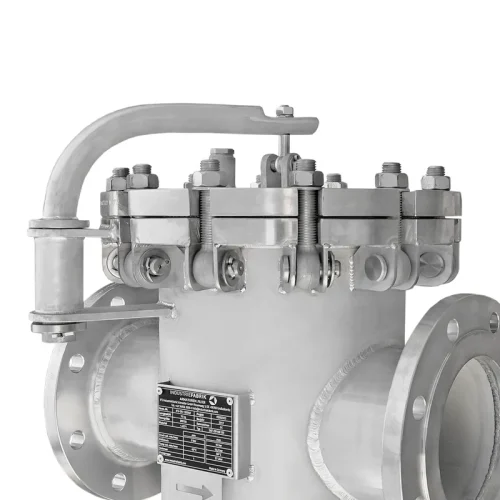
On large nominal sizes a simple hinge is not enough: the cover first has to be lifted before it can swing. The device does both in one movement – built for strainers up to DN1000.

Even without a swivel device, welded-on handles make it easier to guide the cover. Often the simplest solution for medium nominal sizes, and an addition to the hinge on large ones.

Where the cover is lifted off rather than swung, an eye is placed in the centre of the cover – as a ring nut or a welded-on lug. The crane hook or lifting gear is attached to it, the cover hangs level and can be set down in a controlled way. Useful for very heavy covers and where there is no room to swing next to the strainer.

Hinged eye bolts release the cover, the hinge carries it. On strainers from DN300 to DN700 both options are regularly ordered together – the strainer is then open in one minute.

Hinge and handle are welded onto the housing and cover. This is work on a pressure vessel with testing and documentation – with frequent cleaning it still pays off quickly.
The design is engineered for each strainer; the following details define the scope.
| Type or component | Design | Note |
|---|---|---|
| Availability | ||
| Basket strainer, simplex strainer | DN50 – DN1000 | lifting and swivel device |
| Duplex strainer | per chamber | both covers separately |
| T-type strainer | hinge with handle | standard in the horizontal design |
| Pot type strainer | not required | cover by hand, clamp connection |
| Components | ||
| Hinge | welded to the housing flange | material as housing |
| Handle | on the cover | single or in pairs |
| Lifting mechanism | for heavy covers | lifting before swivelling |
| Lifting eye on the cover | ring nut or lug | centred, for attaching to a crane |
Whether the device is needed is decided by the weight of the specific cover. Besides the nominal size, it depends on the pressure rating and the material. We state the weight on the design drawing so that you can check it against your in-house risk assessment.
As a rule of thumb: as soon as the cover can no longer be guided comfortably by one person and is opened regularly, the device pays for itself through the time saved. On strainers from DN300 upwards it is almost always ordered as well.
Yes. Before production starts, you receive the design draft for approval – it shows the hinge side, swivel direction and cover weight. Only once you have confirmed the drawing does the order go into production.
Gladly. Drawings, specifications, parts lists or the data sheet of the previous strainer are the best basis. Our design engineers adopt your requirements and adapt them where manufacturing or the applicable code requires it – we agree any deviations with you in advance.
That is decided not by the nominal size alone but by the cover weight – it increases with nominal size, pressure rating and wall thickness. We state the weight on the drawing. From DN300 upwards, experience shows that the device is almost always ordered as well.
Both terms mean the same thing. Our data sheets and brochures say “cover lifting and swivel device”; the enquiry form refers to a “cover lifting and rotating device”. We use “swivel device” throughout.
Swivelling is used where there is space next to the strainer: the cover stays on the housing and does not have to be put down. Lifting off is used where this space is lacking or the cover is so heavy that lifting gear is needed anyway – then an eye sits in the centre of the cover for the crane hook.
As you specify. What matters is where there is space next to the strainer and from which side it is operated – we define both on the drawing before manufacturing.
Yes, and that is the most sensible combination: the quick-opening closure releases the cover without a spanner set, the swivel device carries it. On large nominal sizes both are regularly ordered together.
Yes. The device is designed so that the opened cover stays securely in place and clears access to the strainer basket – it does not have to be held.
All topics at a glance: Strainer options
Tell us the nominal size, pressure rating and how often cleaning takes place – we will tell you the cover weight and propose the right design.