Home › Applications › Steam and condensate
Applications
Steam carries little dirt – but what it does carry arrives at high velocity and high temperature. After installation and overhaul it is weld spatter, scale and chips; in operation, rust and boiler scale. We design steam strainers and condensate strainers for your line and build them to match.

Y strainer · T-type strainer
Graphite with tanged steel insert
always a custom design
Witch hat strainer
Two things set steam apart from almost every other medium. First, the low dirt load: in normal operation a steam system carries few solids, so the screen area does not need to be large. A Y-pattern strainer is usually the economical answer here. Second, the temperature – it shifts the design completely away from the standard.
As standard, our strainers are designed for −10 to +50 °C. Steam is always above that. This makes every steam design a custom design. Material and wall thickness are calculated for the operating temperature, the gasket must withstand it permanently, and the closure must not loosen during heating up. That is why graphite with tanged steel insert is the standard gasket here, not an elastomer gasket.
In condensate the picture is partly reversed. The temperature is lower, but rust, boiler scale and – in heating and district heating circuits – magnetite are added. Magnetite is so fine that it passes even the finest wire mesh; the only remedy is a magnetic rod in the strainer basket.
The mesh size does not depend on the steam but on the component downstream. These are the most common points of use in steam and condensate systems.
Which type fits is decided by the dirt load and by whether cleaning has to take place during operation.
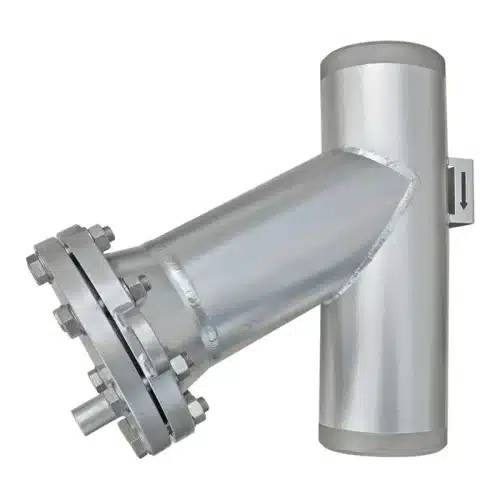
The Y-pattern strainer is short, inexpensive and has enough screen area for the low dirt load in steam. It is installed inclined or horizontally so that the strainer basket does not fill with condensate. Heated version on request.
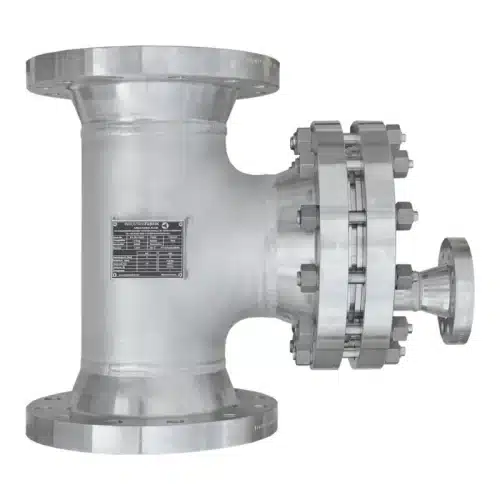
For the same face-to-face length, the T shape puts more screen into the line and is easier to clean. The cover gives access to a screen plate that can be pulled straight out. It is supplied with drain and vent plugs, and with butt-weld ends on request.
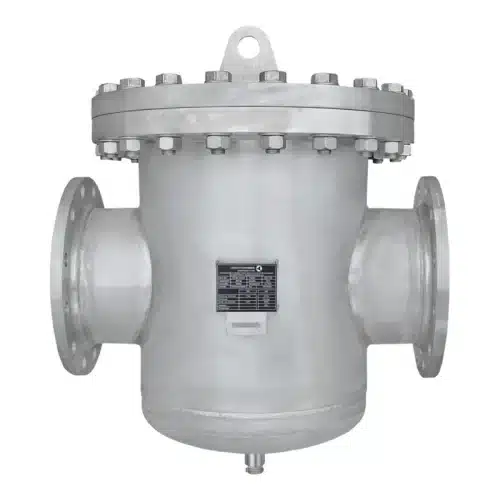
Where more dirt occurs – for example in plants with older piping or after modifications – the pot shape offers many times the screen area. An example from our production: DN250 and DN500 in PN40, designed for 22 bar at 323 °C with a mesh size of 0.2 mm.
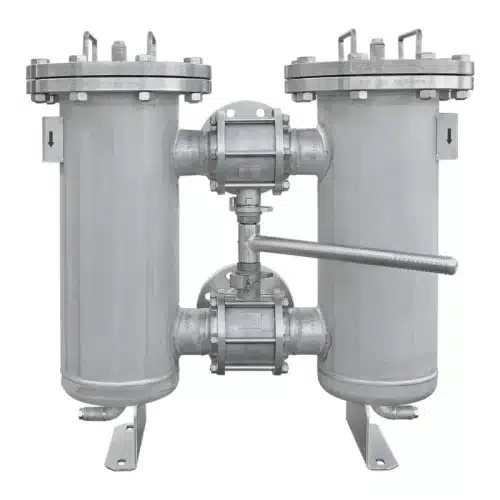
Two chambers, one in operation, one on standby. Switch over, open the isolated side and clean it while the plant keeps running. In a steam system this makes sense wherever an interruption is costly. One example from our production is a steam-heated changeover strainer DN80.
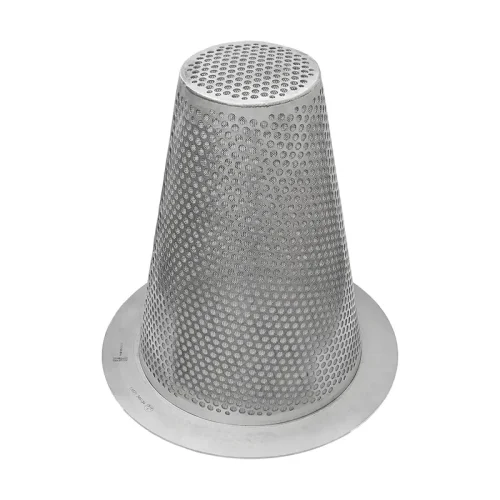
After installation and overhaul, the dirt load is many times higher for a short time. A witch hat strainer is placed between the flanges in the steam line as a temporary strainer, catches the coarsest debris and comes out again after the start-up phase. It has more area and less pressure loss than a flat plate strainer.
Every steam design is calculated. The following data show the scope and examples from our production.
| Feature or example | Value | Note |
|---|---|---|
Design | ||
| Temperature | above the standard | standard range −10 … +50 °C, steam always above |
| Pressure rating | PN6 – PN40 | PN63 as high-pressure design |
| Gasket | graphite with tanged steel insert | temperature-resistant, standard on basket, simplex, duplex and T-type strainers |
| Housing | P235GH · P250GH · 1.4571 | according to temperature and medium |
| Installation position | inclined or horizontal | so that no condensate stands in the basket |
Examples from our production | ||
| Basket strainer DN250 · DN500 | PN40 | 22 bar at 323 °C, mesh size 0.2 mm |
| Y-pattern strainer DN40 | PN25 | grey cast iron, for steam |
Condensate | ||
| Filtration grade | finer than in steam | often around 50 µm in designs |
| Magnetite | magnetic rods in the strainer basket | no wire mesh retains fine ferritic particles |
| Drain | at the lowest point | condensate must be able to run off |
During start-up | ||
| Witch hat strainer | perforated plate cone | more area, less pressure loss |
| Flat plate strainer | flat screen ring | for short start-up phases |
| Afterwards | removal or replacement | a temporary strainer does not stay in continuous operation |
A strainer element does not withstand the operating pressure of the housing – it only withstands the pressure difference between inlet and outlet. If it clogs, this difference rises, and at some point the basket deforms. On our basket strainers the permissible differential pressure is a maximum of 2 bar; in operation we recommend no more than 0.5 bar. In a steam system this is particularly important, because the condition of the screen cannot be seen from the outside. A differential pressure gauge costs little and turns an assumption into a measurement.
That does not depend on the steam but on what is downstream. For a control valve with a narrow seat, a finer mesh is chosen than for a heat exchanger with wide channels. Tell us the component to be protected and, if known, its smallest opening – from this we derive the filtration grade.
In normal steam operation the Y shape is usually sufficient, because few solids occur. A high dirt load, older piping, a modification to the plant or the wish to clean less often speak in favour of a basket strainer. If the plant is to keep running during cleaning, the choice is the duplex strainer with changeover.
Because our standard design covers −10 to +50 °C. A higher temperature affects material properties, wall thickness, gasket and closure – this is calculated for your case and recorded in the drawing, which you approve before manufacture.
Graphite with tanged steel insert: graphite layers on a steel carrier, temperature-resistant and resistant to creep relaxation. It is the standard gasket on basket, simplex, duplex and T-type strainers. Elastomers are ruled out in steam.
Only magnetism. Fine ferritic particles are smaller than any reasonable mesh size and pass even the finest wire mesh. Magnetic rods in the strainer basket retain them and are easy to wipe clean during cleaning.
After installation or overhaul, yes. Weld spatter, scale and chips would clog the permanent strainer within a short time or damage the plant. A witch hat strainer between the flanges catches them and comes out again afterwards – it has more area and less pressure loss than a flat plate strainer.
As a rule, yes – against heat loss and as protection against contact. Removable insulation jackets are recommended on the strainer, because the cover must be accessible for changing the screen. Where the medium cools down or precipitates during downtime, a heating jacket can also be considered.
Yes. Before production starts, you receive the design drawing for approval – with design data, materials, gasket and attachments. Only after your confirmation does the order go into production.
Tell us the steam pressure and temperature, the nominal size and the component to be protected. You will receive a design proposal with strainer type, mesh size and options.