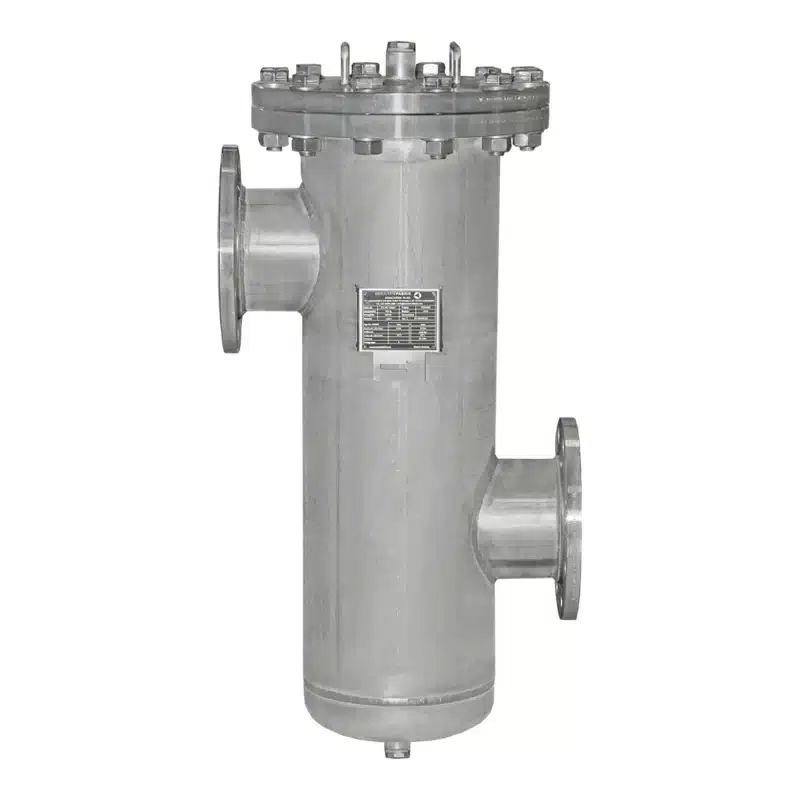
Simplex strainer · Simplex basket strainer
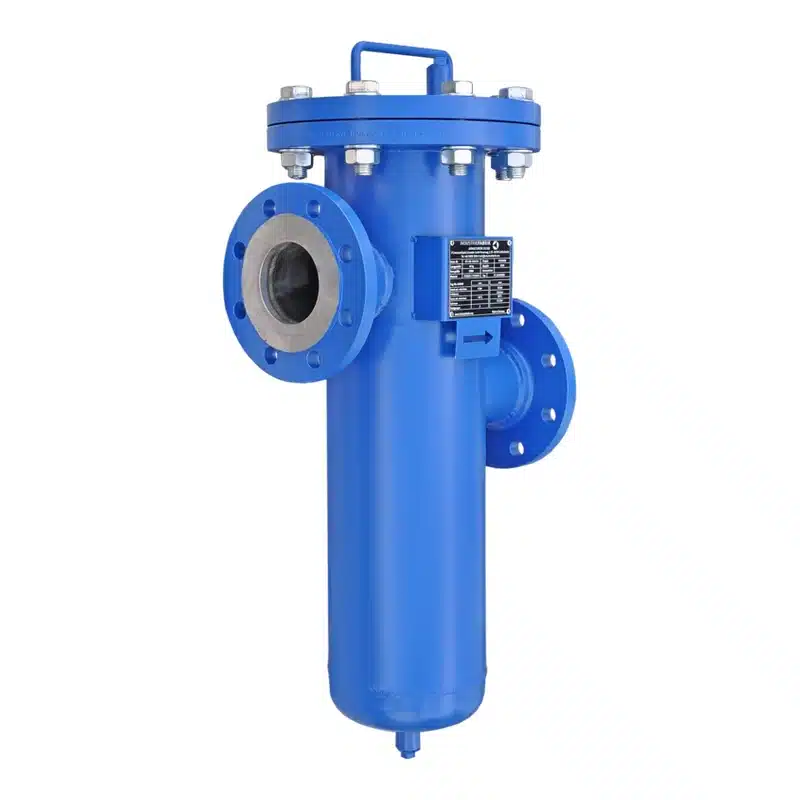
One housing, one strainer basket, one cover: the simplex strainer is the slim design among basket strainers, also known as a simplex basket strainer. Inlet and outlet are offset one above the other, and the housing stands as a tall cylinder. This saves floor space next to the line.
Every simplex strainer is built to your process data. We design nominal size, pressure rating, material, mesh size and connection type together with you – from DN50 to DN500.
ISO 9001 · TÜV-approved welding shop AD2000-HP0 · PED 2014/68/EU
Operating principle
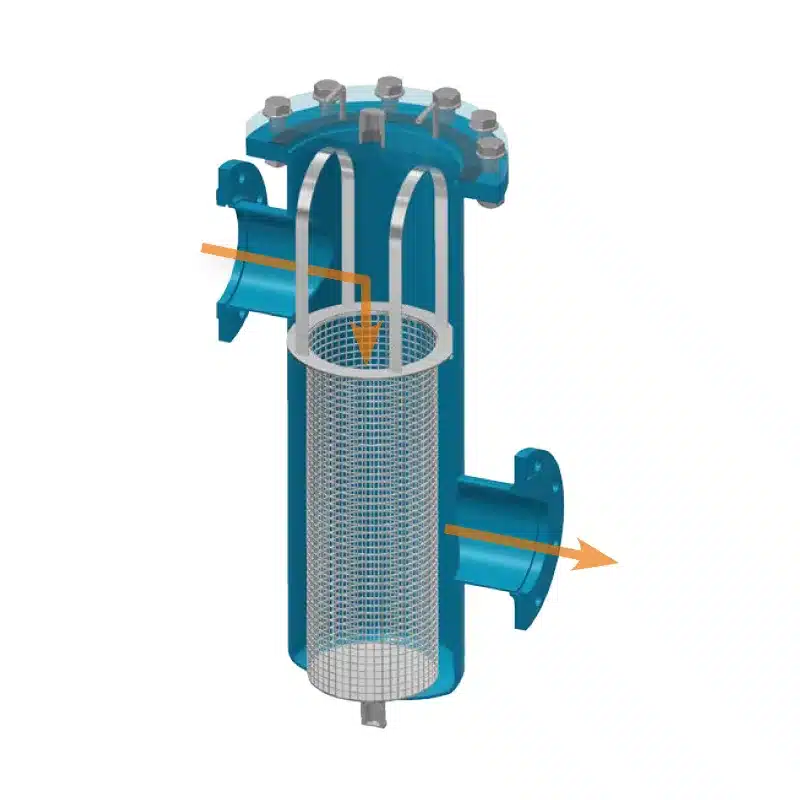
The medium enters at the top on one side, flows from the inside to the outside through the strainer basket and leaves the housing lower down on the other side. The dirt stays in the basket. For cleaning, the cover is opened, the basket lifted out upwards, rinsed and put back.
The height offset between inlet and outlet is the defining feature of this design. It keeps the housing slim – the strainer needs little floor space but requires headroom above the line so that the basket can be removed. Allow for this clearance in the installation from the start.
Strainer element
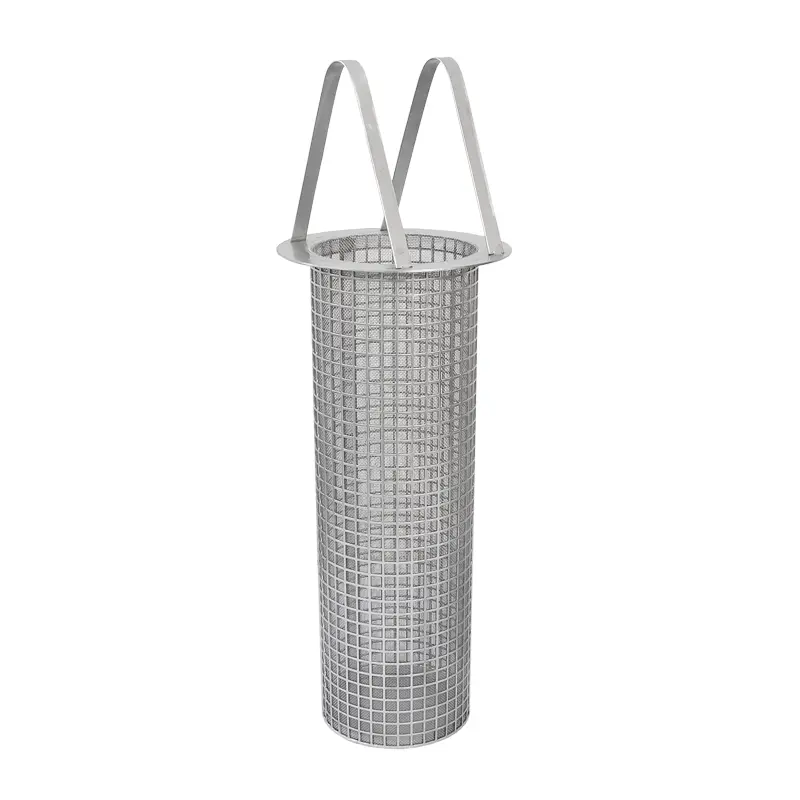
As standard, the simplex strainer works with a support basket in 1.4301 with square perforation Qg 10-12. Inside it sits a fine mesh screen in 1.4401 with a mesh size of 1 mm. It is the same element as in the basket strainer, only longer and narrower.
From a mesh size of about 2.5 mm no wire mesh is needed: the perforation of the basket then does the filtering on its own. With a high dirt load, a coarse perforated plate is used instead of the fine mesh screen – the design then follows a different logic.
Fine mesh, filter bag or both. The housing stays the same – only the element is changed. A filter bag can be fitted in the same support basket instead of the fine mesh, turning the simplex strainer into a bag filter. Both together are possible as well: the bag does the fine filtration, the screen keeps coarse particles away from it.
The bag filters finer than any wire mesh: polypropylene felt from 1 to 300 µm, polyester felt from 1 to 200 µm, nylon on request – in bag sizes 1 to 4. Where the fine mesh ends at 50 µm, the bag goes down to 1 µm. In return it is a replacement part, not a permanent component, and the pressure rating in this design is up to 10 bar.
The right filtration grade is not set by the medium but by the component downstream. How it is selected is explained under Selecting the mesh size for the simplex strainer →.
Connection
The simplex strainer is often installed where space is tight and the line is already in place. That is why the connection type decides the installation more often than the filtration performance – we manufacture all three on the same housing.
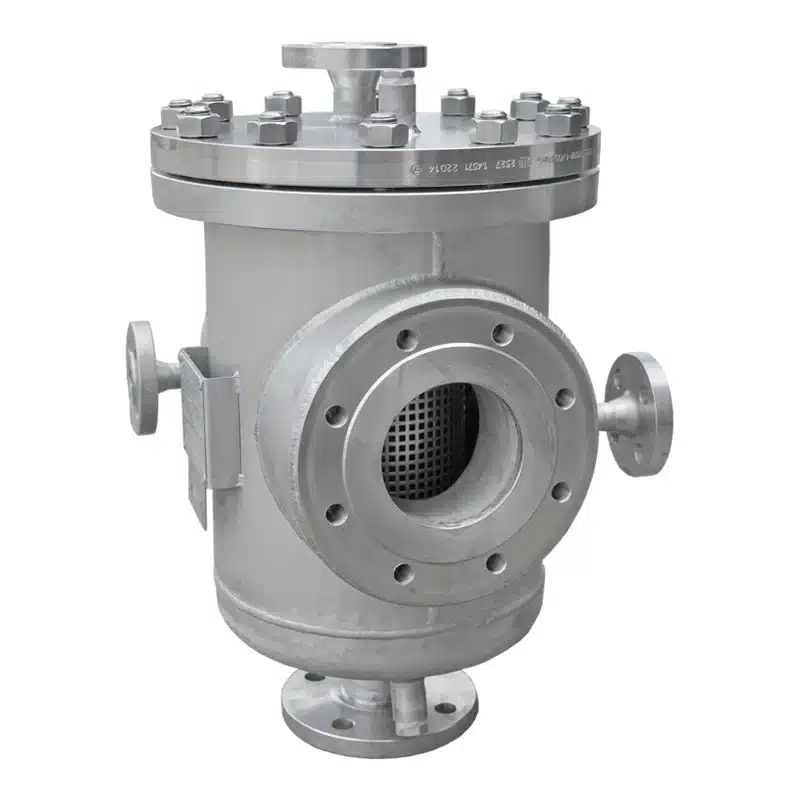
The standard: detachable, inspectable, available in every pressure rating. The strainer can be removed for cleaning or replacement without any welding on the line. To ANSI on request.
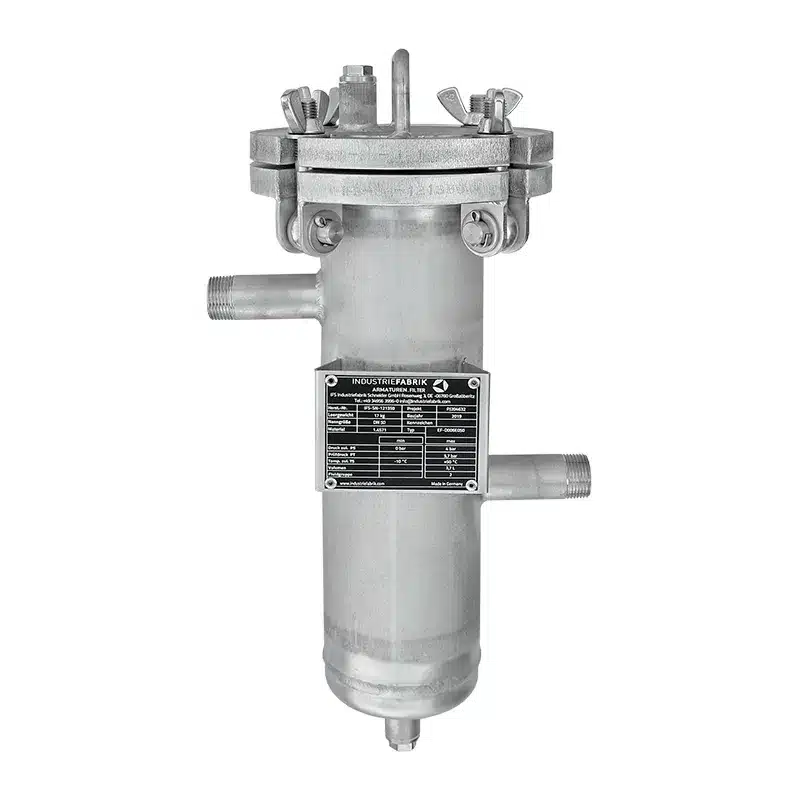
In small nominal sizes often the more practical solution – for example on branch lines, at sampling points or wherever a pair of flanges would exceed the available space. Saves face-to-face length and weight.
Where every flanged joint is a potential leak point, the strainer is welded directly into the line. Also available in special dimensions when the existing installation length is fixed and does not follow the standard.
Variants
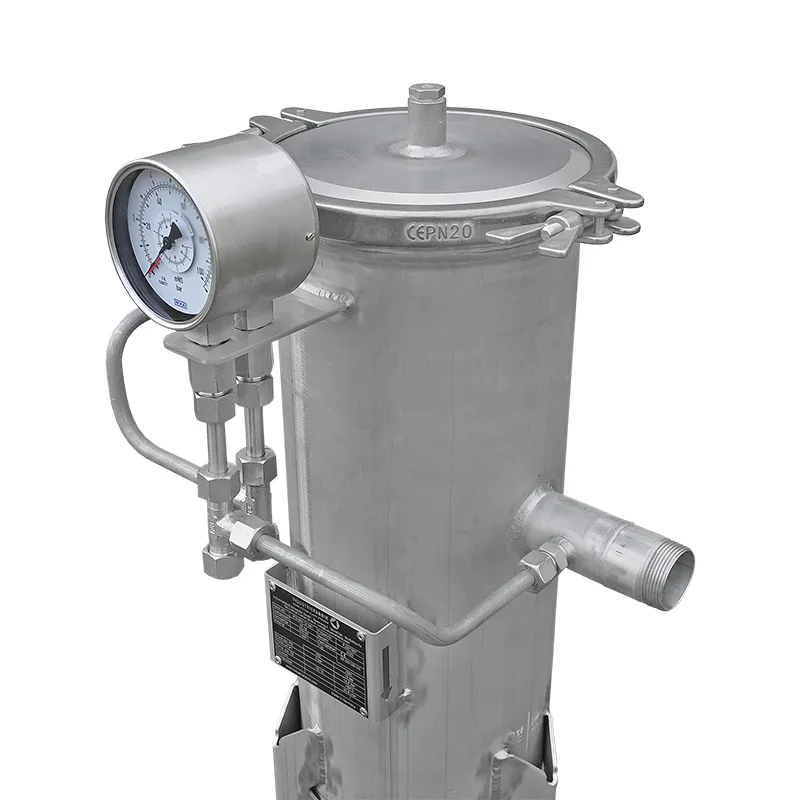
The slim housing is easy to modify – which is why the simplex strainer offers the most options. Four come up regularly.
Related range
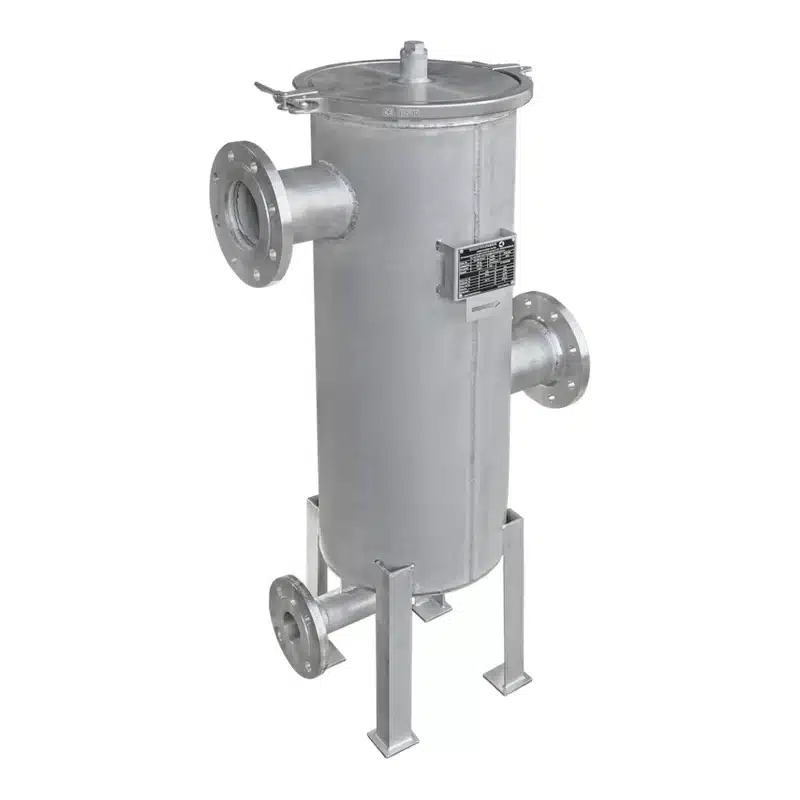
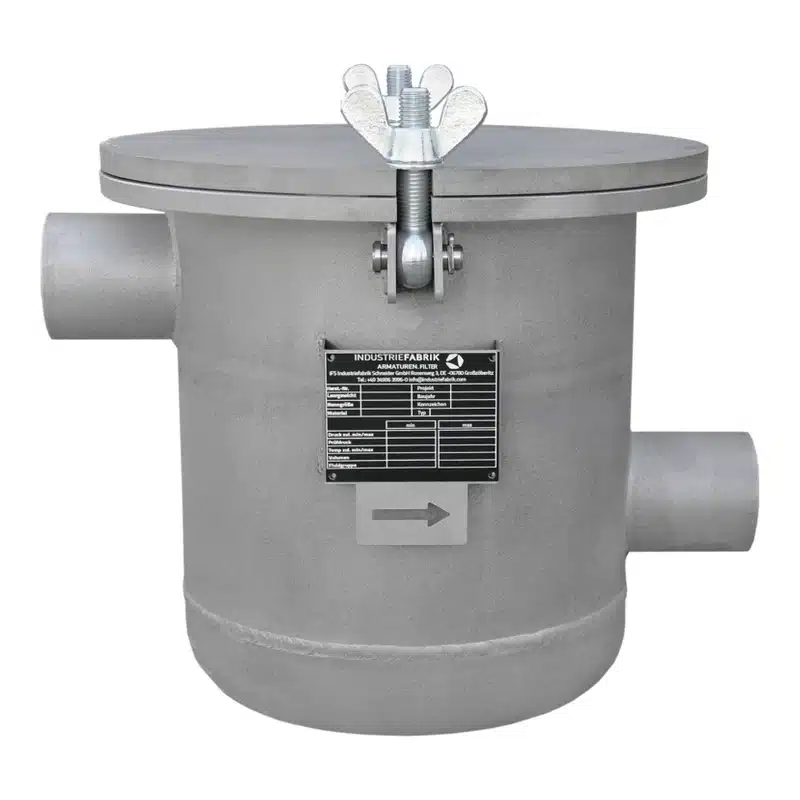
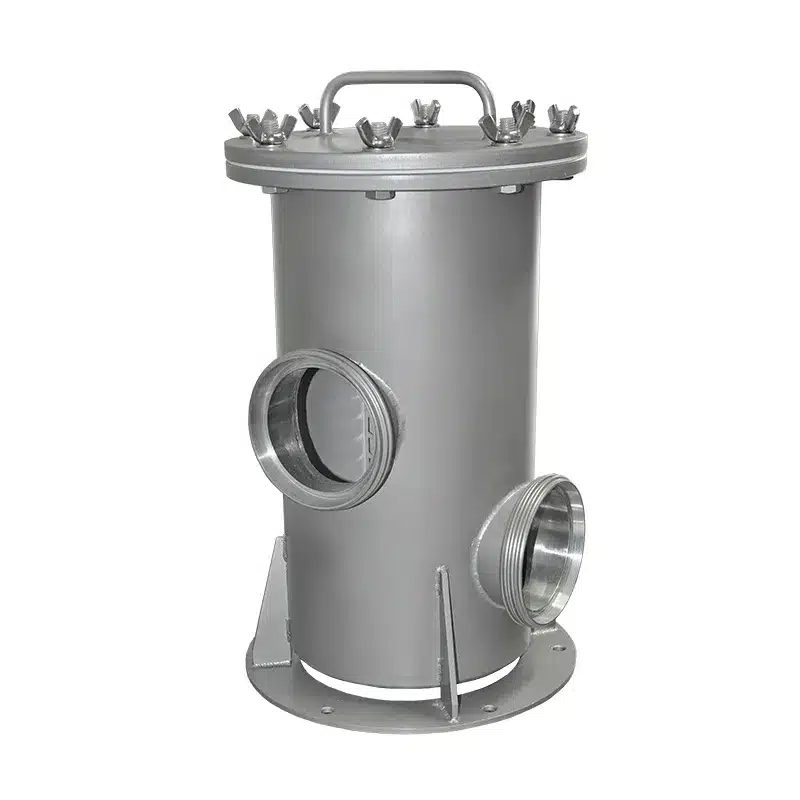
The road tanker strainer belongs to the simplex strainer family and forms a range of its own. Its stainless steel housing is installed in the filling and discharge lines of tank vehicles. It retains coarse particles before they reach the vessel or pump.
It is designed for fast work: the quick-opening closure of the housing with wing nuts can be opened without tools, and the strainer element is removed by hand.
On request with support legs, ball valve for venting and draining, pipe sections and quick couplings. Also available as an angle strainer with 90° change of direction.
Design parameters
Values for the standard design. The final design is based on your process data – higher pressure ratings, further temperature ranges and different face-to-face lengths are available on request.
Dimensions
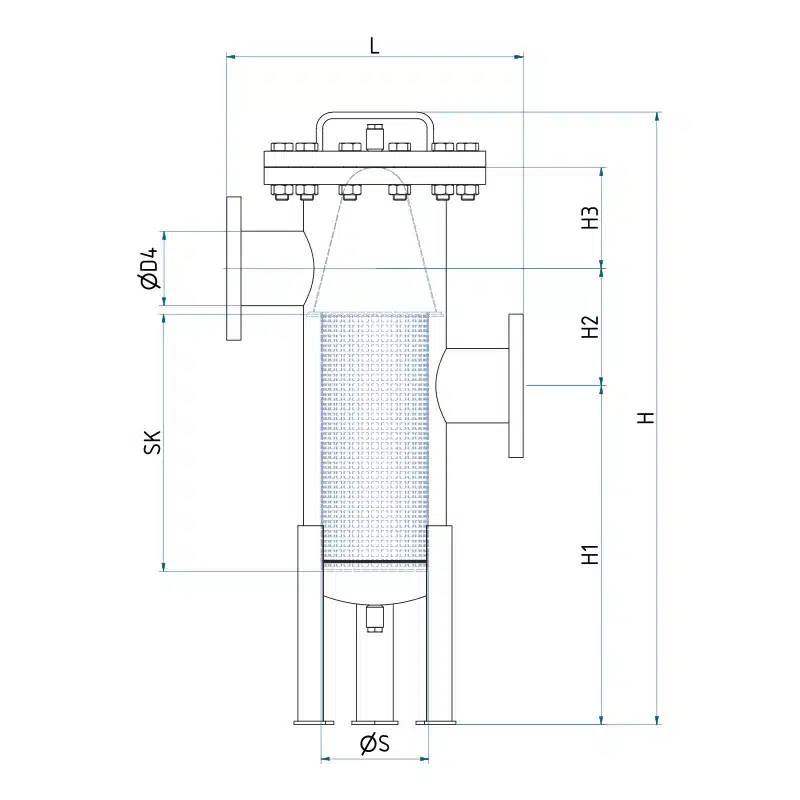
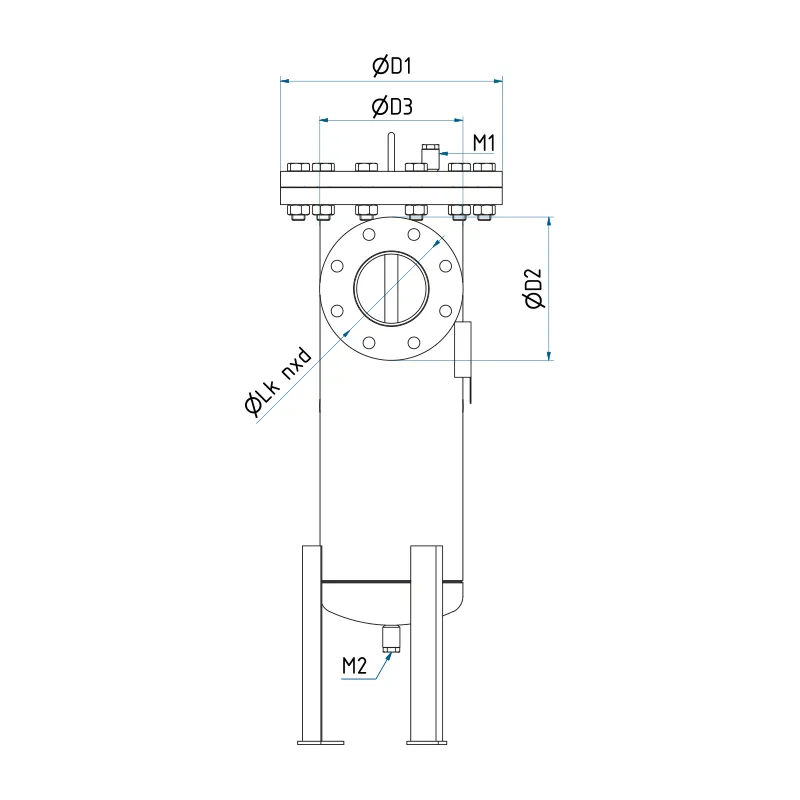
Dimensions of the standard design: H and H1 are the overall heights, L the face-to-face length, ∅D3 the housing pipe. The weight applies to the empty carbon steel design without attachments. A dimensioned drawing for your nominal size is included with the design proposal.
| Nominal size | H [mm] | H1 [mm] | L [mm] | ∅D3 [mm] | Screen area [cm²] | Volume [l] | Weight [kg] |
|---|---|---|---|---|---|---|---|
| DN50 | 610 | 295 | 265 | 114.3 | 265 | 4 | 25 |
| DN65 | 755 | 390 | 350 | 168.3 | 520 | 10 | 45 |
| DN80 | 925 | 505 | 455 | 219.1 | 910 | 23 | 60 |
| DN100 | 940 | 520 | 455 | 219.1 | 910 | 25 | 65 |
| DN125 | 1,145 | 615 | 500 | 273 | 1,440 | 45 | 105 |
| DN150 | 1,295 | 625 | 500 | 273 | 1,750 | 55 | 120 |
| DN200 | 1,380 | 665 | 570 | 355.6 | 2,255 | 95 | 210 |
| DN250 | 1,530 | 725 | 700 | 355.6 | 2,425 | 120 | 250 |
| DN300 | 1,775 | 850 | 870 | 508 | 3,855 | 270 | 500 |
DN80 and DN100 use the same housing pipe and therefore have the same screen area. The table shows the common sizes; DN350 to DN500 are manufactured as well, designed to your connection dimensions. Dimension sheets and STEP models are available on request.
Applications
Wherever a component has to be protected and there is little space next to the line. The prerequisite is that the strainer can be isolated briefly for cleaning. It is the simplest design with a strainer basket: one housing, one basket, no changeover mechanism.
Manufacturing and documentation
Cutting, welding, turning, surface finishing and testing are done in our own workshop. This pays off especially with the simplex strainer. A different face-to-face length, a threaded connection instead of a flange or an additional socket are part of the design – not a surcharge on a catalogue part.

Enquiry
Tell us the medium, flow rate, operating pressure and operating temperature. From this we design nominal size, screen area and material. Only nominal size and pressure rating are mandatory – if you do not know them yet, select “please advise” or “not sure”. Add further strainers with “+ further item”.
Direct
+49 34956 39960
Monday to Friday, 7 am to 4 pm (CET)
You can reach us by email at info@industriefabrik.com.
For printing
Prefer to work on paper? Fill in the form (in German) and send it back to us by email.
Both work with similar strainer elements but differ in design. In the simplex strainer, inlet and outlet are offset one above the other, and the housing is tall and slim. In the basket strainer, they face each other at the same height; the housing is lower and wider and offers more screen area for the same nominal size. The basket strainer goes up to DN1000, the simplex strainer up to DN500. In short: little floor space and smaller nominal sizes favour the simplex strainer, large nominal sizes and long service life favour the basket strainer.
As soon as the line must not be shut down for cleaning. With the simplex strainer the flow has to stop while the basket is out; with the duplex strainer with changeover unit the flow is switched to the second chamber and operation continues. The duplex strainer costs a second housing – this pays off as soon as downtime is more expensive.
At least the height of the strainer basket so that it can be pulled out upwards, plus room to grip it. For larger nominal sizes, the cover lifting and swivel device is added, which moves the cover to the side instead of lifting it off. Tell us about the installation situation – we design the overall height accordingly.
The filtration grade depends on the component downstream of the strainer, not on the medium. Frequently selected sizes are 0.3, 0.5 and 1.0 mm. The finer the screen, the more often it has to be cleaned – too fine is just as wrong as too coarse. The selection is explained under Mesh size and filtration grade.
Yes, in small nominal sizes this is often the more practical solution – for example on branch lines or wherever a pair of flanges takes up too much space. Butt-weld ends to DIN EN 12627 are also possible, including special dimensions to suit your existing installation length.
Yes, also for housings from other manufacturers. The quickest way is with the dimensions of the old part: outside diameter, height, handle or bottom design and the mesh size. A photo also helps.
All basic types compared: Industrial strainers
Replacement strainer elements for simplex strainers are made to size or to sample. When a strainer element is worn, we replace it – for our own ranges as well as for other manufacturers’ strainers. To the spare part →
Tell us the medium, flow rate, pressure and temperature, plus the component to be protected and the installation situation. You will receive a design proposal with nominal size, mesh size, material and connection type.