Home › Temporary Strainers
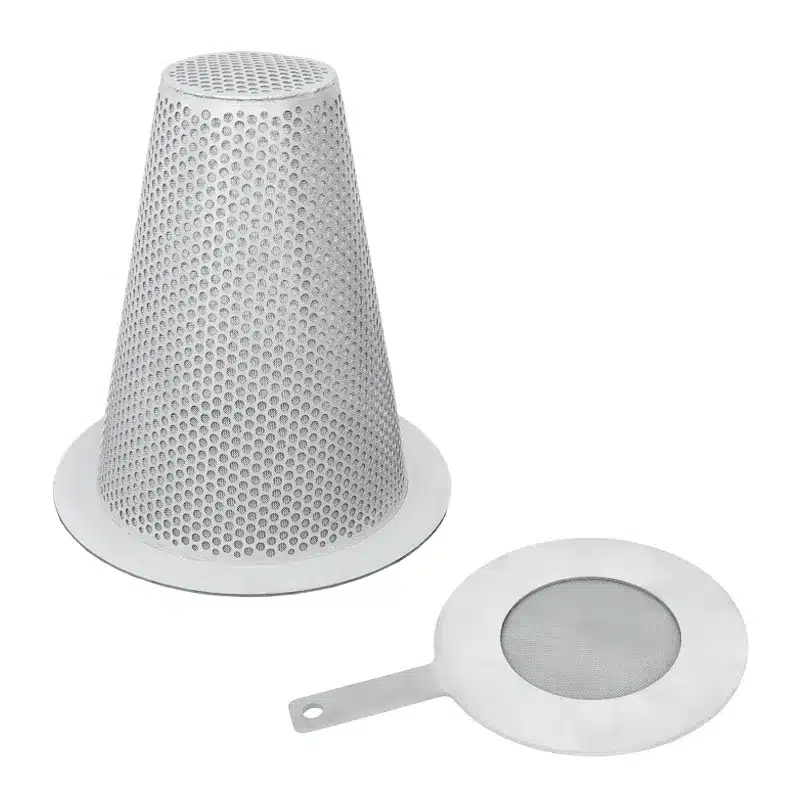
Temporary strainers · Commissioning strainers
When a new pipeline is started up for the first time, it contains weld spatter, scale and chips. Temporary strainers retain this dirt upstream of pumps, valves and heat exchangers. They sit as wafer-type strainers between existing standard flanges and are pulled again after the flushing phase.
Three designs cover the requirement. They differ in screen area and installation space: the strainer gasket needs no additional space, the witch hat strainer offers the largest area.
The three designs
In this order the screen area increases – and with it the space the strainer needs in the line. If you expect little dirt, choose the flat part; if the line is to stay open for a long time, choose the conical one.
Not to be confused with line blinds: they fit between the same flanges but do not filter – they isolate the line, open it or throttle the flow. To the line blinds →
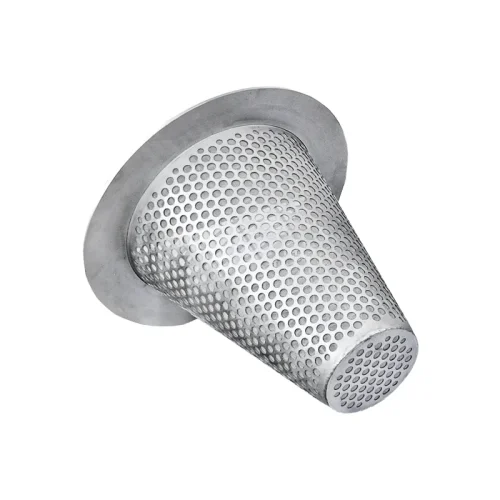
Conical, projects into the line. This gives a multiple of the screen area at the same nominal size – the strainer clogs later.
Witch hat strainers in detail →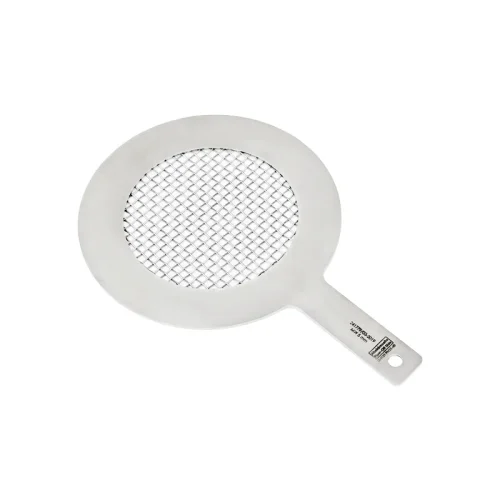
A flat screen ring that is inserted between the flanges. Somewhat more area than the gasket, still almost no installation depth.
Flat plate strainers in detail →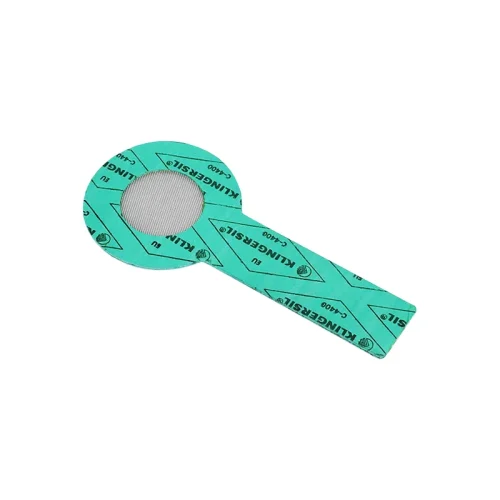
A flange gasket with inserted wire mesh. It needs no additional installation space – the line does not get longer. For short start-up phases with little dirt.
Strainer gaskets in detail →Selection
The decision is usually made on two points: how long the strainer stays in the line and how much space is available.
| Design | Nominal sizes | Installation depth | Screen area | Typical use |
|---|---|---|---|---|
| Strainer gasket | DN10 – DN250 | none additional | small | short start-up phase, no space |
| Flat plate strainer | DN15 – DN350 | flat | medium | start-up and continuous operation with clean media |
| Witch hat strainer | DN20 – DN800 | projects into the line | large | start-up with a lot of dirt, longer service life |
Larger nominal sizes are possible for all three designs. Contact us if your line is above the ranges stated.
Start-up operation
A newly built or modified pipeline contains whatever got into it during construction: weld spatter, scale, mill scale, chips, grease and gasket residues. The same applies after major maintenance work. On the first start-up, all of this travels towards the pump, heat exchanger or control valve.
This is exactly what temporary strainers are for. They stay in the line until it has been flushed clean and are then pulled. A strainer costs considerably less than a pump impeller.
If the strainer stays in the line permanently, a differential pressure gauge across it, upstream and downstream, is needed – otherwise nobody notices that it is clogging.
Most temporary strainers only stay until the line has been flushed clean. A witch hat strainer or flat plate strainer can also remain installed permanently – then as simple basic filtration with a coarser mesh size. As fouling increases, the pressure loss rises. Where dirt arrives continuously, a strainer with a cleanable element is therefore the better choice: simplex strainer or basket strainer.

Mesh size and material
The standard designs are 1.0 mm for smaller and 1.5 mm for larger nominal sizes. We manufacture down to 0.05 mm and up into the millimetre range if only coarse dirt is to be retained.
As a rule of thumb: the finer the screen, the faster it clogs. In a start-up phase this is intended – in continuous operation the right mesh size is the coarsest one that still prevents damage.
For aggressive media and higher temperatures, we select the material to suit your operating data. Special alloys are possible.
Configure directly
Two designs are fully standardised – there you select nominal size, pressure rating and mesh size yourself and see immediately what the part costs. Everything else we design to your operating data.
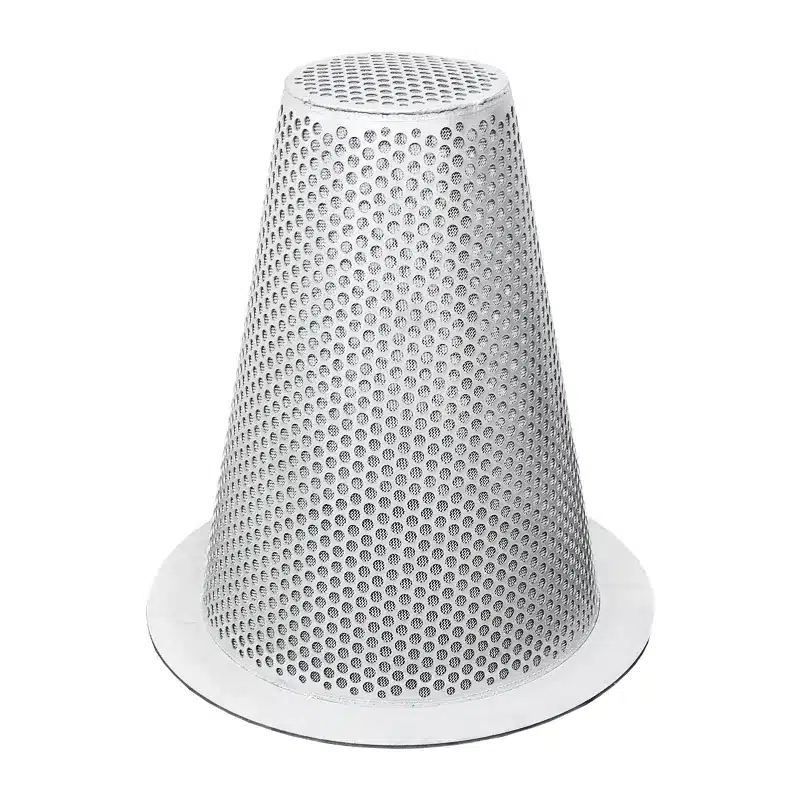
Conical shape, flow from inside to outside or vice versa, with or without handle. Fifteen nominal sizes, four pressure ratings, six mesh sizes.
Configure the witch hat strainer →Design, dimensions and flow direction →
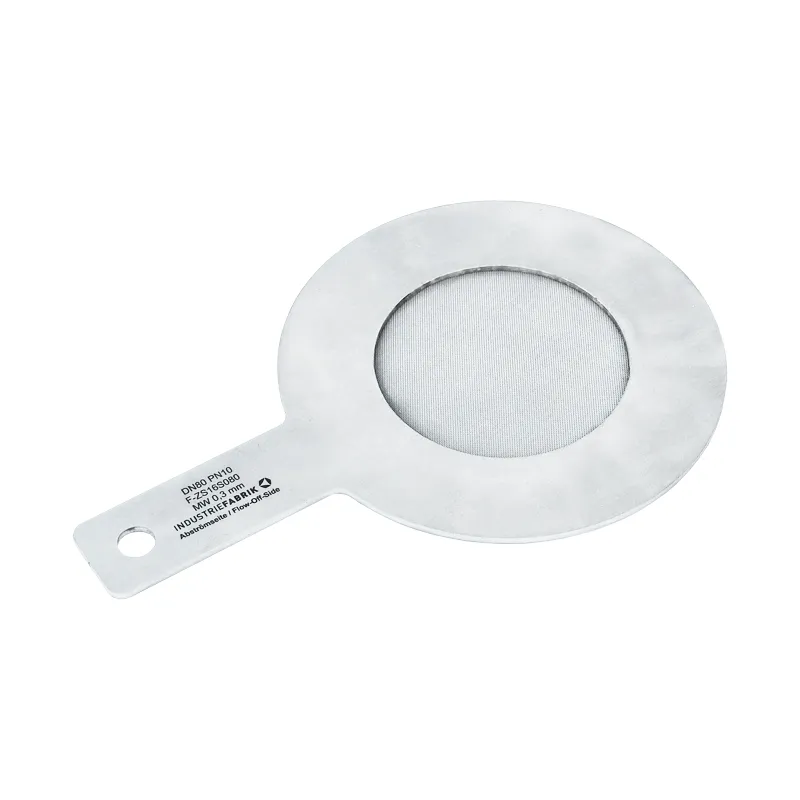
Flat screen ring with internal wire mesh, material thickness 3 mm, handle as standard. Fifteen nominal sizes, four pressure ratings.
Configure the flat plate strainer →Design, dimensions and versions →Frequently asked questions
Until the line has been flushed clean – usually a few operating hours to a few days. If the strainer is to remain permanently, the differential pressure must be monitored and a coarser mesh size selected.
At the same nominal size, the witch hat strainer has a multiple of the screen area and therefore clogs later. However, it projects into the line; behind a bend or upstream of a valve there is not always room for it. The flat plate strainer fits anywhere, but holds less dirt.
For the witch hat strainer, flow from inside to outside is the standard – the dirt then collects inside the cone. Flow from outside to inside is possible and is ordered when the strainer has to sit the other way round for structural reasons. The direction must be fixed with the order.
The handle is a welded-on tab that protrudes outwards between the flanges. It shows that a strainer is installed, and the strainer can be pulled out without searching in the pipe. Length and marking as required.
When dirt is to be expected continuously. A temporary strainer is designed for the flushing phase; the pressure loss rises with every bit of fouling. For continuous operation we recommend a simplex or basket strainer whose element can be cleaned.
Yes. We manufacture witch hat strainers and flat plate strainers to match the nominal size, pressure rating and design of your existing plant – regardless of the original supplier.
For a quotation we need the design, nominal size, pressure rating and the required mesh size. Standard sizes of the witch hat strainer and flat plate strainer can be ordered directly in the shop.