Home › Applications › Oils and thermal oil
Applications
For industrial oil strainers, one rule applies that surprises many: the more viscous the medium, the coarser the screen that is chosen. Otherwise the pressure loss becomes unmanageable. Then there is the temperature – without it, some media do not flow at all.

the more viscous, the coarser
at operating temperature
heating jacket essential
up to +120 °C, 5 – 16 bar
The pressure loss across a screen rises with viscosity. A wire mesh that is hardly noticeable with water makes the plant inoperable with heavy fuel oil or syrup. That is why viscous media are filtered more coarsely – and the housing is chosen larger, often larger than the pipeline, so that the velocity through the screen drops.
The second factor is temperature. Viscosity falls considerably as temperature rises. A design at 20 °C is misleading if the plant runs at 80 or 120 °C – the calculation is made at operating temperature. Conversely: whatever cools down and solidifies during downtime blocks the strainer at the next start-up.
That is why, for solidifying media such as bitumen, greases and chocolate, a heating jacket and insulation are part of the basic equipment, not accessories. And because such strainers are opened more often, a quick-opening closure and a swivel device are not a convenience here but an operational necessity.
Oil circuits protect expensive and sensitive components – and oil strainers are often located where a failure brings the whole machine to a standstill.
The choice follows the viscosity and how often cleaning is needed.
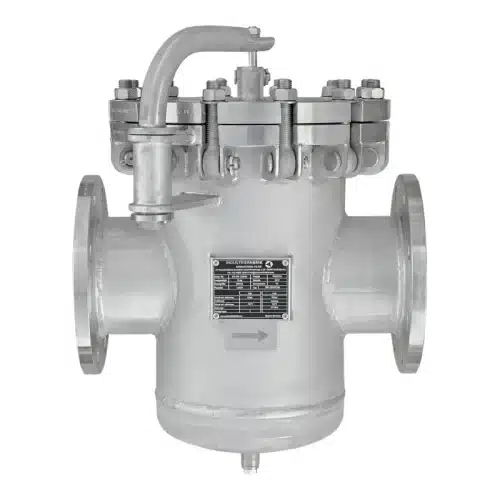
Large screen area with a moderate face-to-face length. Scope of the design: DN80 to DN150 in PN16, stainless steel 1.4571, perforated plate 6 mm or fine mesh screen 1,000 µm, gasket FKM or ePTFE to EU 1935/2004 and 10/2011/EU. Designed for −10 to +120 °C and 5 to 16 bar.
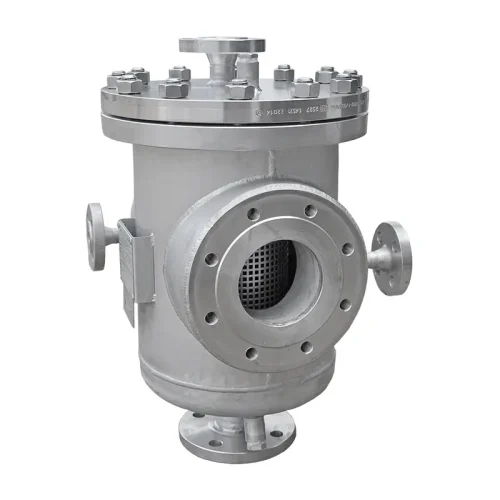
A welded heating jacket around the housing keeps bitumen, greases and heavy fuel oil moving. Heating is by thermal oil, steam or hot water. For media that solidify during downtime, this is not an option but a prerequisite for restarting.
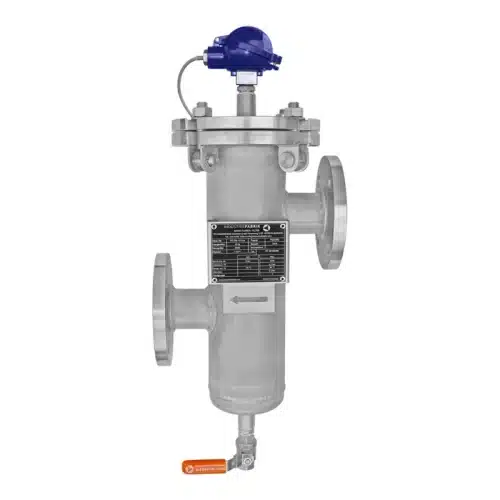
For secondary circuits and smaller flow rates. The design follows the same logic: rather coarser, rather larger, and heated for viscous media.
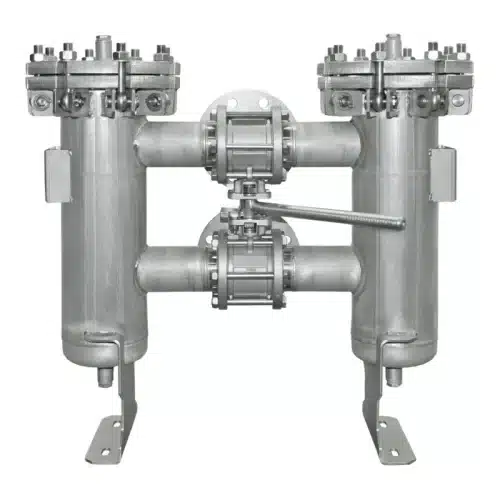
With viscous media the screen clogs faster – and cleaning takes longer than with water. Two chambers with changeover keep the plant in operation while one side is being cleaned.
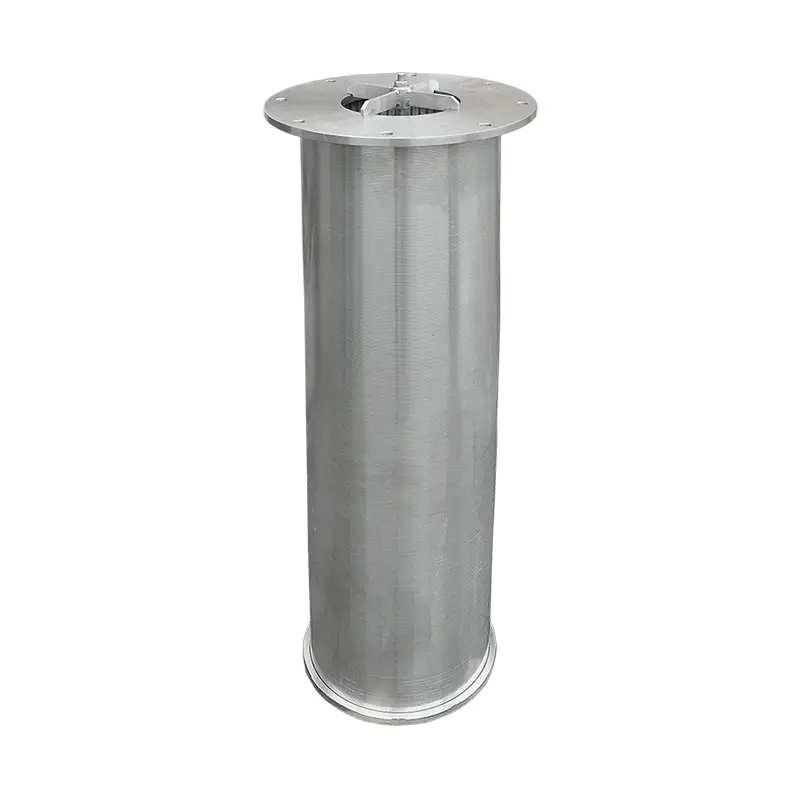
Instead of wire mesh, an element made of profile wire: larger open area, resistant to buckling, low dead space and backwashable. This design is an option where wire mesh reaches its limits – at very high viscosities and high differential pressure.
Scope and examples from our production for oils and viscous media.
| Feature or example | Value | Note |
|---|---|---|
Basket strainer for oils | ||
| Nominal size | DN80 – DN150 | larger as a custom build |
| Pressure rating | PN16 | higher on request |
| Material | 1.4571 | carbon steel also possible |
| Strainer element | perforated plate 6 mm or fine mesh screen 1,000 µm | deliberately coarse |
| Gasket | FKM · ePTFE | ePTFE to EU 1935/2004 and 10/2011/EU |
| Design | −10 … +120 °C · 5 – 16 bar | scope of the designs built |
Heated design | ||
| Heating medium | thermal oil · steam · hot water | according to the existing circuit |
| Jacket | welded, stainless steel | also as partial heating |
| In addition | insulation | retains the heat supplied |
| Note | spindle extensions | keep valves operable above the insulation |
Design for viscous media | ||
| Mesh size | coarser than for water | against the pressure loss |
| Housing | larger than the line | lowers the velocity through the screen |
| Basis of calculation | operating temperature | not 20 °C |
| Strainer element | wire mesh or wedge wire | wedge wire for very high viscosity |
This relationship is most often assumed the other way round in enquiries. The resistance of a screen grows with viscosity, and considerably so. Anyone who chooses the same filtration grade for oil or syrup as for water gets a strainer that costs too much pressure from the first operating hour and has to be cleaned constantly.
The right approach uses two adjustments: a coarser screen and a larger area. The protective effect is maintained, because the filtration grade depends on the protected component anyway. The service life increases considerably. Tell us the viscosity at operating temperature, and we will calculate it.
Because the pressure loss rises with viscosity. A filtration grade that is unremarkable with water makes the plant inoperable with oil. That is why a coarser grade is chosen and the housing is designed larger – the protective effect still depends on the component downstream.
Whenever the medium becomes viscous or solidifies as it cools – bitumen, greases, heavy fuel oil, chocolate. The jacket maintains the temperature at which the plant runs anyway; it is not a heater that heats up, but one that compensates for heat loss. Without it, the strainer blocks at the next start-up.
FKM is the most common choice. Where food contact plays a role, ePTFE to EU 1935/2004 and 10/2011/EU can be used. At high temperatures, graphite with tanged steel insert is chosen. Tell us the medium and temperature, and we will select the right one.
A strainer element made of profile wire instead of wire mesh. It has a larger open area, is considerably more resistant to buckling, has little dead space and can be backwashed. At very high viscosities and high differential pressure, it is superior to wire mesh.
At your operating temperature. Viscosity falls considerably with temperature – a design at 20 °C gives a completely different picture for a circuit that runs at 120 °C. Tell us both: the operating temperature and the viscosity at that temperature.
Yes. Before production starts, you receive the design drawing for approval – with design data, materials, mesh size and attachments. Only after your confirmation does the order go into production.
Tell us the medium, viscosity at operating temperature, flow rate and the component to be protected – you will receive a design proposal with strainer type, filtration grade and heating.