Temperature control
A strainer has more surface area than the pipeline it is installed in – and loses correspondingly more heat. A strainer insulation jacket keeps the heat in the unit. On a strainer, the insulation has to be removable, because the cover is opened regularly to change the screen.

made to measure, removable
Medium up to 700 °C
20 · 30 · 40 · 60 mm
A1 to EN 13501-1
A pipeline is insulated once and stays that way. A strainer does not: its cover is opened regularly, the screen is taken out, cleaned and put back. Permanently fitted insulation would have to be cut open every time – after the second time it is wet, compressed and ineffective.
That is why made-to-measure jackets with hook-and-loop or buckle fastenings are used on strainers. They can be removed in minutes, lie next to the unit during maintenance and are then put back on. On the adjoining pipeline, by contrast, rigid mineral wool pipe sections are the more robust choice. Both systems can be combined on one assembly.
Two systems that complement each other – plus moulded parts for the difficult points.
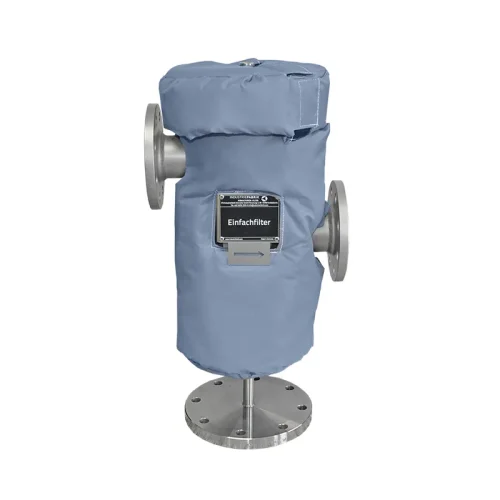
Made-to-measure insulation jackets of thermal E-glass needle mats with hook-and-loop or buckle fastenings – for industrial strainers as well as for ball valves, control valves and pumps. The cover gets its own jacket, which is removed separately. This allows the screen to be changed while the insulation stays on the rest of the housing. The jackets are flexible, sound-absorbing and reusable.

Rigid mineral wool pipe sections with aluminium facing, DN10 to DN200, in 20, 40 or 60 mm insulation thickness. For media up to 700 °C, mechanically resilient, with very low water absorption and a fire protection system to EN 13381-3. The right choice wherever nothing has to be opened.

Also an ideal solution for skids and process plants and for complex industrial valves. On a strainer station, moving and fixed parts meet. A proven approach is to combine both systems on one assembly: jackets on everything that has to be opened, pipe sections on the continuous line. The transitions are designed so that no open joint remains.
Strainer insulation
Every strainer design is opened differently. The strainer insulation is designed accordingly. The parts needed for maintenance get their own jacket. You remove only this one; the rest of the housing stays insulated and warm.
Insulating a strainer pays off wherever the medium has to maintain its temperature. Typical cases are steam and condensate, oils and thermal oil and heating water. At the same time, the insulation protects against burns on hot surfaces and reduces the heat loss of the plant.
The jacket geometry is made to measurements taken on the respective unit. The following material data apply to the two systems.
| Feature | Value | Note |
|---|---|---|
| Insulation jackets IFS-PLAST25 | ||
| Filling | E-glass needle mat | 120 – 140 kg/m³, up to 550 °C |
| Inner cover | PU or PTFE | PU up to 500 °C · PTFE up to 280 °C |
| Outer cover | PTFE grey | approx. 560 g/m², up to 280 °C |
| Material thickness | 20 and 30 mm | other thicknesses on request |
| Fastening | Hook-and-loop or buckle | with fastening straps |
| Properties | flexible · reusable | also sound-absorbing |
| Examples | Y strainer DN40 · DN80 | also valves DN15 – DN150 |
| Pipe insulation IFS-MW20 | ||
| Material | Mineral wool with aluminium facing | density 190 kg/m³ |
| Nominal sizes | DN10 – DN200 | pipe sections for standard sizes |
| Insulation thickness | 20 / 40 / 60 mm | others on request |
| Medium | up to 700 °C | aluminium side up to 100 °C |
| Thermal conductivity | 0.044 W/mK at 50 °C | 0.167 W/mK at 700 °C, EN 12667 |
| Reaction to fire | A1 · laminated A2-s1,d0 | to EN 13501-1 |
| Fire protection | EN 13381-3:2015 | system certificate |
| Melting point | ≥ 1,000 °C | to DIN 4102 |
| Water absorption | < 1 kg/m² | short-term, to EN 1609 |
| Supplements | ||
| Elbow insulation | for bends | follows the geometry |
| Insulation boxes | for valves and flanges | many designs |
| Custom density | of the mineral wool | on request |
| Combination | Jackets and pipe sections | possible on one assembly |
Further information on our insulation products can be found on our website www.isolierfabrik.com. There we also show tests of the insulation. How a basket strainer is insulated with IFS-PLAST25 is described in a separate article on insulating basket strainers.
Pipe sections are available off the shelf for every standard nominal size. A strainer has no standard shape: cover height, flange spacing, support legs, drain nozzle and fitted valves result in a different envelope on every unit. That is why the jacket geometry is made to site measurements – from the manufacturing drawing of your strainer or, for existing units, from measurements taken on site. Also tell us what should remain free: nameplate, pressure gauge, vent and everything that is operated regularly.
Yes. Before production starts, you receive the design drawing for approval – it also records which surfaces are insulated and what remains free. The order goes into production only after you have approved the drawing.
Certainly. Drawings, measurements of the existing unit or requirements for the insulation thickness are the best basis. Our design engineers adopt your requirements and adapt them where production or the applicable code requires – we agree any deviations with you in advance.
Yes, that is exactly what the jackets are made for. Open the hook-and-loop or buckle fastening, remove the jacket, open the strainer – after maintenance the jacket is put back on. The jackets are explicitly reusable and withstand many maintenance cycles.
For the jackets, the E-glass needle mat filling withstands up to 550 °C, the covers up to 500 °C (PU) or 280 °C (PTFE) depending on the design – the decisive factor is the lowest-rated layer on the hot side. The mineral wool pipe sections are designed for media up to 700 °C. Tell us your operating temperature and we will select the right build-up.
Usual thicknesses are 20 and 30 mm for the jackets and 20, 40 or 60 mm for the pipe sections; other thicknesses are possible. The right one depends on the temperature difference, the installation site and the objective – saving energy, maintaining the process temperature or protection against contact.
We clarify this case by case. Jackets can easily be shipped separately and fitted on site; for a newly manufactured strainer, fitting at the factory is often more sensible because the measurements are then taken directly on the unit. Tell us what you prefer.
Yes. For this we need the dimensions of the unit – ideally the manufacturing drawing, otherwise site measurements with photos. Strainers that were not made by us can also be fitted with made-to-measure jackets in this way.
For these there are insulation boxes and elbow insulation. Flanges in particular are critical: if they are left bare, a cold spot forms where a sensitive medium drops out first. Anything that has to be operated or read, on the other hand, we deliberately keep free.
These are two different tasks. Insulation slows down the heat loss; it cannot supply heat. If the medium still cools down or solidifies during longer downtime, you also need a heating jacket. In many cases, both together are the right solution.
The mineral wool pipe sections are non-combustible: reaction to fire A1 unlaminated or A2-s1,d0 with aluminium facing to EN 13501-1, melting point above 1,000 °C to DIN 4102, plus a system certificate to EN 13381-3:2015. If your project requires proof, tell us the required class.
All topics at a glance: Strainer options
Tell us the operating temperature, strainer type and nominal size – and what should remain free. From this we produce the cut for your jackets.