Home › Line Blinds
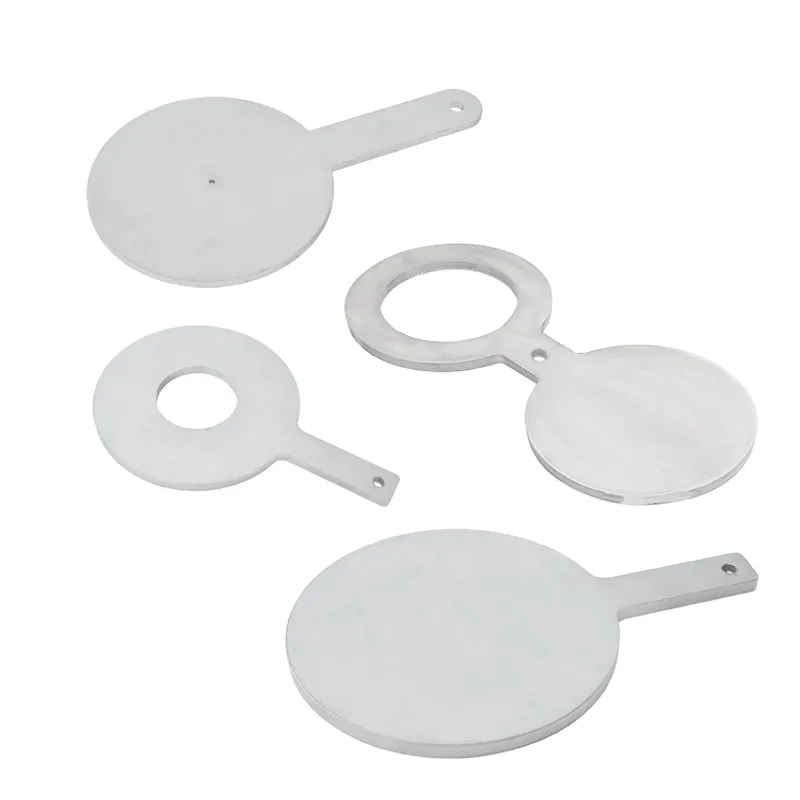
Line blinds
A carbon steel or stainless steel disc between two flanges – that is all it takes to isolate a line safely. Unlike a closed valve, a spade blind is visible from the outside: anyone who sees it knows that the line is sealed.
That is exactly why the line blind is fitted in pipelines and gas lines during maintenance work and pressure tests. Four designs cover everything that is needed between flanges.
The four designs
All four fit between the same standard flanges and look similar from the outside. The difference lies in the centre. Line blinds are also referred to as spade and spacer; the spectacle blind is also known as a figure 8 blind.

Isolates. A solid disc without a bore – the line is closed, visibly and beyond doubt. For maintenance, modification and leak testing.
Configure spade blind →Design and dimensions →
Lets the flow through. A ring with a full bore. It keeps the space of the removed spade blind free so that the flanged joint keeps its dimension.
Configure paddle spacer →Design and dimensions →
Restricts. A reduced bore that limits the flow rate and reduces pressure in a defined way. Not to be confused with the paddle spacer – it has a full bore.
Restriction orifice plates →
Switches over. Spade blind and paddle spacer in one piece. Loosen the bolts, reverse the blind, tighten – the position can be read from the outside.
Configure spectacle blind →Positions and dimensions →Selection
| Type | Bore | Purpose | Typical situation |
|---|---|---|---|
| Spade blind | none | isolate | Maintenance on a plant section, pressure test |
| Paddle spacer | full | hold the space | Normal operation, when the spade blind is removed |
| Spectacle blind | either | switch over | Lines that are regularly isolated and released |
| Restriction orifice plate | reduced | limit | Throttling the flow rate, reducing pressure in a defined way |
Spade blind and paddle spacer are a pair: one replaces the other. If you need both states frequently, the spectacle blind gets you there faster – it stays in the flanged joint and is only rotated.
Design


The handle
As standard, every line blind has a handle (tab) – a web that projects from between the flanges. It is not an accessory but the actual safety feature.
It shows from the outside that a disc is installed at all and, on the spectacle blind, also in which position. Marked with nominal size, pressure rating and plant identification, it becomes part of the documentation.
Ordering
You can order spade blinds, paddle spacers and spectacle blinds directly in the shop, selected by nominal size, pressure rating and material. Restriction orifice plates are designed to your operating data – the bore follows the required pressure drop.
The line blind table with all dimensions to DIN 2626 is available for download in German and English: Dimension table DIN 2626 (PDF)
Designs and versions of all four discs: Brochure line blinds (PDF)
Frequently asked questions
Because a closed valve cannot be proven to be tight. For work on a plant section, safety regulations often require a mechanical isolation that is visible from the outside – and that is exactly what the spade blind with its handle provides.
The paddle spacer has the full pipe diameter and does not change the flow – it only keeps the space of the removed spade blind free. The restriction orifice plate has a reduced bore and is there to limit the flow.
If the line is open in normal operation and is only isolated for maintenance: yes. Otherwise the flanged joint lacks the dimension when the spade blind is removed. The spectacle blind saves you this – it combines both.
A spectacle blind with a hole by which it is pivoted on one bolt of the flanged joint. It then does not have to be removed completely to be reversed – an advantage with large nominal sizes and the corresponding weight.
The dimensions depend on the flanged joint – DIN EN 1092-1 or ANSI B 16.5. For line blinds, DIN 2626 is also commonly used. Tell us the standard, nominal size and pressure rating, and the disc will fit.
That depends on nominal size and pressure rating: the disc has to withstand the full operating pressure against the closed surface. We design the thickness accordingly – at high pressures and large nominal sizes it becomes considerable.
For a quotation we need nominal size, pressure rating, material and design. For restriction orifice plates, we also need the required pressure drop or the flow rate the bore is to pass.