Home › Applications › Cooling and heating water
Applications
Closed circuits age from the inside: corrosion products, sludge and, in heating and district heating networks, magnetite. Whatever of this reaches the plate heat exchanger costs performance – and eventually the component itself. We design cooling water strainers and heating water strainers for this purpose.
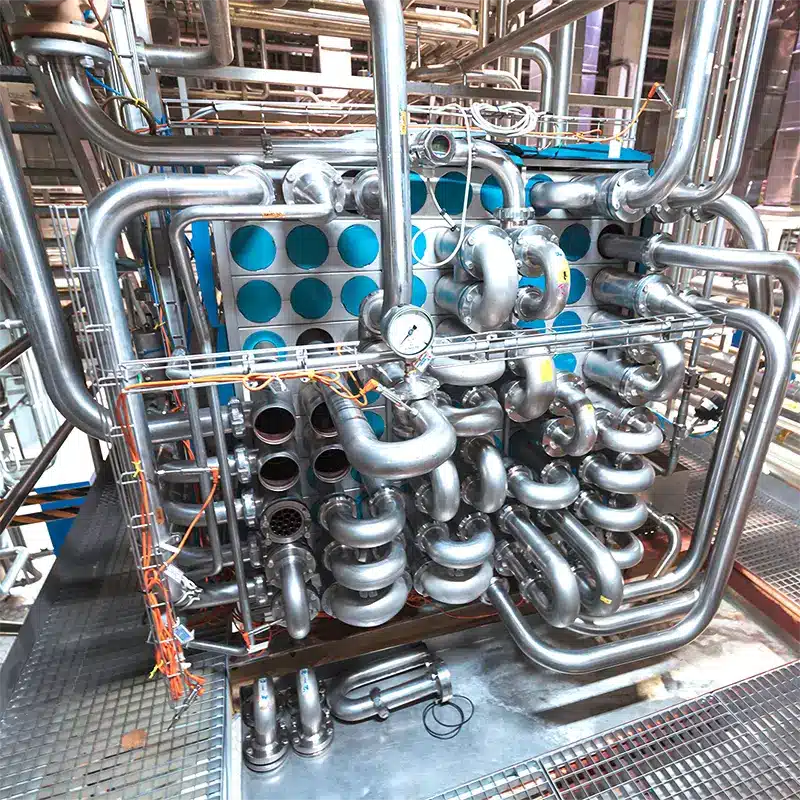
DN250 – DN450
designed for up to +150 °C
Magnetic rods in the basket
Flange or butt-weld end
Plate heat exchangers are the most sensitive components in the circuit. The gaps between the plates are narrow, and whatever settles there cannot be removed without dismantling. In addition, the process is gradual: performance deteriorates slowly, and the damage is often only noticed when the supply temperature can no longer be reached.
In heating and district heating circuits there is a second problem that no screen solves: magnetite. The black sludge from corrosion is so fine that it passes even the finest wire mesh. The only remedy is magnetism – magnetic rods in the strainer basket hold the ferritic particles and can be wiped clean during cleaning.
The third point is the permissible pressure loss. Heating and cooling circuits are designed for low resistance; a tightly sized strainer eats up pump power. Here too: better a larger housing than a finer screen.
In cooling and heating circuits it is almost always the same components – and they differ greatly in what they tolerate.
Here, nominal size and temperature lead to very different units.
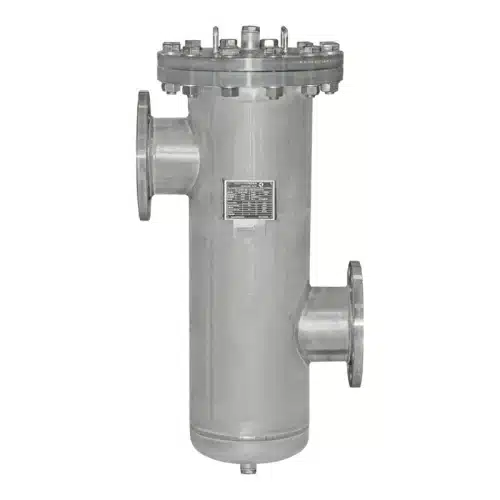
Compact and economical for the closed circuit. Scope of the design: DN50 to DN150 in PN16, stainless steel 1.4571 pickled and passivated, mesh size 0.3 to 0.5 mm, designed for up to +70 °C and 5 bar. Vent socket ½″ in the cover, drain socket ½″ in the torispherical head.
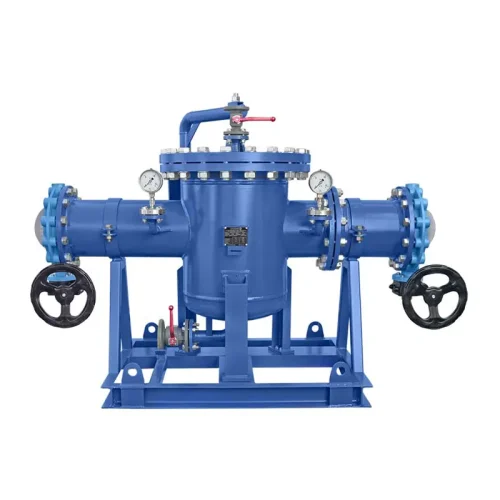
For substations and network sections: DN250 to DN400 in PN16 or PN25, carbon steel P235GH primed and painted in RAL 5010, mesh size 0.25 to 0.5 mm, with support legs. Designed for up to +110 °C and 16 to 22.4 bar, vent ¾″, drain 1½″.
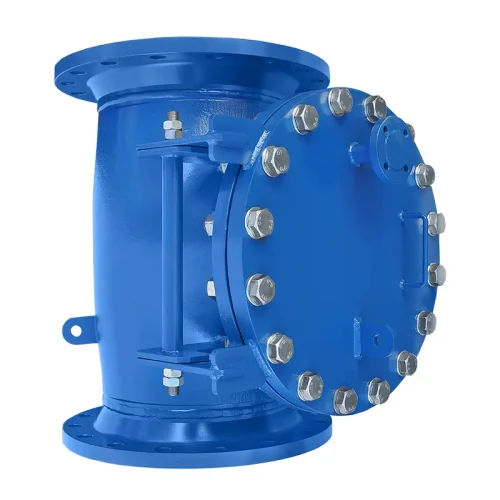
Where the line is welded or flanged: DN300 to DN450 in PN25 or PN40, carbon steel in RAL 5010, butt-weld ends from 323.9 × 7.1 to 457 × 10 mm, perforated plate in 1.4301 with fine mesh screen 1,000 µm, cover with handle and hinge. Designed for up to +150 °C and 16 to 25 bar.
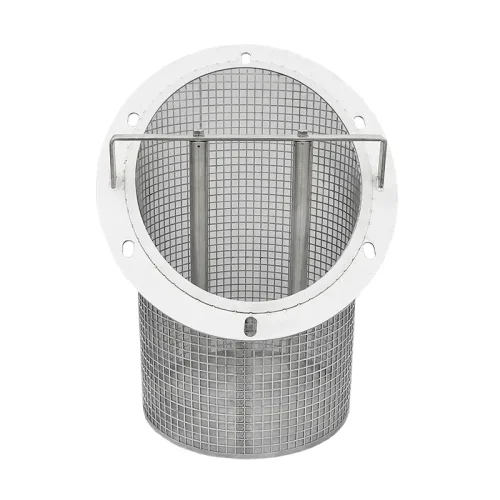
A basket strainer with magnetic rods in the basket retains fine ferritic particles that no wire mesh can capture. The rods are pulled out and wiped clean during cleaning – no wearing part, no element change.
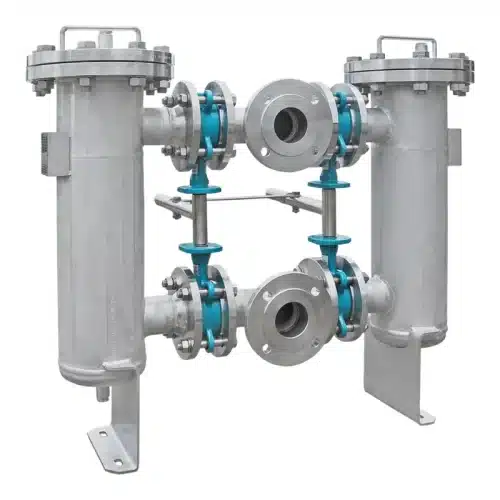
In continuous operation and wherever there is no bypass line: switch over, clean, switch back. The EPDM liner in the changeover unit can be used up to 110 °C and is therefore also suitable for heating water.
Scope and examples from our production for cooling and heating water circuits.
| Feature or example | Value | Note |
|---|---|---|
Cooling water, simplex strainer | ||
| Nominal size | DN50 – DN150 | closed circuit |
| Material | 1.4571 | pickled and passivated |
| Mesh size | 0.3 – 0.5 mm | according to the protected component |
| Design | up to +70 °C · 5 bar | typical cooling circuit |
| Strainer element | support basket 1.4301 · fine mesh 1.4401 | standard combination |
District heating and heating water | ||
| Nominal size | DN250 – DN400 | substation and network |
| Pressure rating | PN16 · PN25 | according to network pressure |
| Material | P235GH, RAL 5010 | primed and painted |
| Mesh size | 0.25 – 0.5 mm | protection of the heat exchangers |
| Design | up to +110 °C · 16 – 22.4 bar | with support legs |
| Connections | vent ¾″ · drain 1½″ | at the highest and lowest point |
T-type strainer, hot water | ||
| Nominal size | DN300 – DN450 | PN25 · PN40 |
| Connection | butt-weld ends | 323.9 × 7.1 to 457 × 10 mm |
| Strainer element | perforated plate 1.4301 with fine mesh screen | 1,000 µm |
| Design | up to +150 °C · 16 – 25 bar | cover with handle and hinge |
| Drain | in the cover flange | socket 1″ |
Against magnetite | ||
| Magnetic rods | in the strainer basket | retain fine ferritic particles |
| Cleaning | wipe off | no wearing part |
| In addition | differential pressure gauge | shows the condition of the mesh |
The black sludge in heating and district heating circuits is magnetite, an iron oxide from corrosion in the network. Its particles are smaller than any mesh size that can be operated without an unacceptable pressure loss. They pass through the finest wire mesh and settle wherever the flow calms down: in the heat exchanger, in the pump, in the valve seat.
Magnetite can only be retained magnetically. Magnetic rods in the strainer basket take on this task, while the wire mesh continues to hold the coarse dirt – two operating principles in one housing.
Because magnetite is present as very fine particles, far below any mesh size that can be operated economically. A finer wire mesh only increases the pressure loss without holding the sludge. Magnetic rods, on the other hand, catch it regardless of particle size.
It depends on the narrowest gap between the plates – the manufacturer of the heat exchanger knows this value. Tell us this value, and we will derive the filtration grade from it. Without this information we choose conservatively and agree it with you.
For large nominal sizes in district heating networks, welded connections are common – this saves sealing points and installation height. We manufacture butt-weld ends to your pipe dimensions, built from 323.9 × 7.1 to 457 × 10 mm. For maintenance points, the flange remains the more practical choice.
As a rule, yes – against heat loss and as protection against contact. Removable insulation jackets are recommended on the strainer, because the cover must be accessible for changing the screen.
That is governed by the differential pressure, not by the calendar. A gauge across the screen turns an assumption into a measurement; with a switching contact it reports the limit value to the control system. On our basket strainers the permissible differential pressure is a maximum of 2 bar; in operation we recommend no more than 0.5 bar.
Yes. Before production starts, you receive the design drawing for approval – with design data, materials, mesh size and attachments. Only after your confirmation does the order go into production.
Tell us the network temperature, pressure, nominal size and the component to be protected – and whether magnetite is an issue. You will receive a design proposal with strainer type and options.