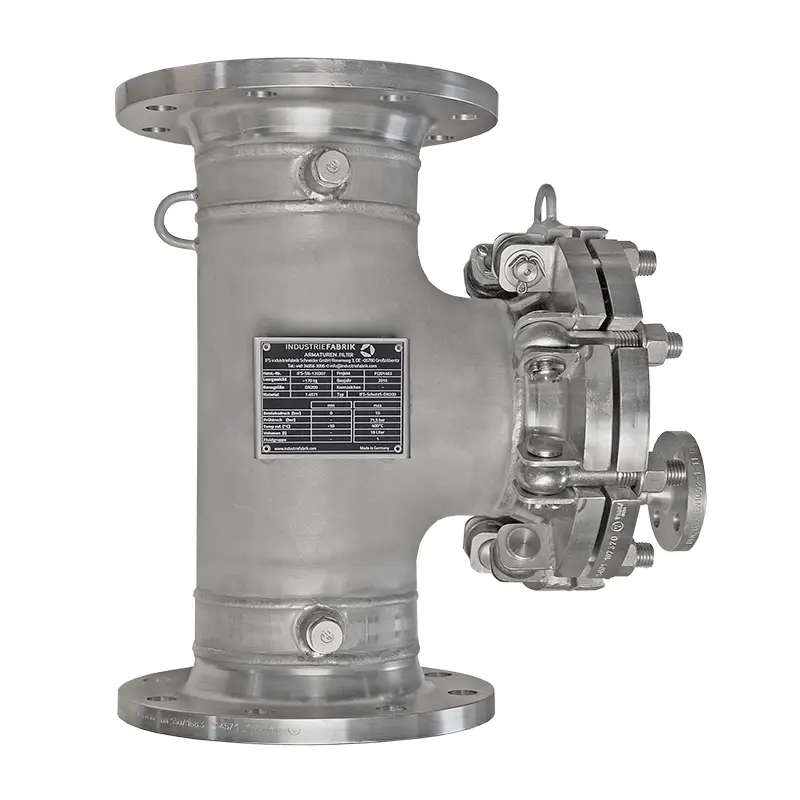
T-type strainer · Pipeline strainer · Protective screen
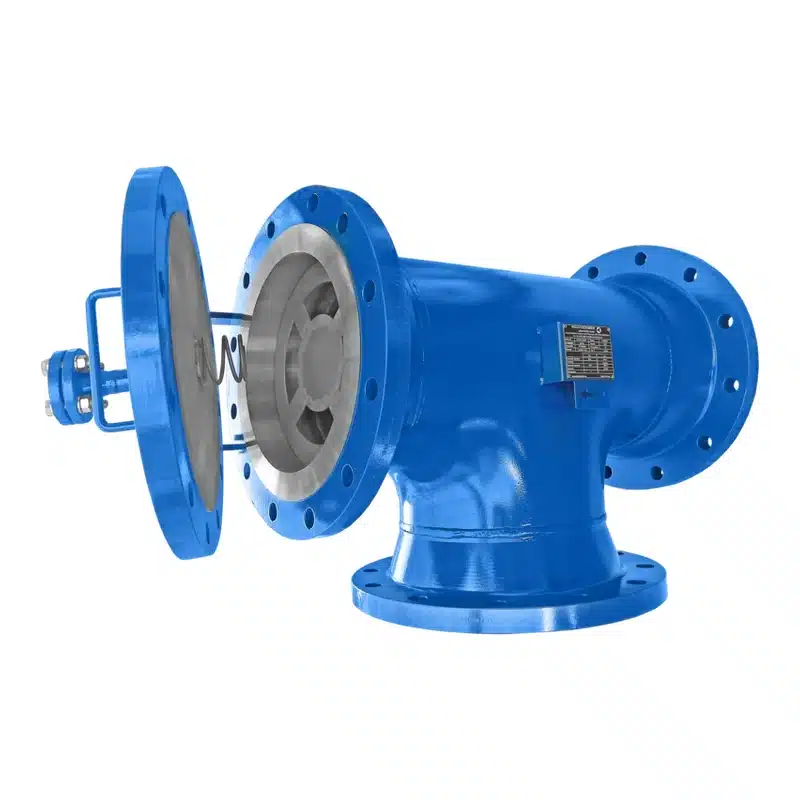
A protective T-type strainer (tee strainer) that becomes part of the pipeline. It sits in the line like a tee fitting, with the screen in the branch. It has a low profile and needs no separate vessel. It also withstands temperatures at which other designs reach their limits.
Every T-type strainer is built to your process data. We design nominal size, pressure rating, material, installation position and perforation together with you – from DN100 to DN1000, to DIN or ANSI.
ISO 9001 · TÜV-approved welding shop AD2000-HP0 · PED 2014/68/EU
Operating principle
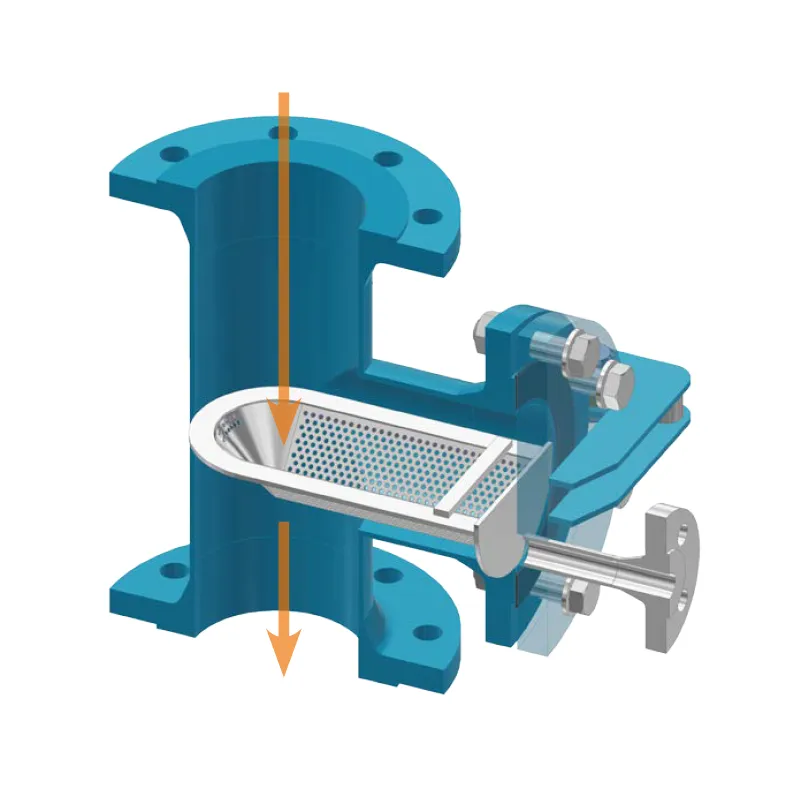
The medium flows straight through, and the strainer plate sits in the branch of the tee. Whatever is retained collects there and is removed together with the plate when the cover is opened. That is why this design is also called a pipeline strainer or in-line strainer – or a T-type or tee strainer.
The advantage lies in the installation space. A basket strainer needs headroom above the line and a separate vessel. The T-type strainer, in contrast, fits into the run of the line and can also be accommodated where nothing is free above or beside it. For large nominal sizes it is often the only design that fits at all.
Strainer element
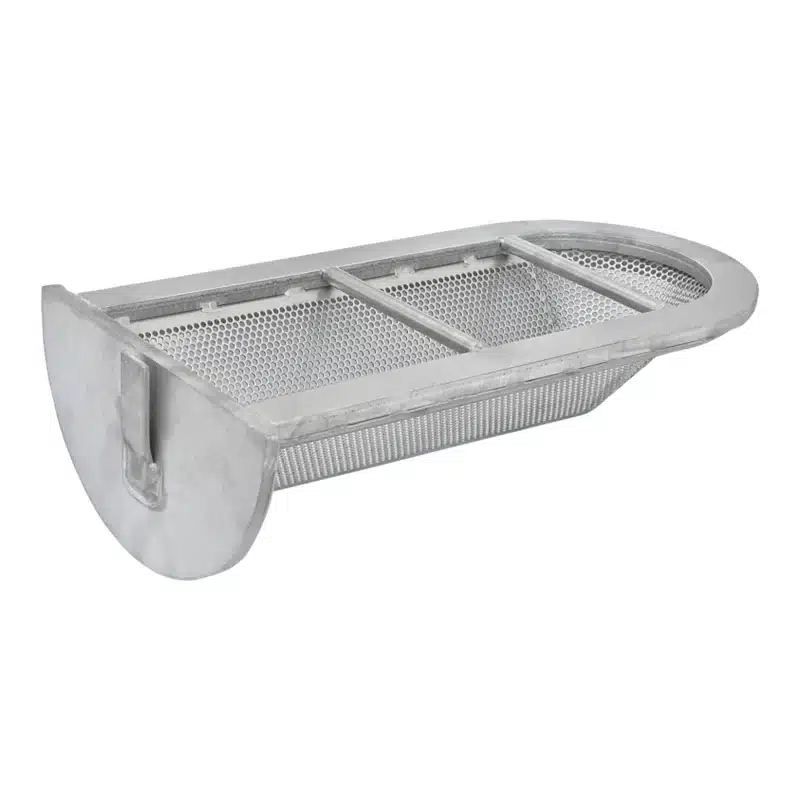
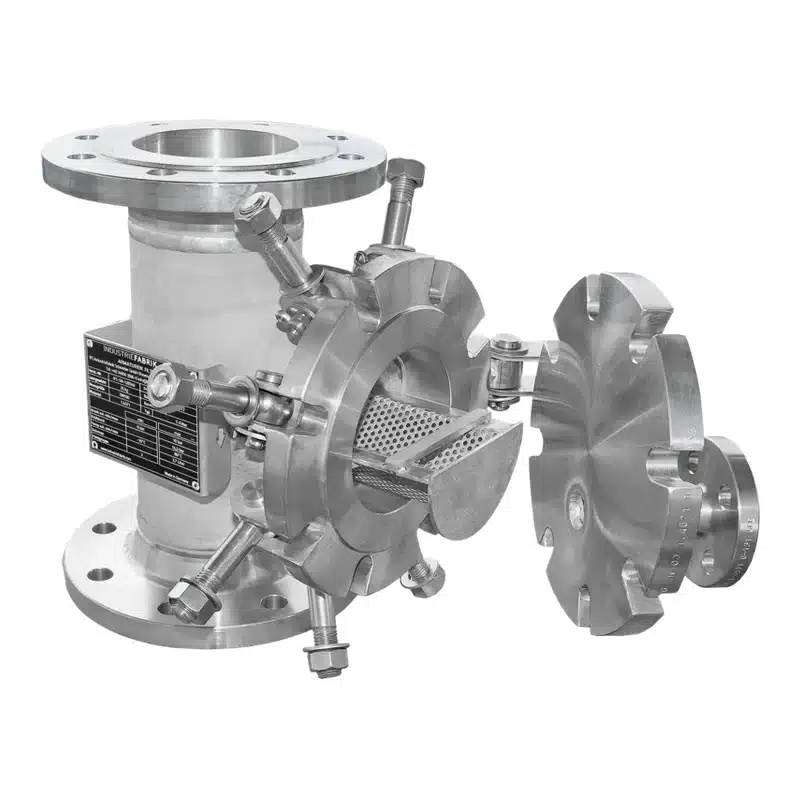
This is the difference from all other designs. Instead of a support basket with fine mesh screen, the T-type strainer works with a strainer plate in stainless steel 1.4301 with round perforation, 3 mm as standard. It is flat, dimensionally stable and easy to hose down. With a coarse dirt load this is an advantage.
Installation
Because the T-type strainer is part of the line, three things determine the design: the installation position, the opening direction of the cover and the position of the vent.
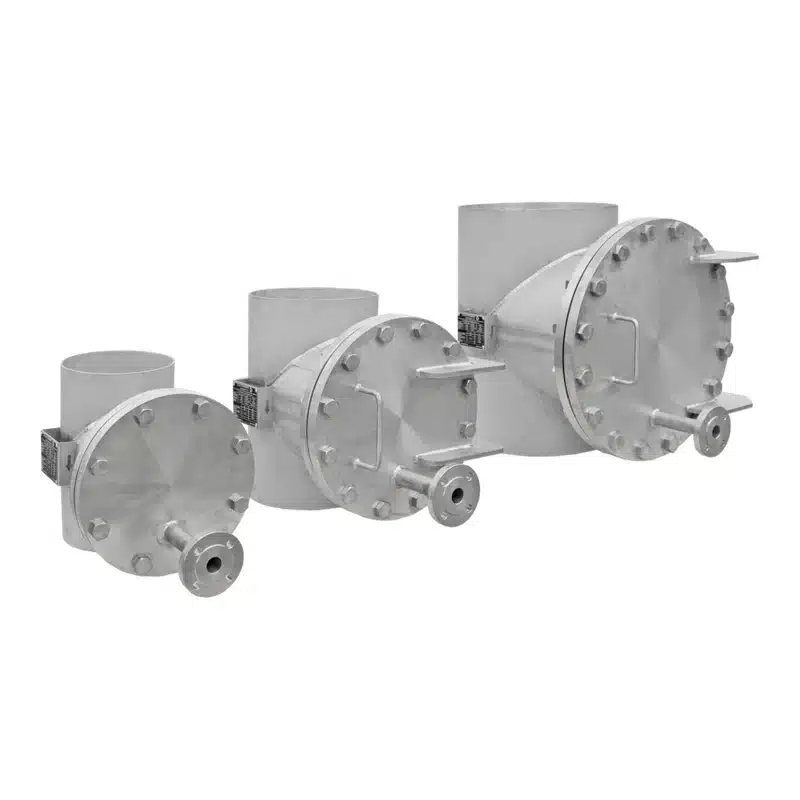
The design is suitable for both installation positions – which is not a given for strainers. The branch with the strainer plate can point downwards, sideways or upwards. This determines where the dirt settles and how it is removed.
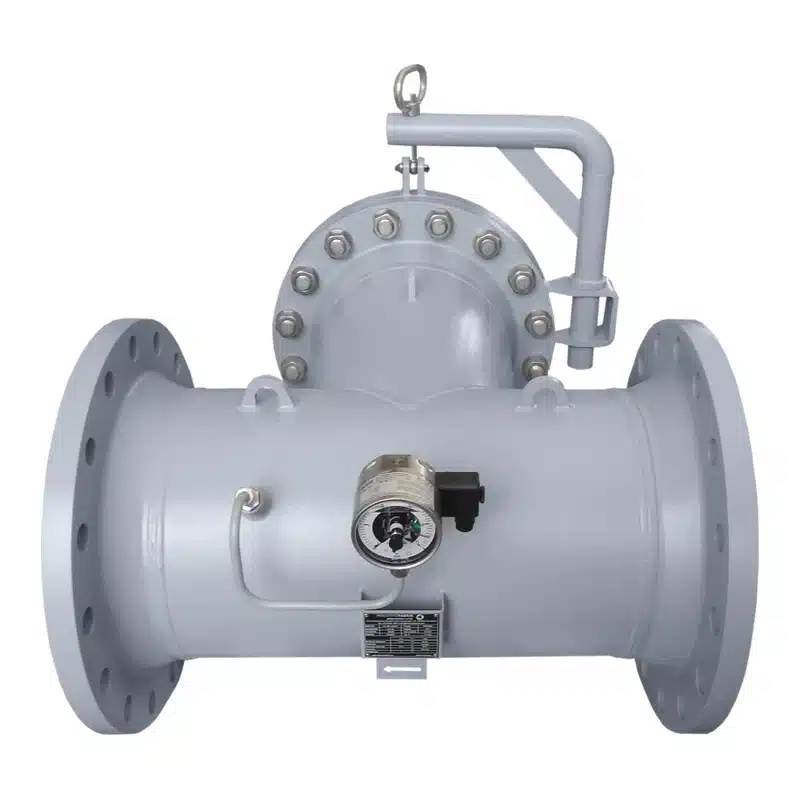
From medium nominal sizes upwards, the cover is too heavy to lift off. Hinge and swivel device guide it to the side without it having to be put down – together with the quick-opening closure, the plate is out in a few simple steps.
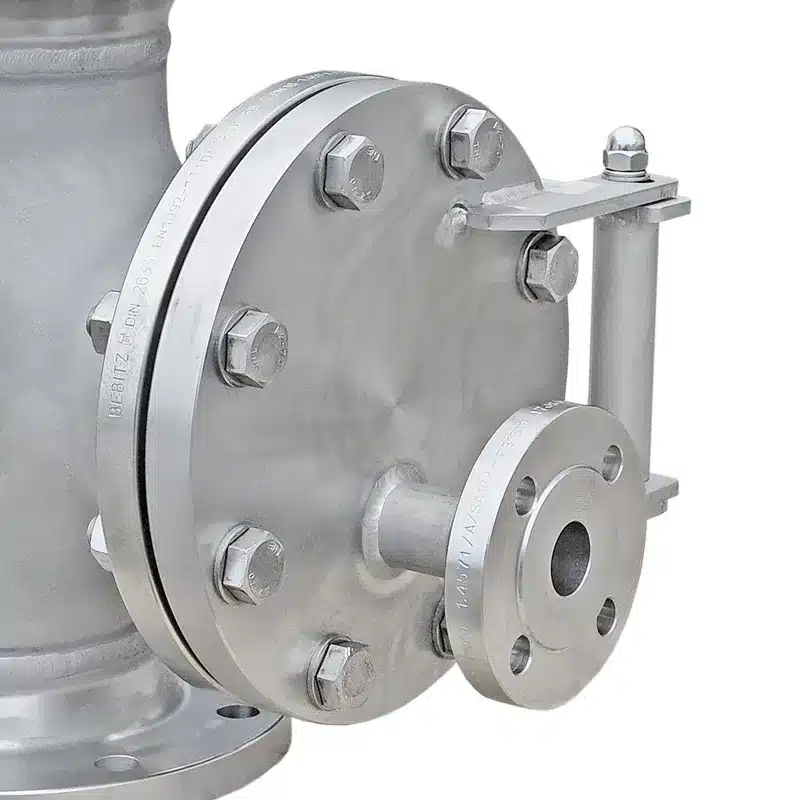
Socket or flange, depending on whether the strainer is only to be vented or also flushed and sampled. The connection sits in the housing cover, i.e. at the highest point – where air and gas collect.
Temperature
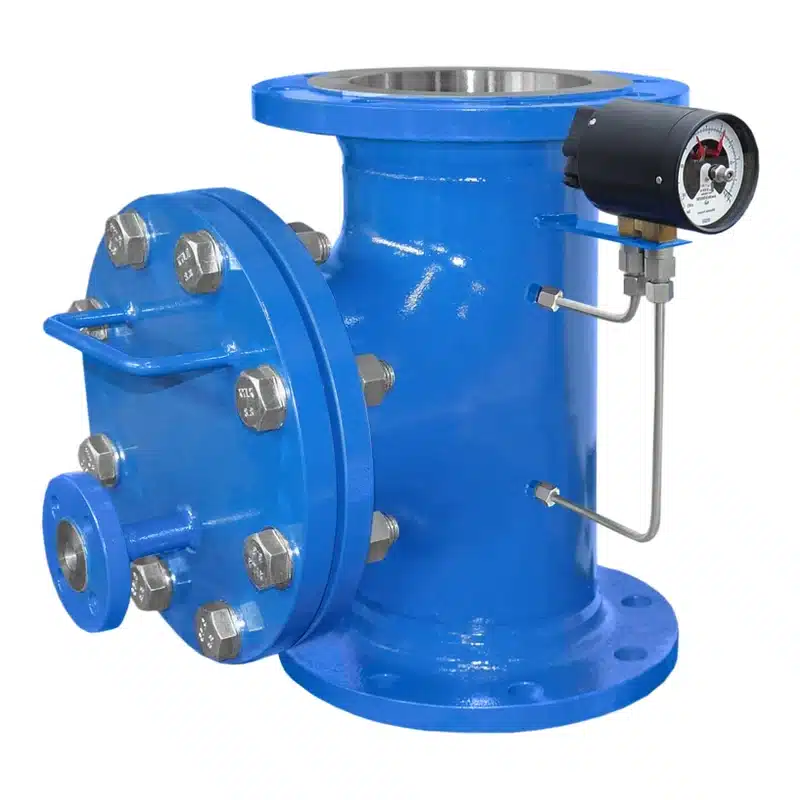
Where basket, simplex and duplex strainers end at +50 °C as standard, the T-type strainer goes up to +400 °C. This is not a side note but the reason why this design is the right choice in steam and hot water lines.
The construction makes this possible: no large flat surfaces, a compact housing and a gasket made of graphite with tanged steel insert that copes with temperature changes. The permissible temperature rise is 50 °C per hour – start-up should not be faster.
Export
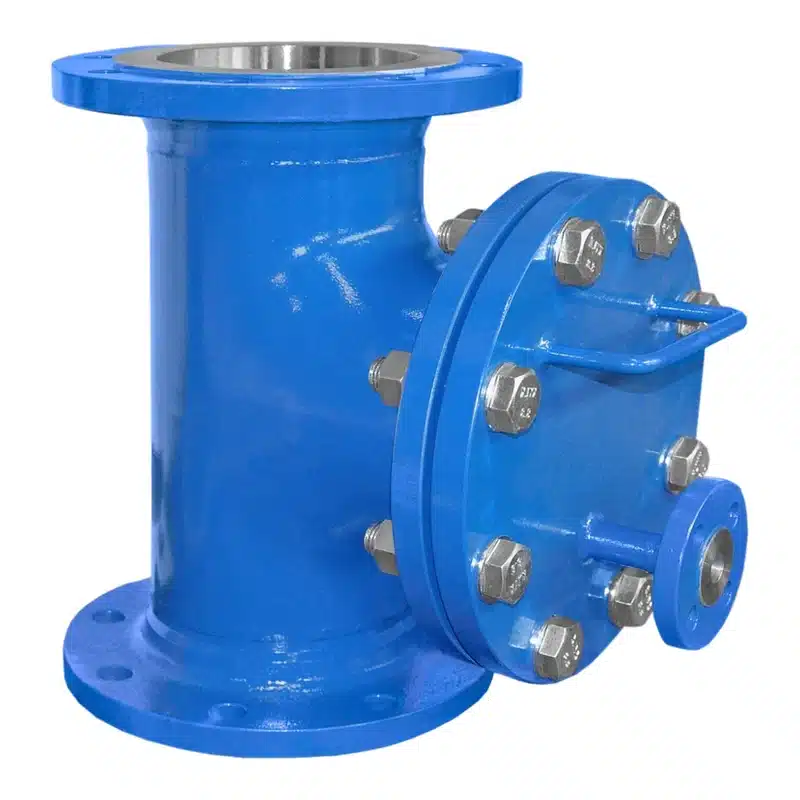
A considerable share of our T-type strainers goes into plants built to American codes. We therefore also manufacture in inch sizes: 6, 8 and 12 inch in class 150 and class 300, with flanges to ASME B16.5 and materials to ASTM.
Supplying the screen on its own is also possible: if the tee is already installed in the line, we supply the matching strainer plate – made to size or to sample.
Design parameters
Values for the standard design. The final design is based on your process data – different nominal sizes, pressure ratings and face-to-face lengths are available on request.
Dimensions
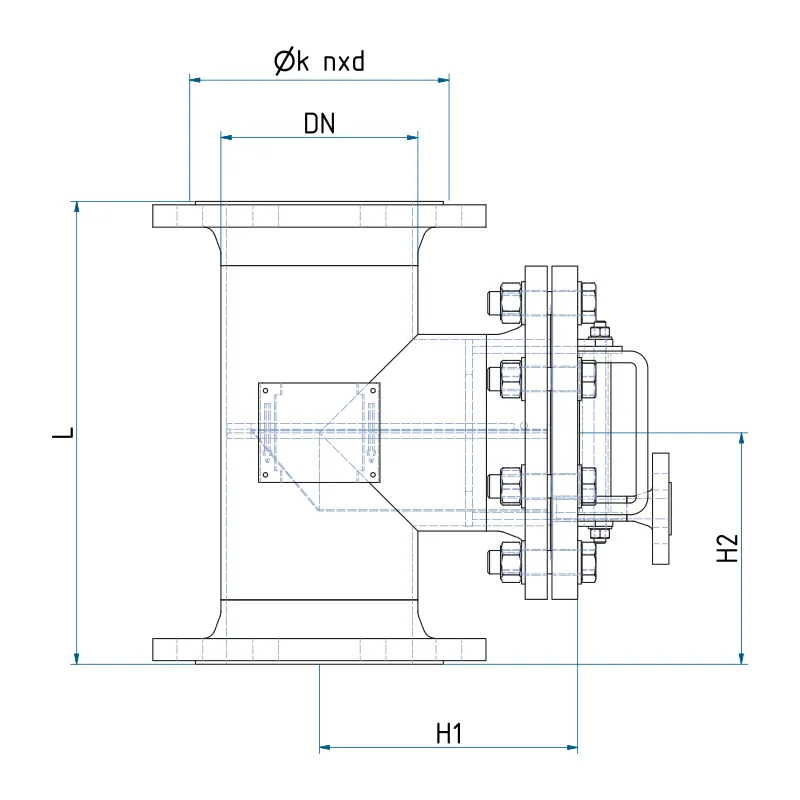
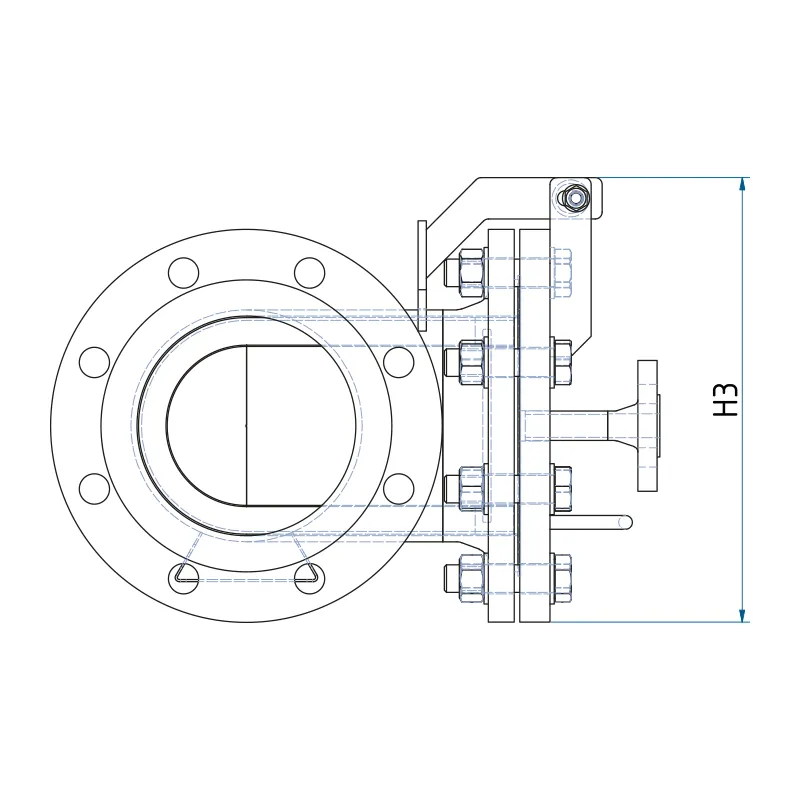
Dimensions of the standard design in PN10 and PN16: H1, H2 and H3 are the overall heights, L the face-to-face length. The weight applies to the empty carbon steel design without attachments. A dimensioned drawing for your nominal size is included with the design proposal.
| Nominal size | H1 [mm] | H2 [mm] | H3 [mm] | L [mm] | Screen area [cm²] | Volume [l] | Weight [kg] |
|---|---|---|---|---|---|---|---|
| DN100 | 178 | 157 | 225 | 314 | 210 | 3.5 | 26 |
| DN125 | 202 | 179 | 285 | 358 | 330 | 6.2 | 36 |
| DN150 | 221 | 198 | 323 | 396 | 435 | 10 | 46 |
| DN200 | 265 | 240 | 387 | 480 | 705 | 20 | 74 |
| DN250 | 313 | 286 | 473 | 572 | 1,095 | 39 | 112 |
| DN300 | 361 | 332 | 535 | 664 | 1,615 | 64 | 150 |
| DN350 | 392 | 361 | 600 | 722 | 1,980 | 80 | 205 |
| DN400 | 448 | 415 | 707 | 830 | 2,730 | 125 | 265 |
The table shows the common sizes. DN450 to DN1000 are manufactured as well, designed to your connection dimensions – in this class usually with butt-weld ends instead of flanges. Dimension sheets and STEP models are available on request.
Applications
Wherever the line itself is the installation point: no space for a vessel, but high temperature, large nominal size or both.
Manufacturing and documentation
Cutting, welding, surface finishing and testing are done in our own workshop. With the T-type strainer this counts twice: because it is welded into the line, the face-to-face length has to suit the existing piping layout – not the other way round.

Enquiry
Tell us the medium, flow rate, operating pressure and operating temperature. From this we design nominal size, screen area and material. Only nominal size and pressure rating are mandatory – if you do not know them yet, select “please advise” or “not sure”. Add further strainers with “+ further item”.
Direct
+49 34956 39960
Monday to Friday, 7 am to 4 pm (CET)
You can reach us by email at info@industriefabrik.com.
For printing
Prefer to work on paper? Fill in the form (in German) and send it back to us by email.
Yes. Pipeline strainer, in-line strainer and T-shaped protective screen refer to the same design; it is also known as a T-type strainer or tee strainer. It always means a strainer that is installed in the line as a tee fitting and carries the strainer plate in the branch.
When space is lacking or the temperature is too high. The basket strainer needs a separate vessel and headroom above the line, and ends at +50 °C as standard. The T-type strainer fits into the run of the line and goes up to +400 °C. In return, it has less screen area for the same nominal size – it is the choice for coarser separation, not for very fine filtration.
3 mm as standard; the range goes from 1 to 10 mm. The perforation depends on the component downstream, not on the medium: a pump tolerates coarser particles than a nozzle. Below 1 mm, wire mesh is used instead of the perforated plate – see Mesh size and filtration grade.
Yes, the design is suitable for vertical and horizontal installation. What matters is the position of the branch: if it points downwards, the dirt collects there and falls out when the strainer is opened. If it points upwards, medium remains in the plate when it is opened – a drain connection is then required.
Yes. If the tee is already installed in the line, we make the plate to size or to sample – also for housings from other manufacturers. We need the outside diameter, thickness, hole pattern and edge design. A photo helps.
We manufacture up to DN1000. The table above shows the common sizes up to DN400; above that, the housing is designed to your piping layout, usually with butt-weld ends. In inch sizes we manufacture 6, 8 and 12 inch in class 150 and 300.
All basic types compared: Industrial strainers
Replacement screens for T-type strainers and pipeline strainers are made to size or to sample. We replace worn screens for our own ranges as well as for other manufacturers’ strainers. To the spare part →
Tell us the medium, flow rate, pressure and temperature, plus the installation position and the component to be protected. You will receive a design proposal with nominal size, perforation, material and connection type – to DIN or ANSI.