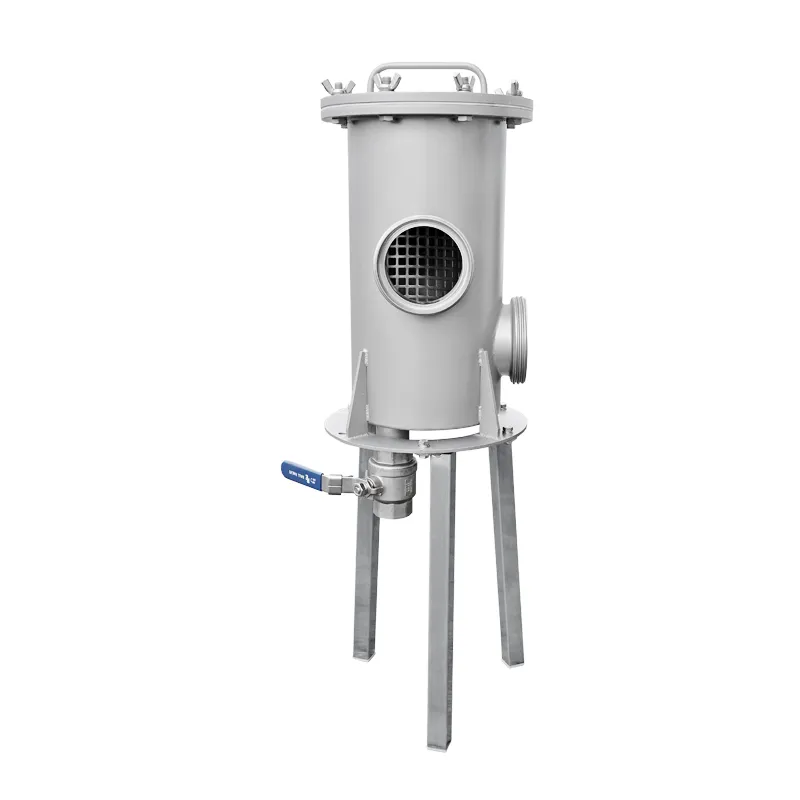
Custom strainers
Not every filtration task fits into a standard range. If the medium, the installation space or the applicable code deviates from the usual, the strainer is designed and fabricated as a one-off. Whether special filter, tubular filter for the pipeline or strainer with heating jacket: the basis is the same production that also makes the standard ranges.
This page shows the custom designs that are requested regularly. They are not catalogue goods: each one starts with your process data and ends with a drawing that did not exist before.
ISO 9001 · TÜV-approved welding shop AD2000-HP0 · PED 2014/68/EU
Why custom designs work for us
A custom strainer is not a special case in production. Cutting, welding, turning, surface finishing and testing are done in-house – the same operations that produce the standard ranges. That is why a different geometry is not a surcharge on a catalogue part but part of the design.
A custom design therefore does not need more time in the workshop, but more clarity beforehand. We need the medium, flow rate, pressure, temperature, the available installation space and the component to be protected. The design is based on these six details.
Special designs of standard strainers → – when only individual features differ and no completely new housing is needed.
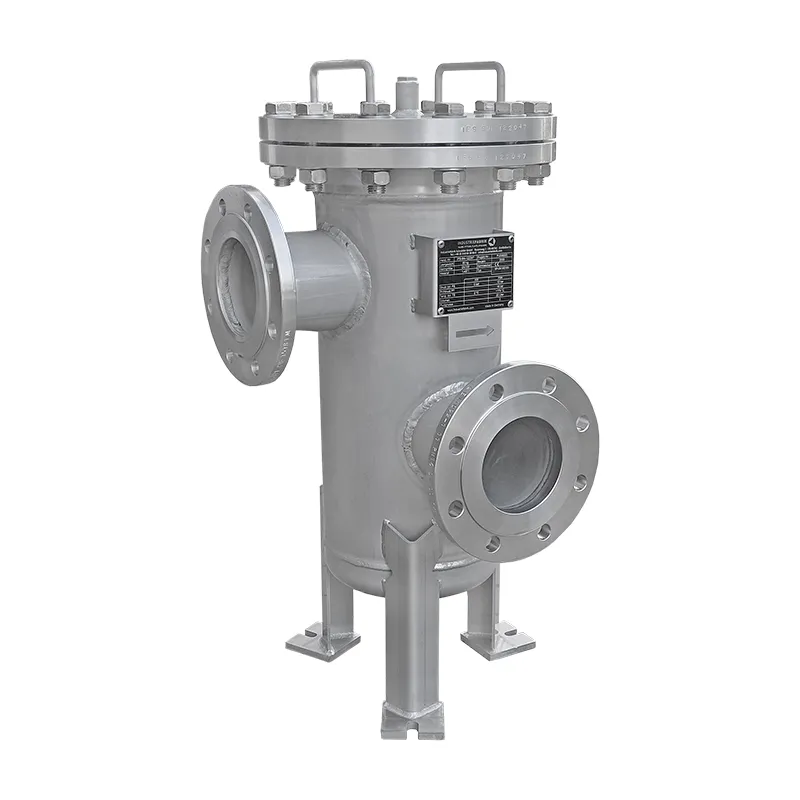
Overview
Each one leads to the detailed section on this page.
The strainer as a tee in the line – flat design, up to DN1000.
For filling and discharging road tankers, element change without tools.
Bag filter housing
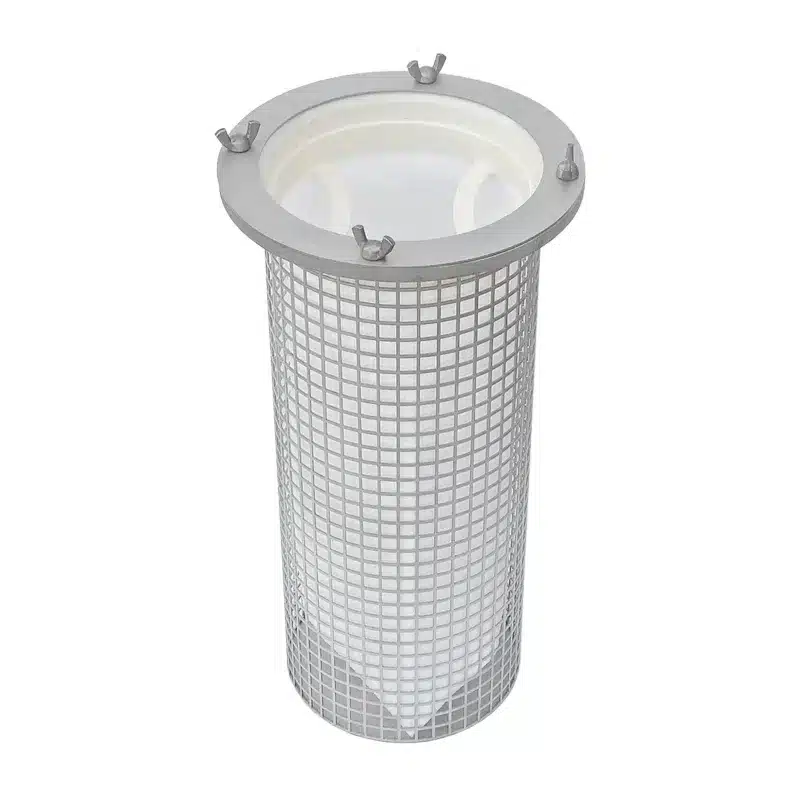
For us, the bag filter is not a separate unit but a version of the strainer element. Instead of the fine mesh screen, a filter bag is fitted in the support basket of a basket, simplex or duplex strainer – nothing changes on the housing.
The reason is the filtration grade. Wire mesh ends at 0.05 mm, that is 50 µm. The bag goes down to 1 µm: polypropylene felt covers 1 to 300 µm, polyester felt 1 to 200 µm, nylon on request – each in bag sizes 1 to 4.
Both together are possible and often useful: the fine mesh screen retains coarse particles and protects the bag, the bag does the fine filtration.
Oil strainer
Oils are the case in which the standard design is most often not enough. Not because of the filtration grade, but because of the temperature: thermal oil, heavy fuel oil and waste oil are run hot, and they become viscous when they cool down.
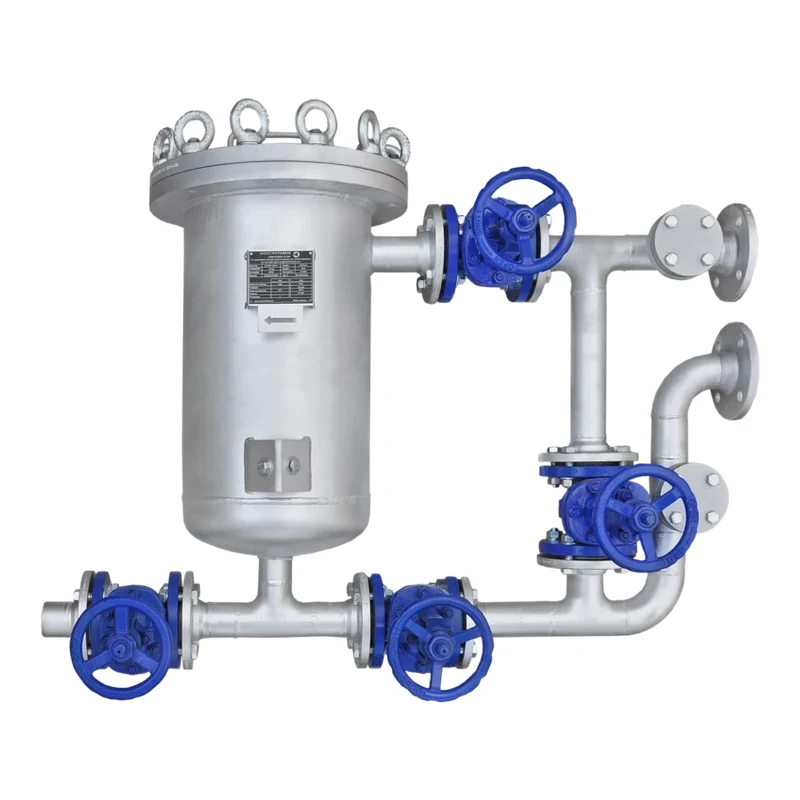
The photo shows a design DN50 in carbon steel, designed for up to +450 °C, with quick-opening closure and lifting lugs – supplied fully piped and with wedge gate valves for isolation. The strainer therefore comes not as a component but as a ready-to-connect assembly.
Where the medium solidifies during downtime, a welded heating jacket is added. This applies to bitumen and greases as well as to heavy fuel oil.
Activated carbon filter
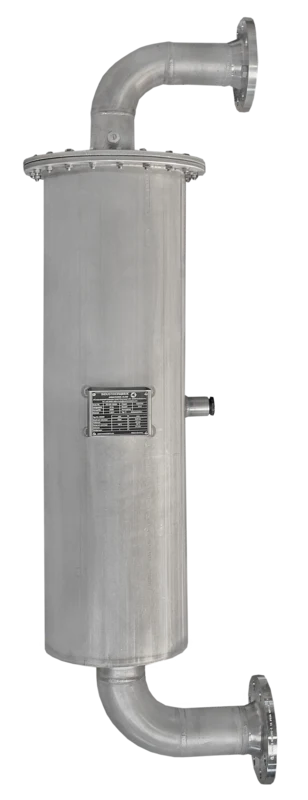
The activated carbon filter is not about particles, but about what is dissolved in the medium – odours, organic compounds, residual traces. They are retained not by a screen but by a bed of carbon that the housing has to hold and support.
For us, this is a matter of vessel construction: housing pipe, heads, filling and emptying openings, supports for the carbon bed and screens that keep the carbon in the housing. The flow path remains clear. A design in DN80 with housing pipe DN200 in 1.4571 was built in this way.
We do not supply the carbon itself – type and grain size depend on the medium and are specified by the user.
Cassette filter
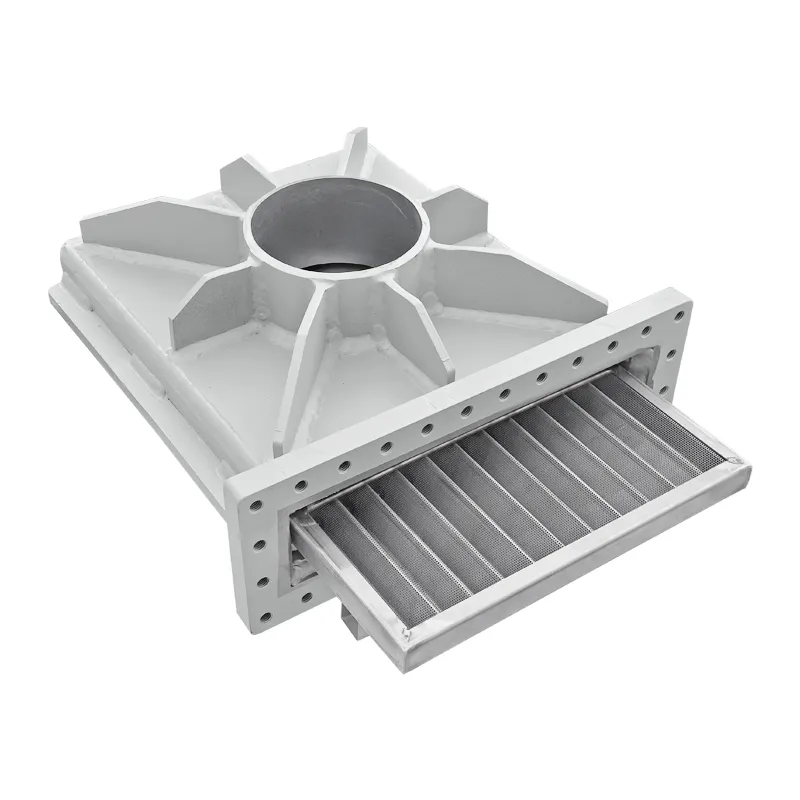
Where a large area is needed but little height is available, flat filter cassettes take the place of the basket. They are placed side by side in a housing and pulled out individually – this keeps the change time short, even with large nominal sizes.
So far we have designed this type in DN125 and DN300 at PN25, in carbon steel with a mesh size of 1.0 mm, Viton gasket and RAL 5010 paint finish, to the PED and AD 2000. It is therefore possible, but remains a separate design for each version.
Cartridge filter housing
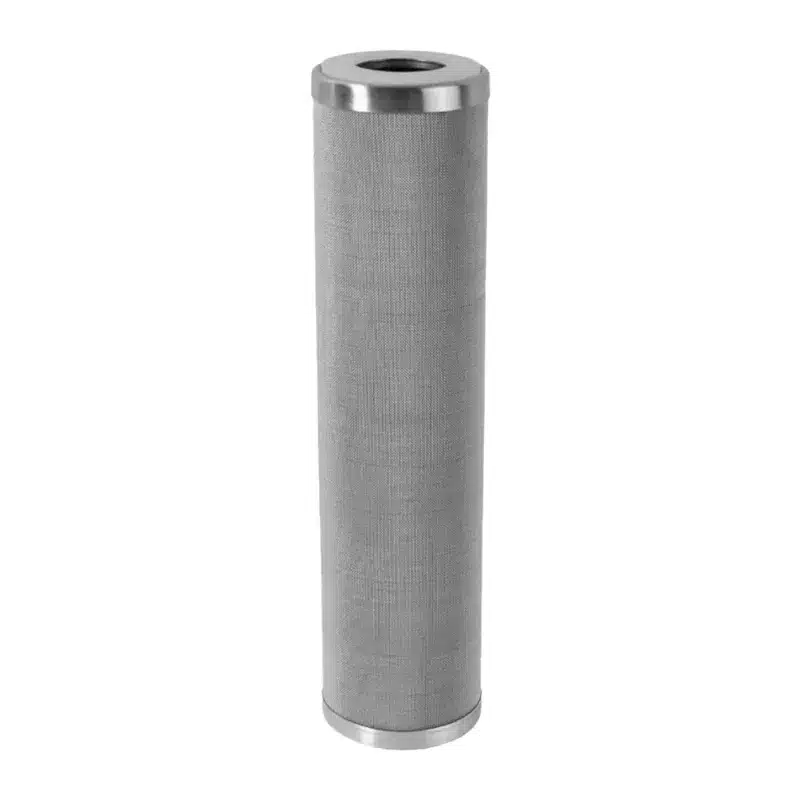
Filter cartridges are long, slender elements. They are suspended vertically in a housing, and because many of them fit side by side, a large filter area is achieved on a small cross-section. That is why this design is chosen for fine separation and high flow rates.
In terms of the housing, the cartridge filter is a simplex strainer: the same upright cylinder, the same cover, the same production. What changes is the element and its suspension. That is why we design it as a variant and not as a separate range.
We currently have no photos of our own for this design – the illustration shows a multi-stage strainer element as an example.
Wedge wire strainer
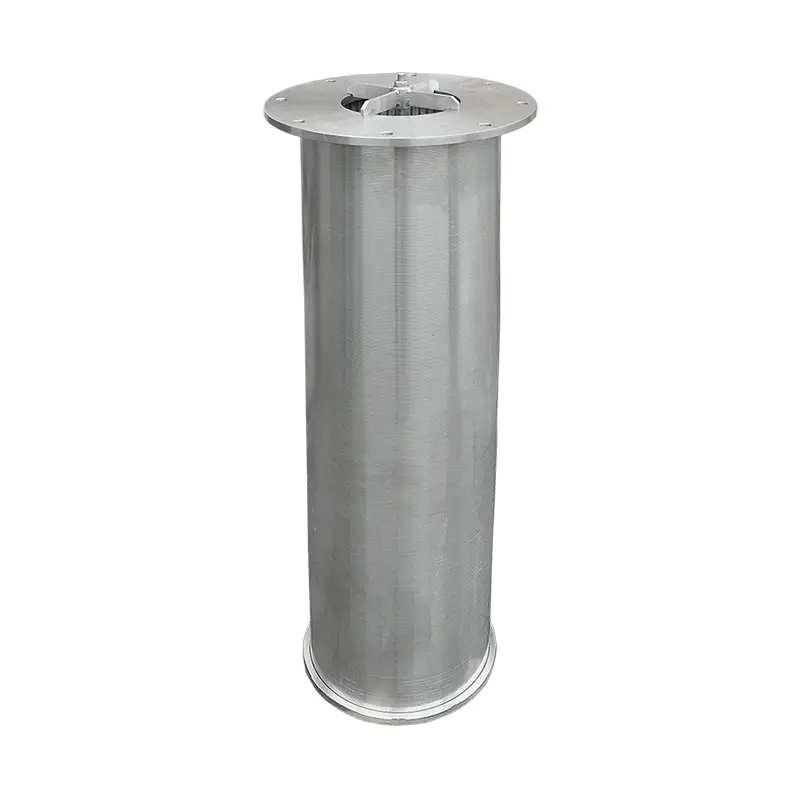
In the wedge wire strainer, separation is done not by a wire mesh but by a basket made of profile wire. A defined slot remains between its windings. This gives a smooth inner surface that clogs less easily. The element withstands more mechanical load than a wire mesh.
It is used where the filter cake is scraped off or backwashed, or where coarse, hard particles would damage a wire mesh. We build the housings for this and supply matching elements – also as replacements for existing units.
Pipeline strainer
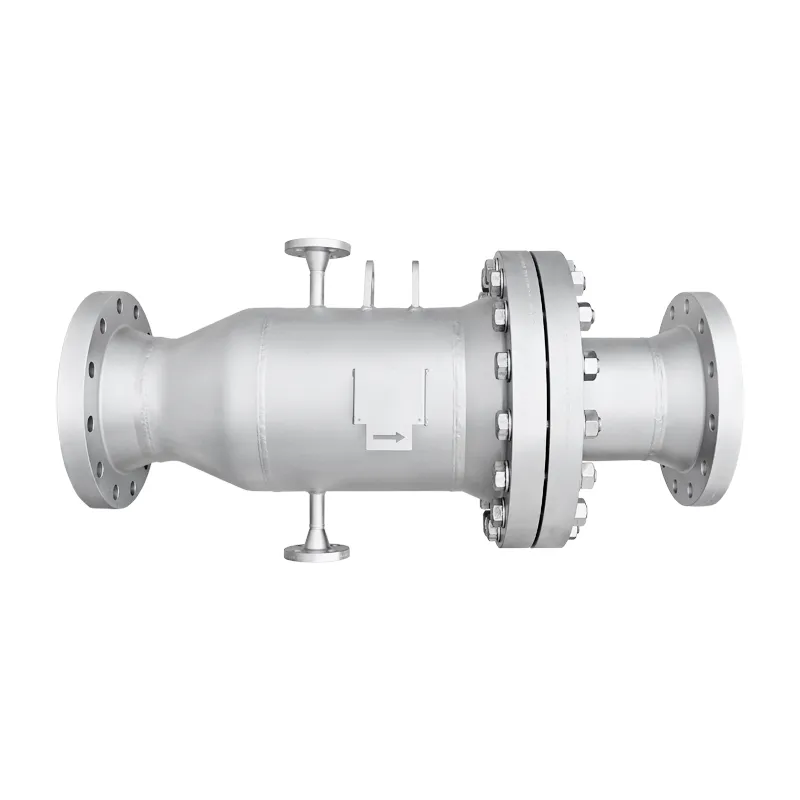
Pipeline strainer, in-line strainer, tubular filter, T-shaped protective screen: four names for the same design. It means a strainer that is installed in the line as a tee instead of standing in front of it as a vessel.
It has a flat design, needs no height above the line and can be fitted even where there is no free space next to it. With large nominal sizes it is often the only design that fits at all – and it withstands much higher temperatures than a basket strainer.
In our range, this design is called the T-type strainer. All characteristics, dimensions and designs are given there: T-type strainer – pipeline strainer from DN100 to DN1000 →
Road tanker strainer
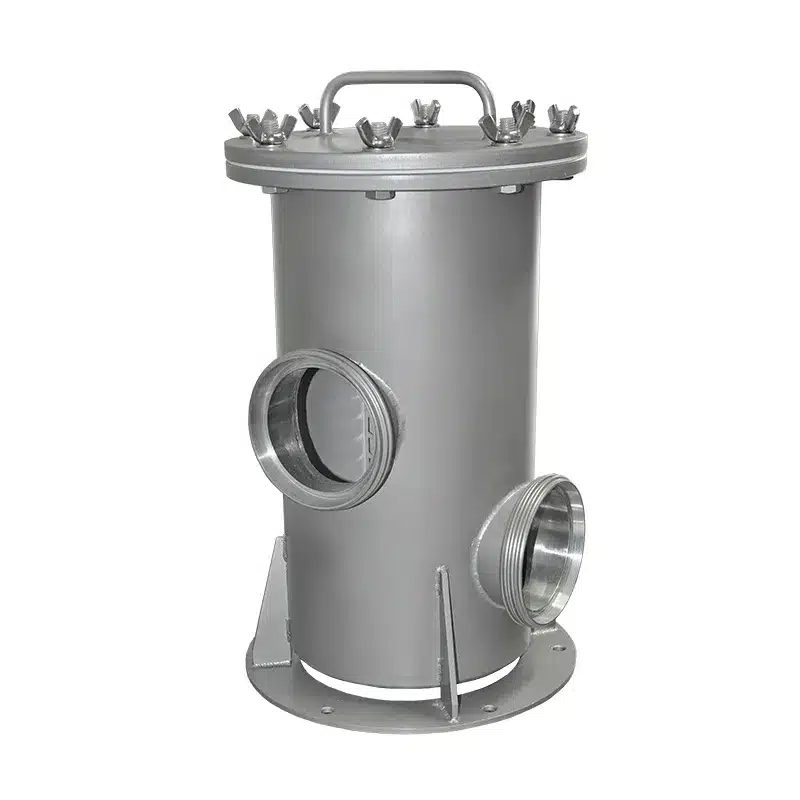
Filling and discharging road tankers decides what gets into the tank. The road tanker strainer sits in this line and retains coarse particles before they reach the pump or the storage tank.
It is designed for speed: the quick-opening housing closure with wing nuts can be opened without tools, and the element is removed by hand. On request with support legs, ball valve for venting and draining, pipe sections and quick couplings – and as an angle design with a 90° change of direction.
The road tanker strainer belongs to the simplex strainer family and is described in detail there: Simplex strainer and road tanker strainer →
Custom design
Two of these topics have their own page, because there is more to say than one section can hold.
Variant
Inlet and outlet at right angles: the strainer takes over the change of direction, saving installation space and a weld seam.
To the basket strainer →Separate page
Materials, filtration grades from 1 to 300 µm, bag sizes and matching housings.
To the bag filter housing →Separate page
A large filter area on a small cross-section – housing to your specification.
To the cartridge filter housing →As soon as the task can no longer be solved by selection. A different mesh size, a different material or an additional connection are options, not a custom design. A custom strainer begins where the design, the element principle or the operating conditions lie outside the standard ranges – for example at +450 °C, with a carbon bed instead of a screen, or with a geometry that follows the existing installation space.
Six details: medium, flow rate, operating pressure, operating temperature, the available installation space and the component to be protected. Everything else – nominal size, filtration grade, material, connection type – follows from these. A sketch of the installation situation or a photo helps more than a long description.
Yes. If a drawing, a sample or an old part is available, we manufacture accordingly – including remanufacturing elements for units that were not made by us. For replicas made from a sample, the dimensions of the old part are the safest way.
Yes, to the same extent as the standard ranges: inspection certificate 3.1 to EN 10204, TÜV inspection, pressure test report and declaration of conformity to the PED. With custom designs in particular, it pays to define the documentation early – it also shapes the design. See Certificates and documentation.
For custom designs there is deliberately no order form. Describe the task to us: medium, flow rate, pressure, temperature, installation space and the component downstream. You will receive a design proposal and, where applicable, the advice that a standard range would be more economical.