General options
The strainer mesh size determines the level of protection and the pressure drop. It cannot be fixed across the board: it depends on the medium, the particle size and above all on the component downstream. We manufacture from 10 mm down to 0.05 mm (50 µm or 50 microns), finer on request – and select the filtration grade together with you.

10 mm – 0.05 mm (50 µm)
0.02 mm (20 µm) on request
Wire mesh · Perforated plate · Support basket
1.4401 · 1.4404 · 1.4301
If the mesh is too coarse, dirt reaches the downstream component – the strainer does not do its job. If it is too fine, the screen clogs, the pressure drop rises and the plant has to be shut down more often.
That is why the design does not start with the medium but with the component to be protected. Pumps, heat exchangers, control valves and nozzles tolerate particles of different sizes. Only then do medium, viscosity, dirt load and flow rate come in – they determine how large the screen area has to be.
We take care of this calculation. You tell us the process and the component to be protected. Together we define the mesh size, screen design and screen area, and we manufacture the element in our own workshop. Design, manufacturing and testing are thus in one hand – certified to ISO 9001, with TÜV welding approval to AD 2000-HP0.
The achievable filtration grade depends on the design. Coarse separation is handled by the perforated plate alone; below 2.5 mm a fine mesh screen in 1.4401 is added, carried by the support basket. The values are guide values – the design is made case by case.

The fine range. Largest open area and therefore the lowest pressure drop for the same mesh size.

Coarse separation without a fine mesh screen. Robust, easy to clean, for higher mechanical loads.

The basket carries, the mesh separates. Standard perforation Qg 10-12 with inserted fine mesh screen.

As above, for higher dirt loads. Fine mesh screen in 1.4401 in a basket of 1.4301.

The pleating increases the screen area considerably. This keeps the pressure drop under control where a flat mesh would clog too quickly.

The cylindrical screen is the wearing part and can be replaced on its own – the support basket remains. This means the filtration grade can also be adjusted later if the medium or dirt load changes. More robust in continuous operation.
Felt instead of mesh
A wire mesh ends at 0.05 mm, i.e. 50 µm. If you need to filter finer, you change the principle: instead of a mesh, a felt bag is placed in the support basket. Nothing changes on the housing – the strainer becomes a bag filter without the need for a different unit.
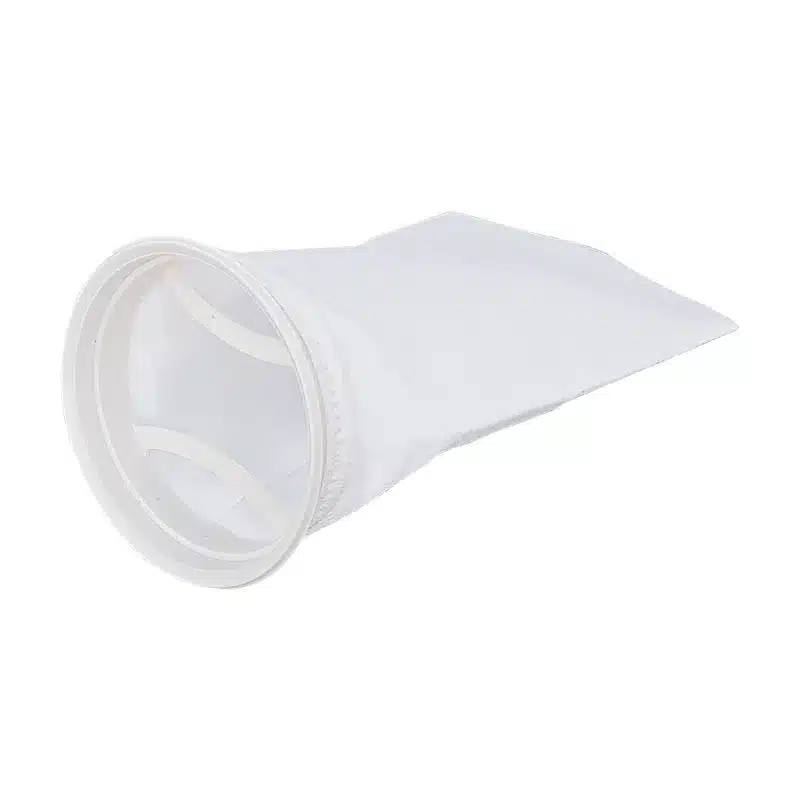
Polypropylene felt covers 1 to 300 µm, polyester felt 1 to 200 µm, nylon on request. The bag is supplied in sizes 1 to 4 and has a plastic ring at the top that holds it in shape.
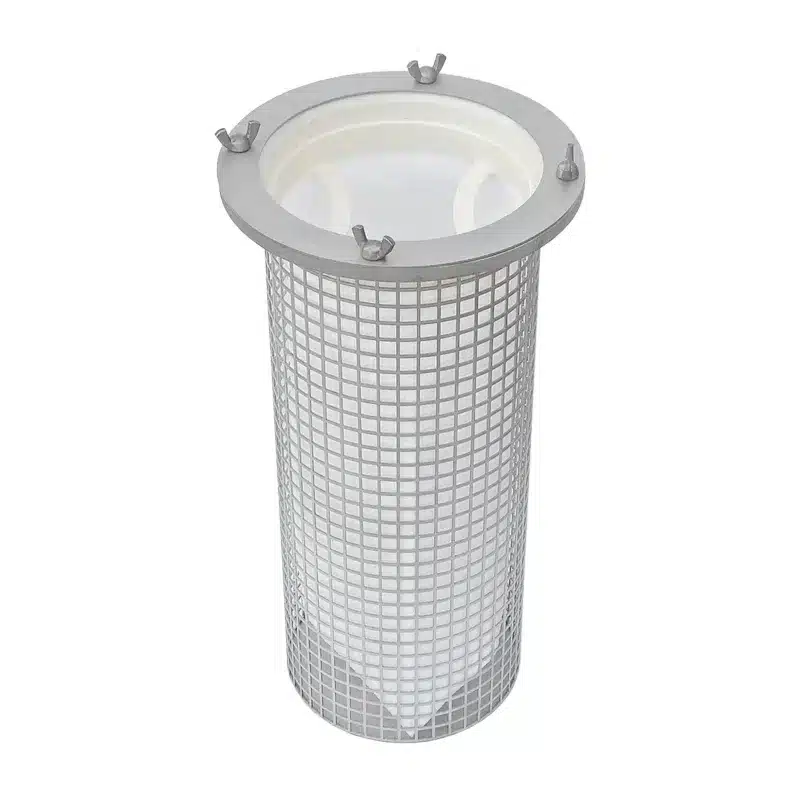
The support basket remains what it is: the load-bearing part. It takes up the pressure, the bag does the separation. That is why you can switch between screen and bag without changing anything on the strainer.

Both together are possible and often sensible: the screen retains coarse particles and protects the bag, the bag filters fine. This way the more expensive stage lasts longer.
Two things are different from a screen. The bag is replaced, not cleaned – it is a replacement part, not a permanent component. And the pressure rating in this design is up to 10 bar, whereas a basket strainer goes up to PN40. Where both come together – fine separation and high pressure – pleated wire mesh is the better choice.
Perforated plate, wire mesh, witch hat strainer or flat plate strainer – made to your filtration grade, optionally with support mesh.


Typical designs as a first orientation – not a specification. The final filtration grade depends on the component to be protected, the flow rate and the dirt load and can deviate upwards or downwards.
| Medium | Mesh size |
|---|---|
| Condensate | 0.05 mm (50 µm) |
| Nitrogen and gases | 0.05 mm (50 µm) |
| Diesel, fuels | 0.09 mm (90 µm) |
| Glycol | 0.09 mm (90 µm) |
| Hydrogen | 0.1 mm (100 µm) |
| Acids and alkalis | 0.15 – 0.4 mm |
| Medium | Mesh size |
|---|---|
| Steam | 0.3 mm (300 µm) |
| Cooling and drinking water | 0.4 mm (400 µm) |
| Wastewater | 0.5 mm (500 µm) |
| Process water | 1 mm (1,000 µm) |
| Seawater | 1.5 – 2 mm |
| Slurries | Perforated plate 3 – 10 mm |
If the screen clogs too quickly, the mesh size is too fine for the actual dirt load or the screen area is too small. A coarser element or a larger strainer basket solves this without any work on the pipeline. If particles get through, a finer element is needed; the higher pressure drop then has to be taken into account.
Two limits of the design are fixed: a flow velocity in the housing of max. 2.5 m/s for water and a permissible differential pressure across the element of max. 2 bar. In operation we recommend no more than 0.5 bar. We also manufacture replacement screens for strainer housings from other manufacturers – to sample, drawing or dimensions.
Yes. Before production starts, you receive the design drawing for approval – the drawing also states the mesh size, screen construction and material of the element. The order goes into production only after you have approved it. We incorporate any requested changes beforehand.
Certainly. Drawings, specifications, parts lists or the data sheet of the previous strainer are the best basis. Our design engineers adopt your requirements and adapt them where production or the applicable code requires – we agree any deviations with you in advance.
From 10 mm to 0.05 mm (50 µm) in the standard range. Finer is possible: we manufacture strainer elements with 0.02 mm (20 µm) on request.
The mesh size is the clear width of the opening. The filtration grade describes which particle size is actually retained – it also depends on the type of mesh, the direction of flow and the dirt load.
Yes. The strainer element is exchangeable – a replacement element with a different mesh size fits into the existing housing as long as the design and dimensions remain the same. With the multi-part element, it is even enough to replace the cylindrical screen; the support basket stays in the strainer.
Medium, component to be protected, flow rate, operating pressure and temperature. If the mesh size has not yet been defined, we derive it from these.
Yes – to sample, drawing or dimensions, also for strainer housings from other manufacturers.
All topics at a glance: Strainer options
Tell us the medium, the component to be protected and the flow rate – we derive the right filtration grade and design the screen and screen area together.