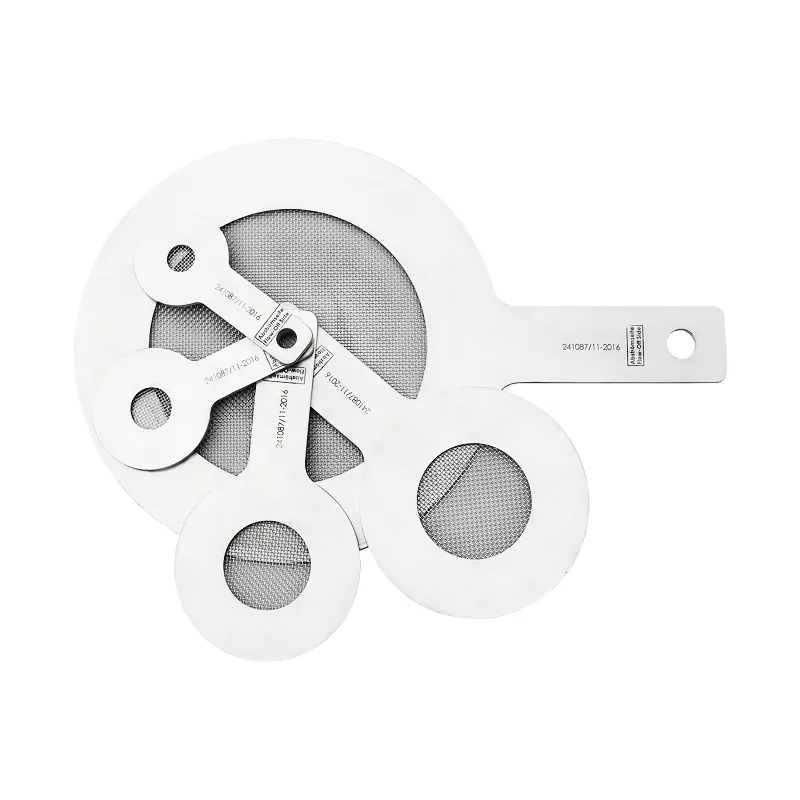
Flat plate strainer · Temporary strainer
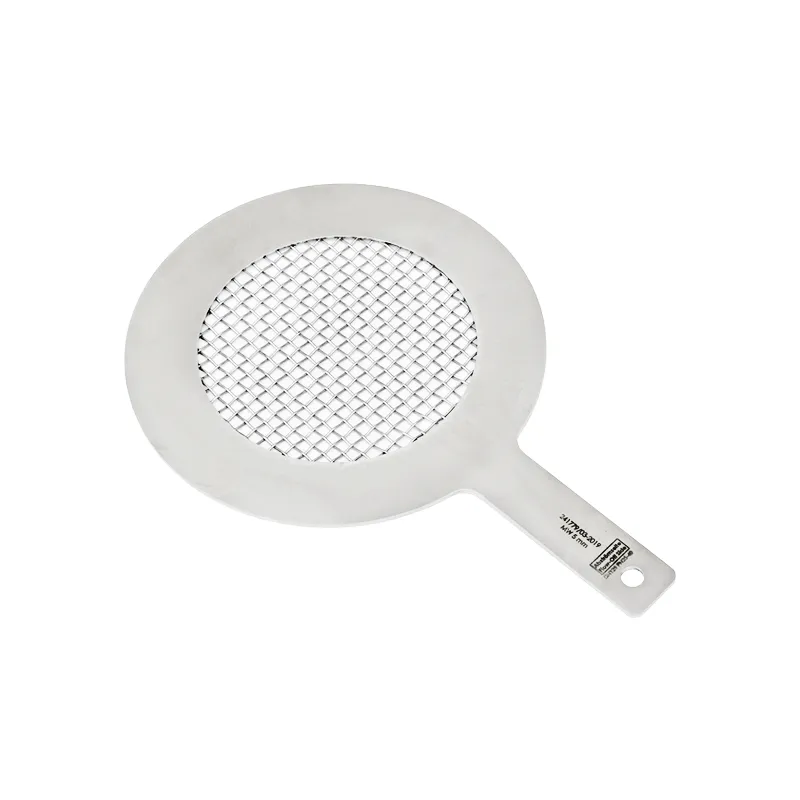
The flat plate strainer (plate strainer) is a flat screen ring with internal stainless steel wire mesh. It is clamped between two standard flanges as a wafer-type strainer. It is so thin that the pipeline practically does not get longer – and it can be removed just as quickly.
That is the difference from the witch hat strainer: less screen area, but the flat plate strainer fits anywhere, even close behind a bend or directly upstream of a valve.
Operating principle
The flat plate strainer is inserted between two flanges. The line stays as it is: there is no additional face-to-face length, and you do not need a separate fitting. The flange bolts hold the screen ring in position.
The medium flows through the ring and passes through the wire mesh. Particles are retained in the mesh. The handle protrudes between the flanges and shows from the outside that a strainer is in the line.
A flange gasket sits on each side of the screen ring. It compensates the sealing face and seals the joint. We select gaskets to suit nominal size, pressure rating and medium. They are available separately and are not included in the scope of supply of the strainer.

Selection
The flat plate strainer is not the strainer with the largest area – it is the one with the smallest space requirement. Four situations speak in its favour.
Between a bend and a valve there are often only a few centimetres. A flat plate strainer needs hardly more space than the flange gasket it replaces.
Loosen the flanges, pull the strainer, rinse it, insert it again. No cone gets caught, and no additional clearance is needed.
Where particles are only expected occasionally, the smaller area is sufficient. If you expect a lot of dirt, the witch hat strainer is the better choice.
For larger nominal sizes, the mesh is additionally supported by a perforated plate – otherwise the free area would not withstand the differential pressure.
Construction
The screen ring in stainless steel 1.4301 performs the sealing function between the flanges. The wire mesh lies on the inside – so the flow presses it against the ring rather than away from it.
The handle is more than a grip: it shows from the outside that a strainer is installed. Without it, it is easily forgotten at the next modification that something is still in the line.
Designs
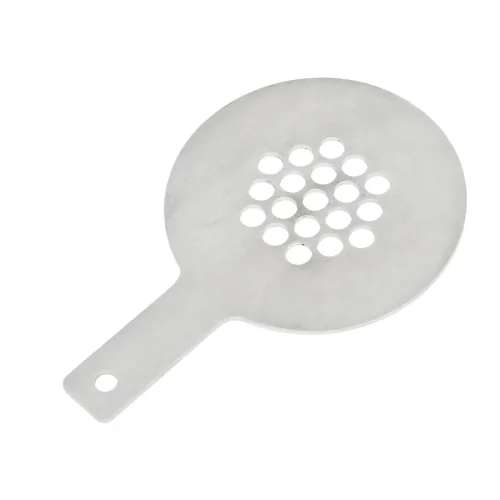
The standard is 1.0 mm. For the start-up phase it may be finer, in continuous operation coarser. We manufacture elements from 0.05 to 10 mm – also as drilled perforated plate if only coarse particles are concerned.
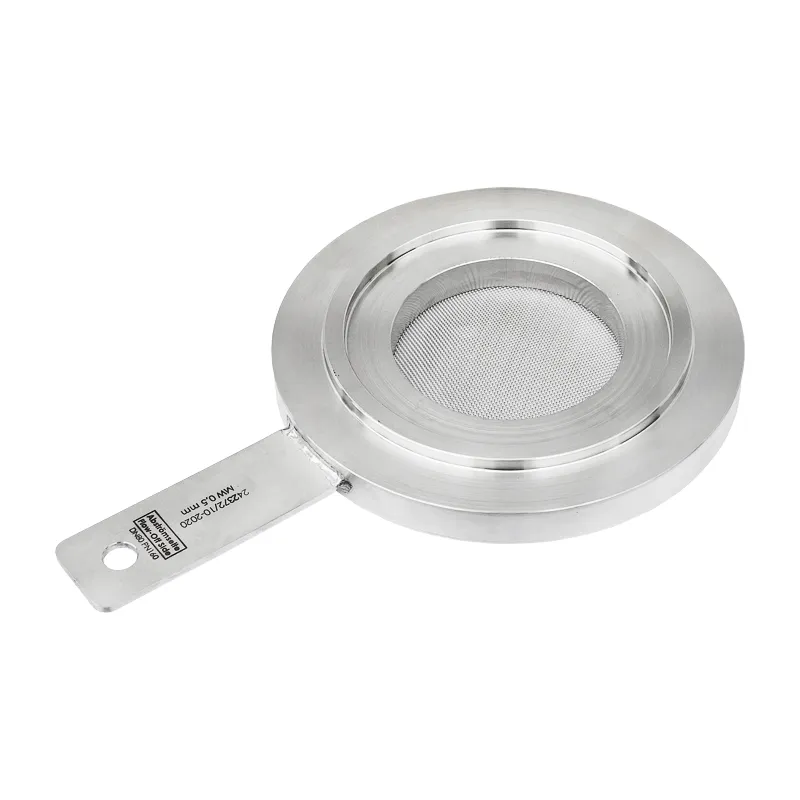
We make the screen ring to match the tongue and groove form of your flanges. The gasket thus stays in position, even when temperature and pressure change.
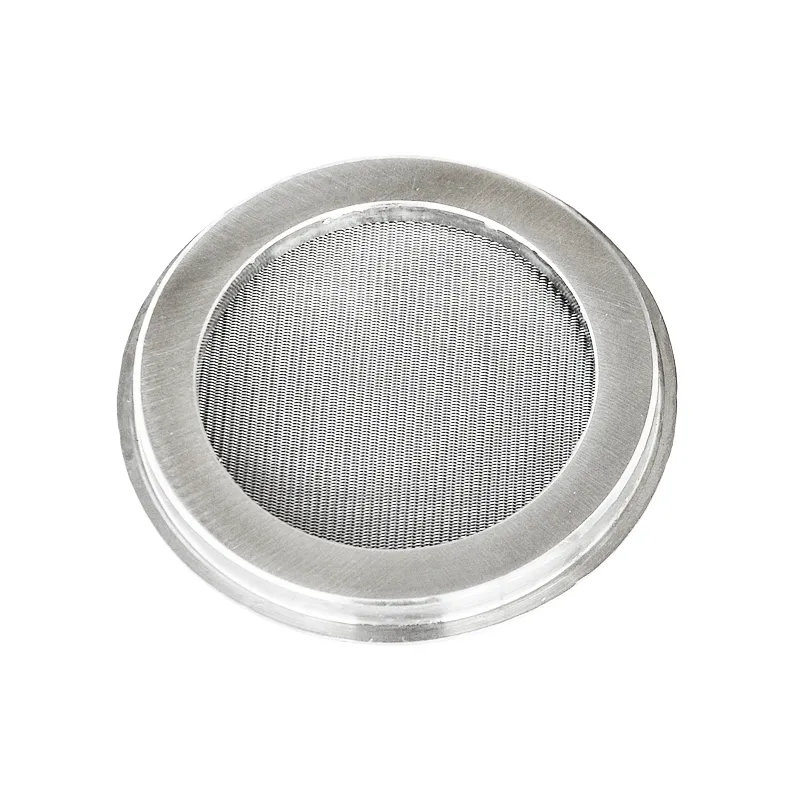
For pipe unions to DIN 11851, the ring receives the matching connection. The strainer fits into existing lines in food and beverage processing without an adapter.
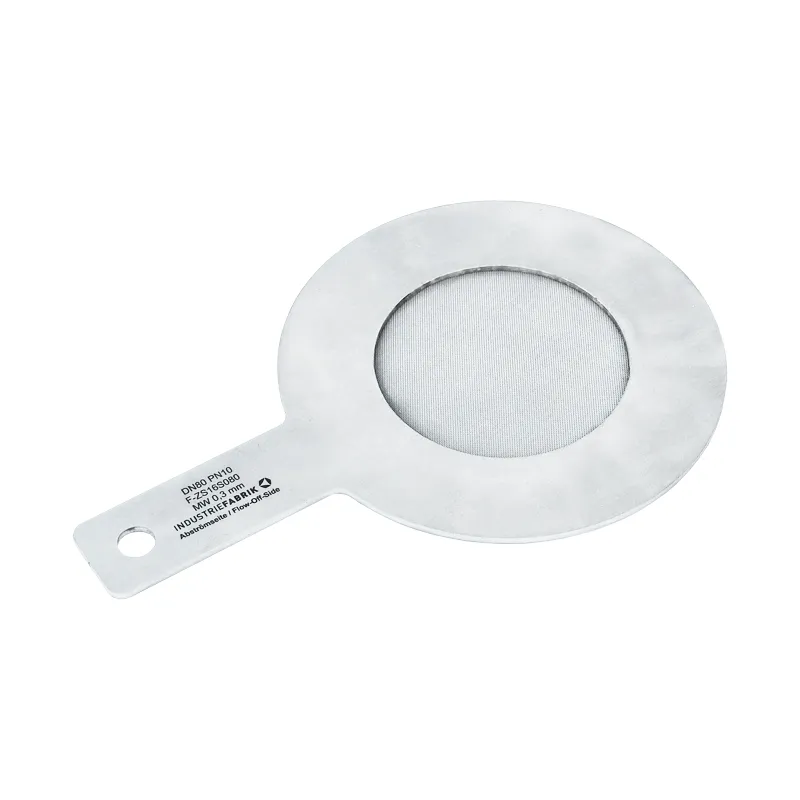
We mark the screen ring permanently by laser: nominal size, mesh size or your plant identification. The marking remains legible after cleaning. This saves re-measuring on reinstallation.
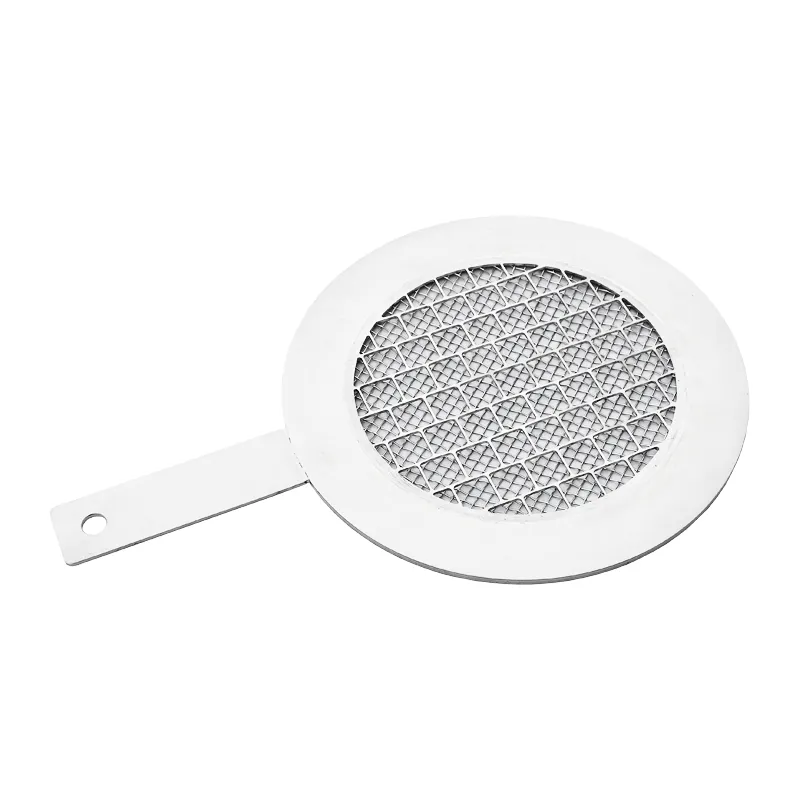
If the differential pressure rises, we make the ring and mesh heavier and additionally support the strainer with perforated plate. We match the design to your operating point.
Dimensions
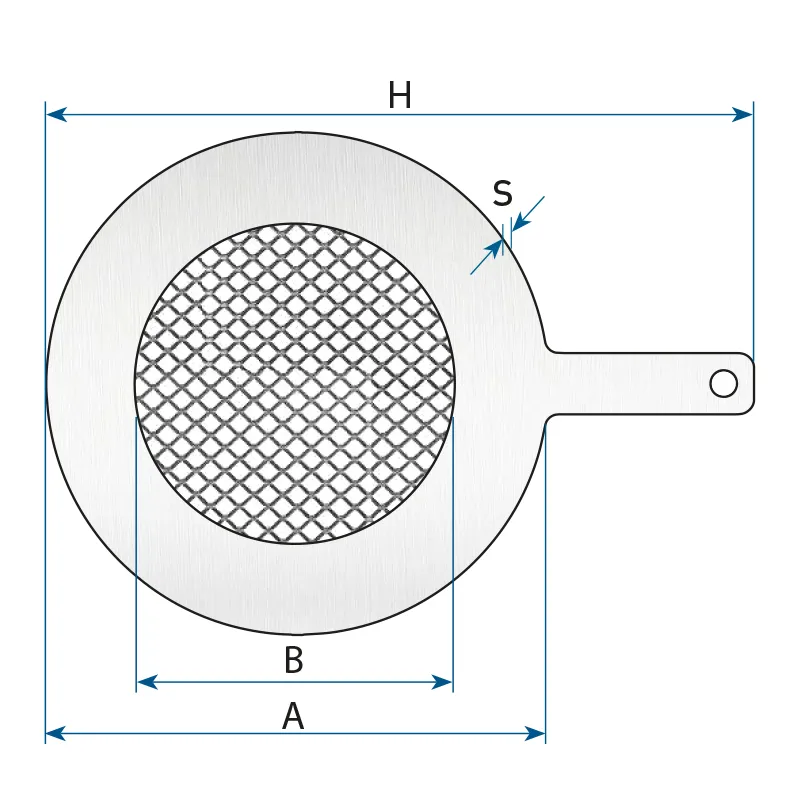
∅ A is the outside diameter of the screen ring, ∅ B the free passage. Both depend on the pressure rating. The overall height H includes the handle – from DN100 it differs depending on the pressure rating.
| DN | PN10 ∅A/B | PN16 ∅A/B | PN25 ∅A/B | PN40 ∅A/B | Height H | Thickness S |
|---|---|---|---|---|---|---|
| DN15 | 50/15 | 50/15 | 50/15 | 50/15 | 120 | 3 |
| DN20 | 60/20 | 60/20 | 60/20 | 60/20 | 129 | 3 |
| DN25 | 70/25 | 70/25 | 70/25 | 70/25 | 138 | 3 |
| DN32 | 81/32 | 81/32 | 81/32 | 81/32 | 151 | 3 |
| DN40 | 91/40 | 91/40 | 91/40 | 91/40 | 168 | 3 |
| DN50 | 106/50 | 106/50 | 106/50 | 106/50 | 181 | 3 |
| DN65 | 126/65 | 126/65 | 126/65 | 126/65 | 201 | 3 |
| DN80 | 141/80 | 141/80 | 141/80 | 141/80 | 216 | 3 |
| DN100 | 161/100 | 161/100 | 167/100 | 167/100 | 246 · 256 | 3 |
| DN125 | 191/128 | 191/128 | 193/128 | 193/128 | 281 · 293 | 3 |
| DN150 | 217/156 | 217/156 | 223/156 | 223/156 | 312 · 323 | 3 |
| DN200 | 272/202 | 272/202 | 283/202 | 288/202 | 407 · 422 · 433 | 5 |
| DN250 | 327/256 | 328/256 | 339/254 | 351/254 | 462 · 467 · 483 · 501 | 5 |
| DN300 | 377/306 | 383/306 | 399/304 | 416/304 | 512 · 522 · 543 · 566 | 5 |
| DN350 | 437/338 | 443/336 | 456/336 | 473/334 | 572 · 582 · 607 · 628 | 5 |
All dimensions in millimetres. Where several values are given for the height, they apply in ascending order to PN10, PN16, PN25 and PN40. Larger nominal sizes and higher pressure ratings are available on request.
Sealing face
The flat plate strainer sits with its screen ring between two flanges. The ring must therefore match the sealing face of the flanges. As standard, the ring is flat. For flanges with a groove or tongue to DIN EN 1092-1, we manufacture it in the mating form. If the flange has a tongue, the ring receives a groove on that side – and vice versa.
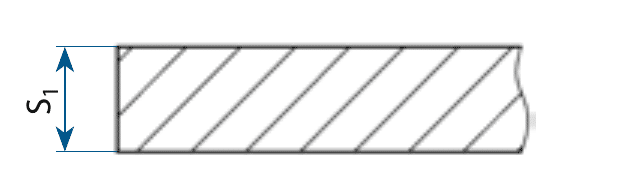
Flat · Standard
The screen ring is flat on both sides. It fits flanges with a flat face or a raised face.
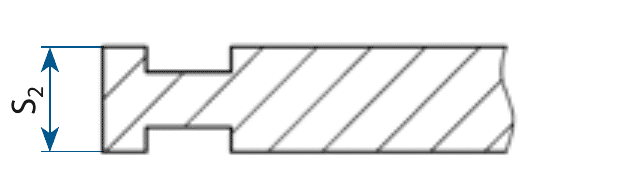
Groove – groove
A groove on both sides. The ring sits between two flanges with a tongue.

Groove – tongue
A groove on one side, a tongue on the other. This is the form for the usual tongue and groove joint made up of one tongue flange and one groove flange.

Tongue – tongue
A tongue on both sides. The ring sits between two flanges with a groove.
The drawings show the cross-section at the sealing face.
For tongue and groove, we make the screen ring in a reinforced design. Tongue and groove need material that the flat ring does not have. We state the dimensions in our quotation.
For removal and installation, the flanges have to be spread slightly further apart until tongue and groove are clear. Allow for this travel in the pipeline.
Tell us the sealing faces of your flanges, for example Form C and Form D to DIN EN 1092-1. We then manufacture the flat plate strainer in the matching mating form.
Enquiry
Nominal size, pressure rating and mesh size are sufficient for a quotation. Special designs such as tongue and groove or the connection for a dairy pipe union are selected per item. Add further sizes with “+ further item”.
In the shop
For standard sizes, the shop is the quicker route. You select nominal size, pressure rating and mesh size and add the strainer straight to your shopping basket.
To the flat plate strainer in the shop →
Direct
+49 34956 39960
Monday to Friday, 7 am to 4 pm (CET)
You can reach us by email at info@industriefabrik.com.
Frequently asked questions
The flat plate strainer fits anywhere and is changed quickly, but only has the area of the pipe cross-section. The witch hat strainer offers a multiple of that, but projects into the line. Rule of thumb: little space or little dirt → flat plate strainer; a lot of dirt and space available → witch hat strainer.
No. The mesh lies on the inside of the ring and the design is symmetrical – unlike the witch hat strainer, there is no preferred direction. Installation position horizontal or vertical.
From this nominal size, the strainer receives a perforated plate insert as support body. Otherwise the free mesh area would be too large to withstand the differential pressure. From DN200 the material thickness also increases to 5 mm.
Yes, with flanges to DIN EN 1092-1 – the ring is clamped between the sealing faces, the bolts remain the same. For ANSI flanges to B 16.5 we make the ring dimensions to suit.
Yes. Outside diameter, free passage, overall height and mesh size are sufficient. A photo of the old part shows us the design of the rim and handle.
For a quotation we need nominal size, pressure rating and the required mesh size. For reproductions, the dimensions of the old part are sufficient. Standard sizes are available directly in the catalogue.