Home › Applications › Wastewater
Applications
Wastewater brings everything with it: solids, fibres, grease and sand, plus a changing composition. With a wastewater strainer, what counts is not the finest separation but a strainer that holds a lot and can be emptied again quickly.
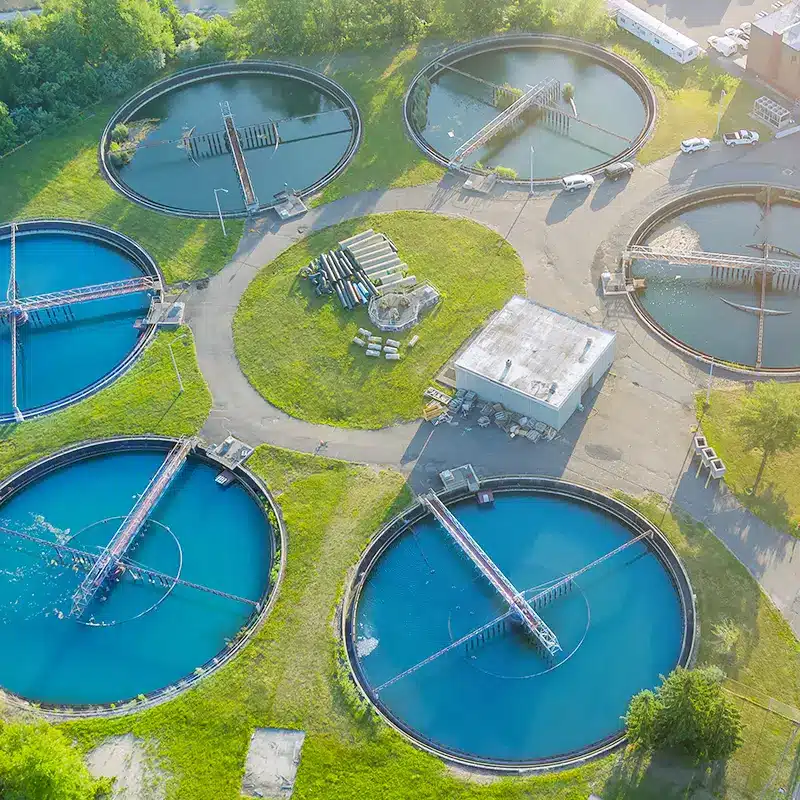
the coarsest separation
Perforated plate instead of wire mesh
Access and drain
Stainless steel or coated
In wastewater lines the dirt load is high and fluctuates. A strainer designed for the average load clogs at the first peak. That is why the design starts with the question of the maximum – and with cleaning, not with the filtration grade.
Separation here is at the coarse end of what we build: perforated plate instead of wire mesh, because fibres, textile residues and grease get caught in any mesh. Coarse perforated plate can be scraped off and rinsed out without damage and keeps its shape even under uneven loading.
The third point is the material. Wastewater is rarely neutral – depending on its origin, it contains chlorides, acids or cleaning agents. Stainless steel is therefore the rule; where carbon steel is sufficient, it is primed and painted with a coating system that suits the environment.
In the wastewater line, the strainer sits upstream of components that are sensitive to coarse matter.
Area and access beat any filtration grade here.
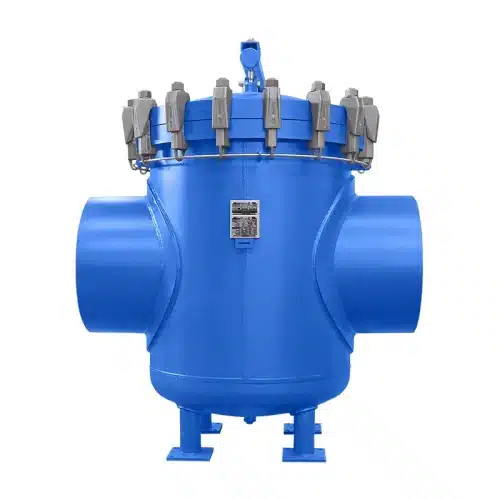
The pot-shaped design holds large quantities of solids before the differential pressure rises. The strainer basket can be removed as a whole, emptied and rinsed out – with wastewater, the decisive advantage over designs with a permanently installed element.
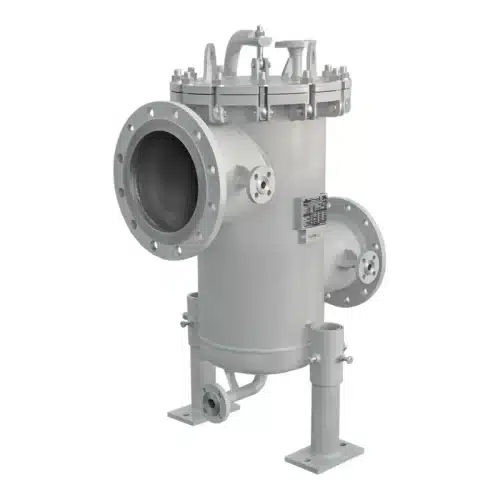
For smaller lines: strainer element as coarse perforated plate instead of wire mesh, housing in stainless steel or painted carbon steel. The design follows the dirt load, not the nominal size of the line.
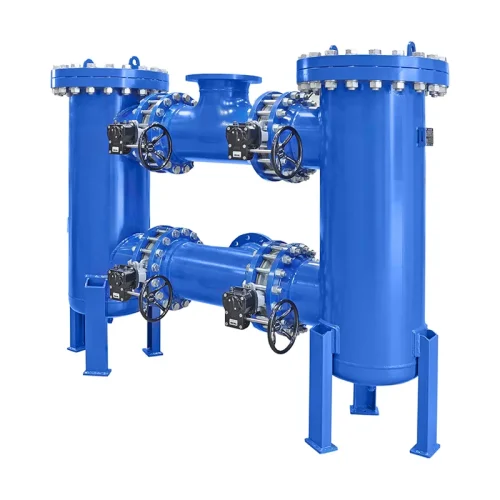
Two chambers with changeover: one is cleared out while the other is working. Useful wherever the inflow cannot be shut off – in sewage treatment plants and in production with continuous discharge.
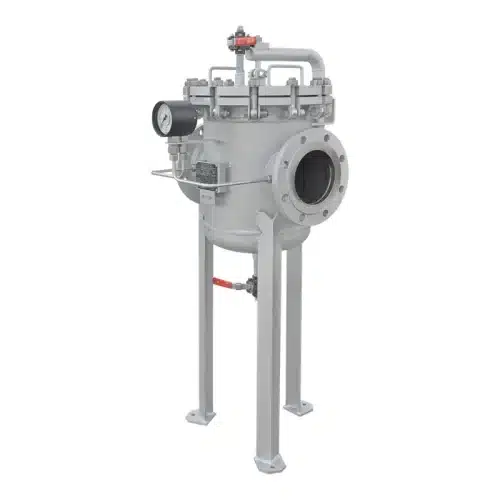
What is needed is a tool-free closure and a cover that stays on the unit via hinge or swivel arm. Plus support legs for the considerable operating weight and a generously sized drain at the lowest point. With wastewater, a ball valve is the better choice there than a plug.
Design ranges for wastewater applications.
| Feature or example | Value | Note |
|---|---|---|
Design | ||
| First parameter | Peak load | not the average value |
| Strainer element | Perforated plate, coarse | wire mesh snags on fibres |
| Screen area | generous | extends the cleaning interval |
| Differential pressure | max. 2 bar | in operation, max. 0.5 bar recommended |
Material and surface | ||
| Standard case | Stainless steel 1.4571 | pickled and passivated |
| With chlorides | Duplex | higher resistance |
| Carbon steel design | primed and painted | coating system to corrosivity category |
| Gasket | EPDM · graphite | to suit medium and temperature |
Handling | ||
| Closure | Hinged eye bolts | opens without tools |
| Cover | Hinge or swivel arm | stays on the strainer |
| Drain | Ball valve instead of plug | at the lowest point |
| Support legs | usually required | high operating weight |
Wastewater does not arrive evenly. A cleaning batch from production, a heavy rainfall, the emptying of a basin – events like these bring more load in one hour than the previous days together. A strainer designed for the average then clogs, and the flow backs up. The design therefore starts with the expected peak and with the question of how quickly the strainer can be emptied again afterwards. Both together determine the size – and thus a strainer that works even on the most unfavourable day.
The coarsest separation in our range – as a rule perforated plate instead of wire mesh. Exactly how coarse depends on the component downstream: a submersible pump tolerates different particles than a dosing point. Tell us the component to be protected.
Because fibres, textile residues and grease get caught in it and are hard to remove. Coarse perforated plate can be scraped off and rinsed out. Where finer separation is also needed, we combine perforated plate as a support basket with a fine mesh screen.
As a rule stainless steel 1.4571, pickled and passivated – wastewater is rarely neutral. With high chloride contents, duplex comes into consideration. Painted carbon steel is possible where the composition is known and uncritical; we then select the coating system according to the corrosivity category of the environment.
The strainer basket is removed as a whole, emptied and rinsed out. To make this quick, a tool-free closure and a cover that stays on the strainer are part of the design. On large units, a lifting and swivel device is added.
Then it will be a duplex strainer. Two chambers, one in operation, one on standby: switch over, clear out, switch back – the flow continues without interruption.
Yes. Before production starts, you receive the design drawing for approval – with design data, materials, mesh size and attachments. Only after your confirmation does the order go into production.
Tell us the origin and composition of the wastewater, the flow rate, the expected peak load and the component to be protected.