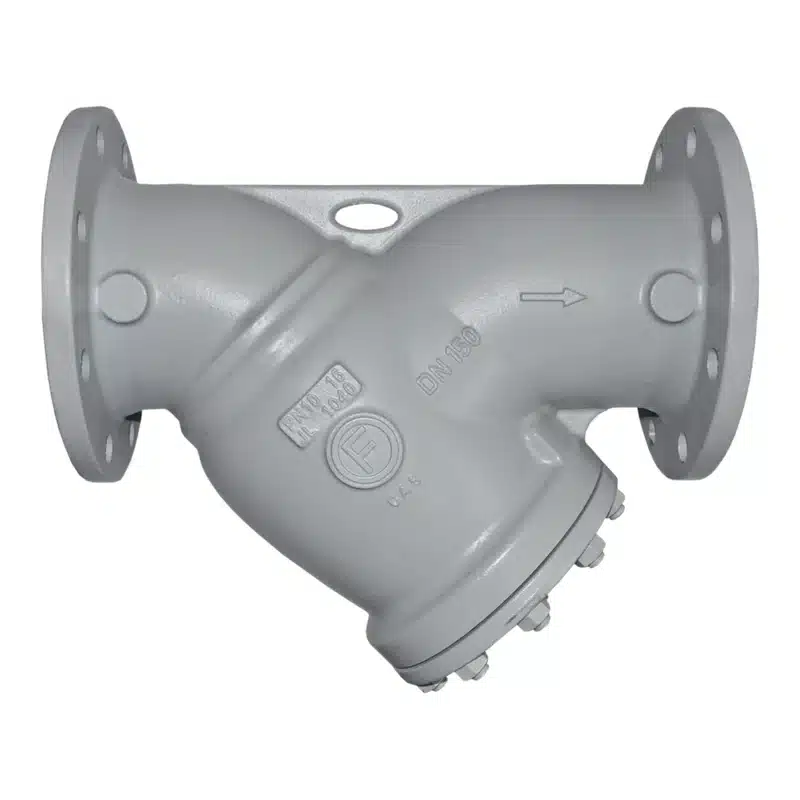
Y strainer · Y-pattern strainer
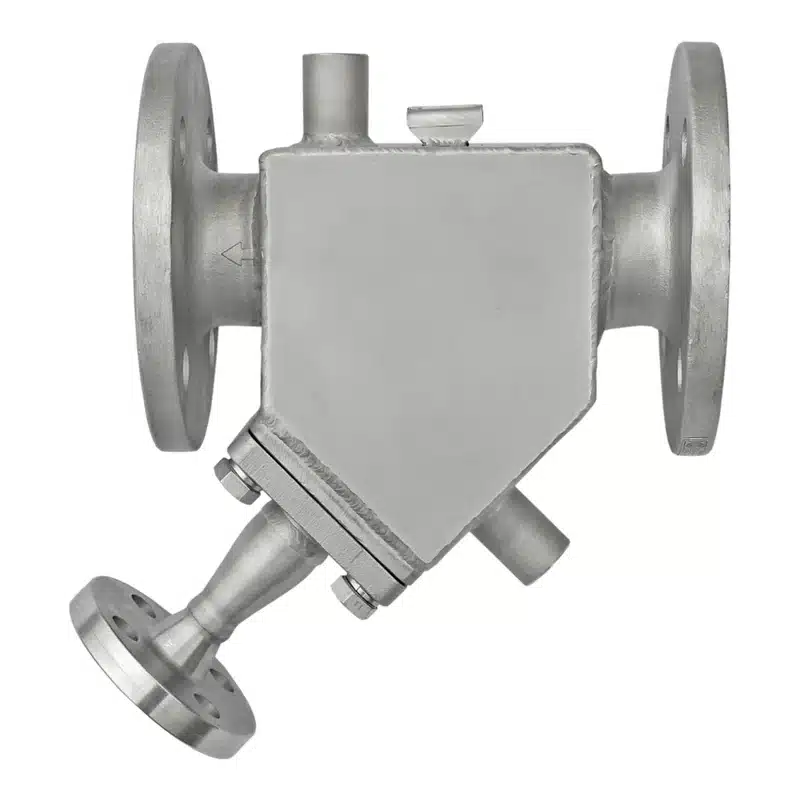
The most widely used strainer of all: a Y-shaped housing with an angled strainer element, installed directly in the pipeline. It is short, needs little space and is available from DN10 to DN500.
With the Y strainer, there are two routes to the goal: housings in cast iron, stainless steel or brass from our supply range – and adaptation to your process in our own workshop. You get both from us. As a pipeline strainer it protects pumps, valves and meters. This makes it the standard strainer for industry.
ISO 9001 · TÜV-approved welding shop AD2000-HP0 · PED 2014/68/EU
Operating principle
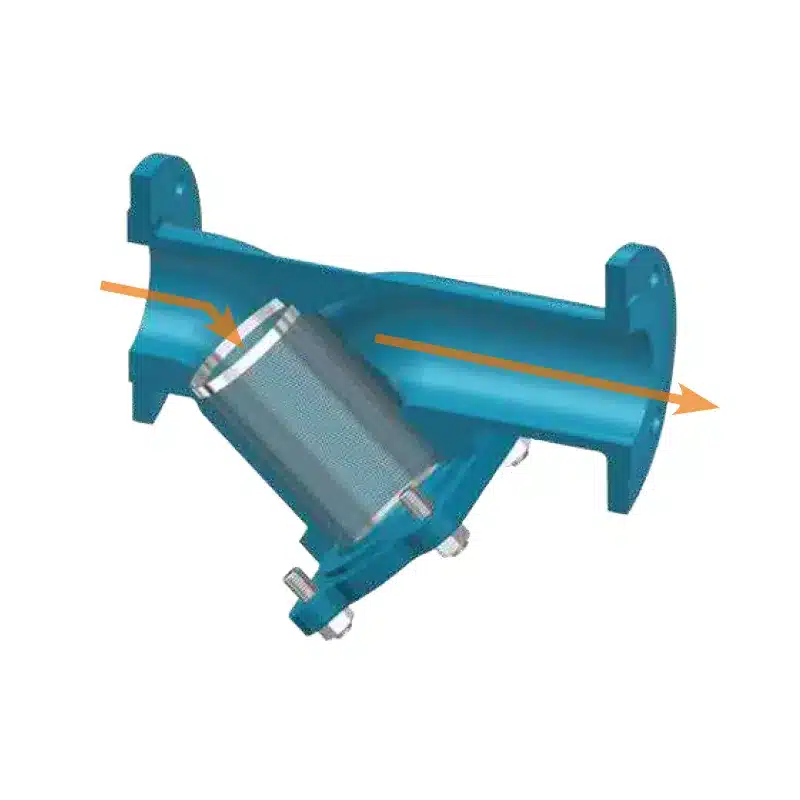
The medium flows straight through; the strainer element sits in the angled leg of the Y. Whatever is retained collects there and is removed together with the screen when the screwed cap is opened.
This shape has two advantages: the strainer needs hardly more face-to-face length than a fitting, and the screen can be cleaned without dismantling the line. On the other hand, the screen area is smaller than in a basket strainer – the Y strainer is the choice for protecting a component, not for a high dirt load.
Names
Because the strainer element sits at an angle to the flow, this design is also called a Y-pattern strainer or wye strainer. Other common names are Y type strainer and Y filter.
A note to avoid confusion: “Y-pattern” on its own usually refers to a valve, not a strainer. If you are looking for a strainer, include the addition – Y-pattern strainer or Y strainer.
Materials
Unlike the welded designs, the Y strainer mainly comes with a cast housing. This makes it economical in small nominal sizes and allows shapes that could hardly be produced by welding.
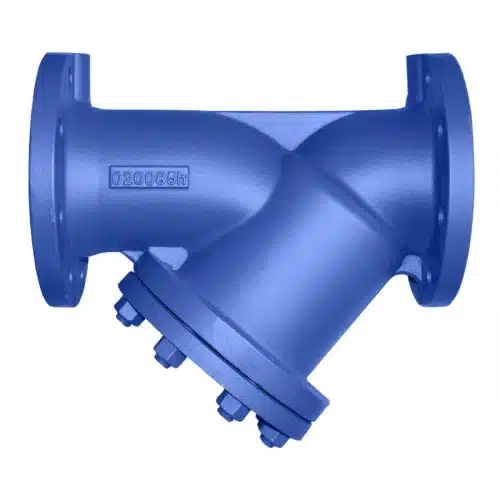
Grey cast iron, ductile iron and cast steel cover most applications – from the heating system to the process line. Ductile iron is used where higher pressures and temperature changes come together.
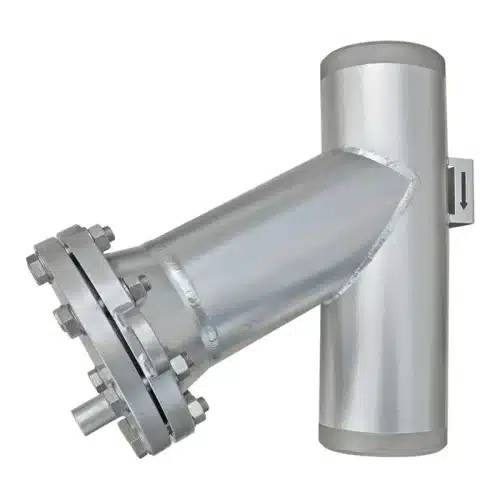
For media where cast iron reaches its limits: acids, alkalis, high-purity media. Also available as a welded design with butt-weld ends instead of flanges.
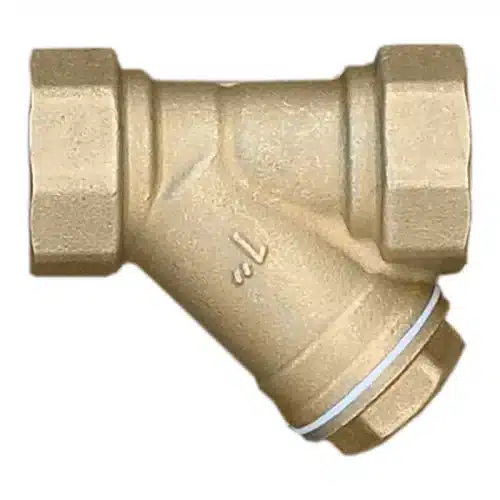
In small nominal sizes and with threaded connections, the most compact and economical design. It is common in building services and on branch lines.
Connection is by flange to DIN EN 1092-1, butt-weld end or thread; the face-to-face length follows EN 558, or a special length on request. ANSI designs are also possible.
Strainer element
The strainer element determines what is retained. It is also the part that wears. Four versions cover the range from coarse to fine:
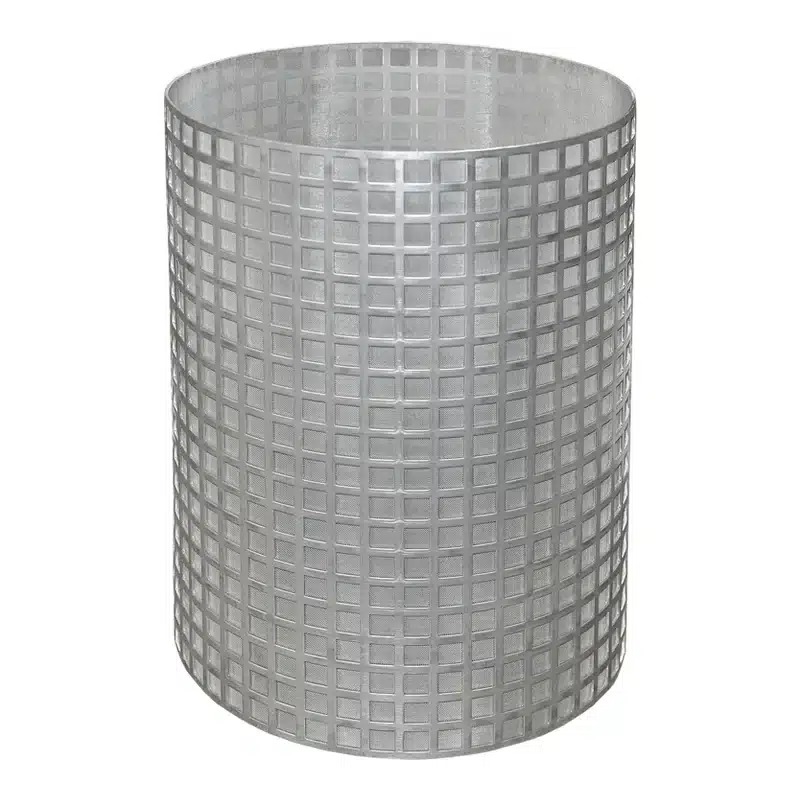
The mesh size ranges from 0.05 to 10 mm. The right filtration grade depends on the component downstream – explained under Selecting the mesh size for the Y strainer →.
Two routes
With the Y strainer, we work differently from our welded ranges. There is a simple reason: for this design there is a wide, proven range of cast housings. Reinventing it would be more expensive for you and no better.
First
We supply Y strainers from leading valve manufacturers. These include Fromme in grey cast iron, cast steel and stainless steel from DN15 to DN300 and ARI in various cast materials up to DN500. KSB supplies the BOA-S and BOACHEM-FSA series up to DN400. All series are available in PN10 to PN40.
Which make fits depends on medium, pressure rating and connection – and on what is already installed in your plant. Uniformity saves spare parts later.
Second
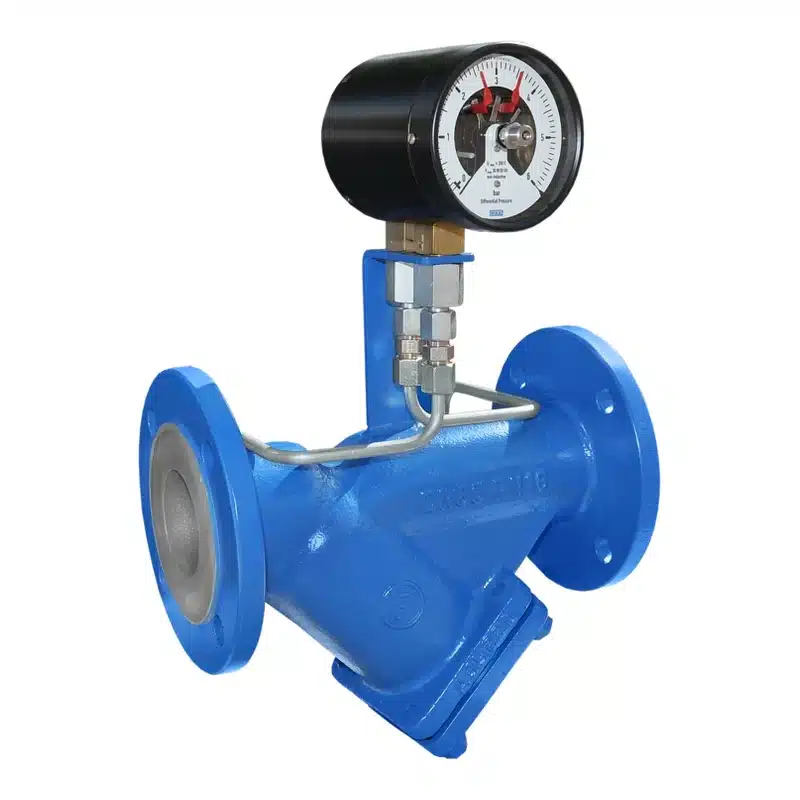
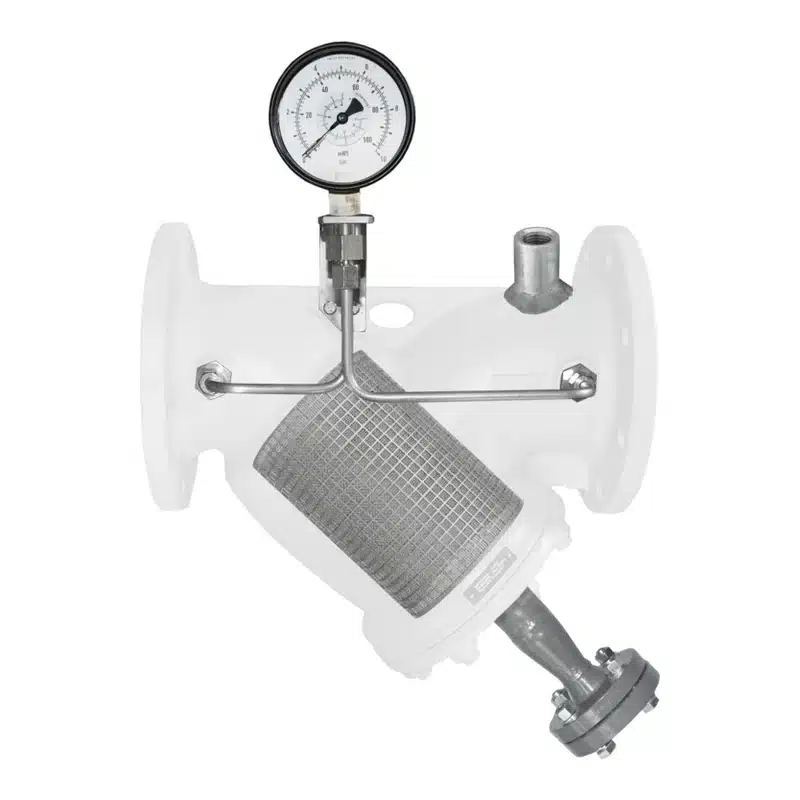
Whatever the standard housing does not include, we add: differential pressure gauges, operating pressure gauges, drain and vent sockets or flanges, custom connections and other gaskets. In addition, a welded heating jacket if the medium has to stay warm.
This explicitly also applies to units not supplied by us. If you want to retrofit an existing strainer or need a replacement screen, you do not have to replace the strainer.
Modification and replacement
The most frequent case is the replacement screen. It wears, tears or has become too coarse for the task – the housing, on the other hand, lasts for decades. We make strainer elements to sample or to size, from a diameter of about 60 mm, also for makes that no longer exist in this form.
For a replacement screen, the dimensions of the old part are enough: outside diameter, height, edge design and the required mesh size. A photo helps to identify the design.
Heated design
Media that become viscous or solidify when they cool down need heat in the strainer as well. Otherwise clogging occurs precisely where the cross-section is narrowest. The heating jacket is placed around the housing and operated with steam, hot water or thermal oil.
With the Y strainer this is almost always custom work: the cast housing comes without a jacket, and we design one for it. This applies to our own housings as well as to housings from other suppliers.
Design parameters
Range across all versions. The exact dimensions depend on material and make – we will give them to you for the selected version.
Higher pressure ratings, different face-to-face lengths and special mesh sizes are available on request. We compile certificates and approvals to suit the applicable code.

Applications
Above all where a single component has to be protected and little dirt is expected: upstream of pumps, valves, meters and heat exchangers. It is the standard protection in the line – small, economical and suitable for installation almost anywhere.
Where more dirt is expected or longer intervals between two cleanings are wanted, a basket strainer is the better choice – it offers many times the screen area.
Why us
The advantage does not lie in the housing – that is available from many sources. It lies in the fact that selection, add-ons, replacement screen and heating jacket come from a single source. If you buy the strainer from us, you will later also get the matching screen without having to identify the design again.
We weld our own ranges ourselves. That is why we can judge when the Y strainer is the right choice and when a basket strainer works more economically. You receive this advice before you order.

Enquiry
Tell us the nominal size, pressure rating and medium. We then select the housing material and strainer element. If an existing strainer is to be adapted, select this under “Request type” and feel free to upload a photo. Add further sizes with “+ further item”.
Direct
+49 34956 39960
Monday to Friday, 7 am to 4 pm (CET)
You can reach us by email at info@industriefabrik.com.
For printing
Prefer to work on paper? Fill in the form (in German) and send it back to us by email.
Yes. Y strainer, Y-pattern strainer, Y filter and Y type strainer denote the same design. Just make sure to include the addition: “Y-pattern” on its own usually means a valve, not a strainer.
For the Y strainer, we mainly supply housings from a proven range by recognised manufacturers – for this design that is the more economical route. What we do ourselves is the adaptation: attachments, replacement screens, heating jacket, gaskets. Our own welded ranges are the basket strainer, the simplex strainer and the duplex strainer.
Yes, this is one of our most frequent orders. We make strainer elements to sample or to size from a diameter of about 60 mm – also for units that no longer exist in this form. We need the outside diameter, height, edge design and mesh size; a photo also helps.
When there is a lot of dirt. The screen area is small in relation to the nominal size, so it clogs faster than a basket strainer. Where frequent cleaning would be needed or downtime is a problem, the basket strainer or directly the duplex strainer is the right choice.
Horizontal and vertical are both possible. What matters is the position of the screen leg: it should point downwards so that the dirt collects there and falls out when the strainer is opened. If it points upwards, medium remains in the screen when it is opened.
Yes, with a heating jacket for steam, hot water or thermal oil. Because cast housings come without a jacket, this is custom work – we design one for it, also on existing housings.
All basic types compared: Industrial strainers →
Screens for Y strainers are made to order – from 60 mm outside diameter, with a matching gasket. We also replace dented or clogged screens for other manufacturers’ strainers. To the spare part →
Tell us the nominal size, medium, pressure rating and temperature – and whether an existing unit is to be upgraded or a new one supplied. You will receive a proposal with material, connection and mesh size. If it is only about a replacement screen, the dimensions of the old part are enough.