Home › Applications › Chemicals, acids and alkalis
Applications
With a chemical strainer, the mesh size is the lesser question. Whether acid strainer or alkali strainer: what matters is which material withstands the medium at your concentration and temperature – and which documentation the installation requires.
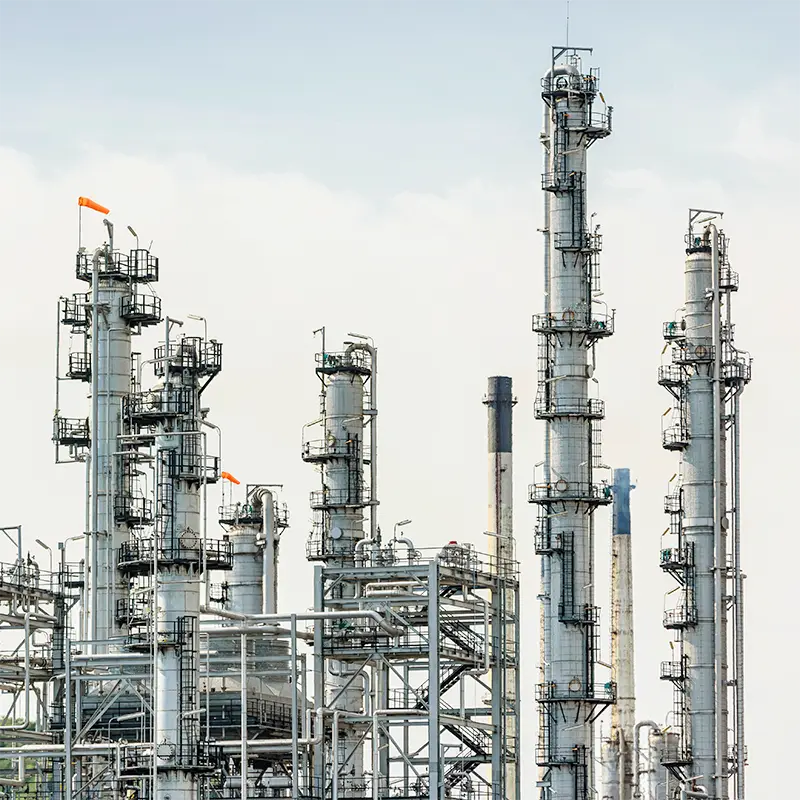
Material compatibility
1.4571 · 1.4404 · Duplex
up to +150 °C, fluid group 1
Vacuum down to −0.1 bar
For acids, alkalis and solvents there is no meaningful mesh size recommendation per medium – and that is technically correct. A strainer made of the wrong material fails regardless of how fine its screen is. Selection therefore starts with resistance: 1.4404 and 1.4571 cover a great deal; with chlorides and at higher temperatures, duplex, Hastelloy, Alloy 20 or Monel come into consideration.
It is not only the medium that counts, but the combination of concentration and temperature. The same acid is uncritical when dilute and cold; concentrated and hot, it attacks austenitic stainless steel. That is why we always ask for both – and in case of doubt we check against a corrosion resistance chart instead of estimating.
The gasket follows the same logic. Viton, PTFE and graphite cover different ranges; the gasket is often the component that sets the limit of the strainer – not the housing.
In the chemical industry, strainers sit upstream of components whose failure shuts down the whole line – and upstream of the product itself.
The design follows the process – the choice of material comes first.
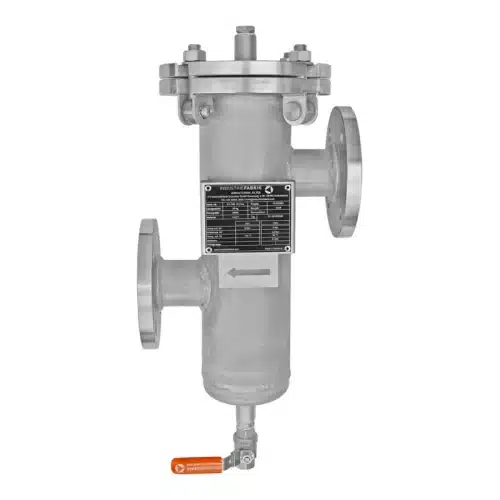
Design range: DN50 to DN80 in PN10 or PN16, stainless steel 1.4571 or 1.4404, mesh size 50 µm to 1 mm, closure as Tri-Clamp or clamp flange, gasket FKM, PTFE or EPDM. Designed for −10 to +110 °C and from −0.1 bar (vacuum) up to 10 bar.
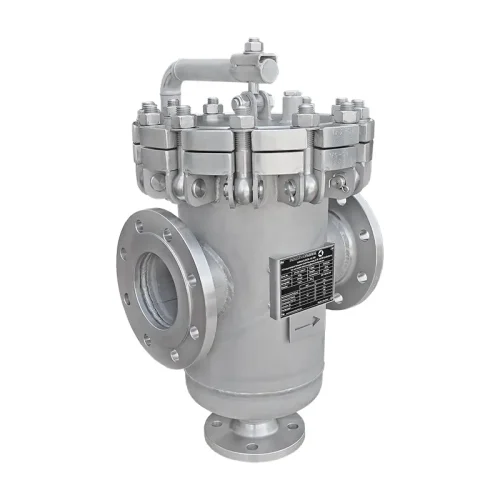
For larger flow rates and higher temperatures: DN50 to DN100 in PN16, stainless steel 1.4571, mesh size 400 to 1,000 µm, gasket as PTFE O-ring or graphite. Designed for −10 to +150 °C and 5 to 12 bar, also for fluid group 1.
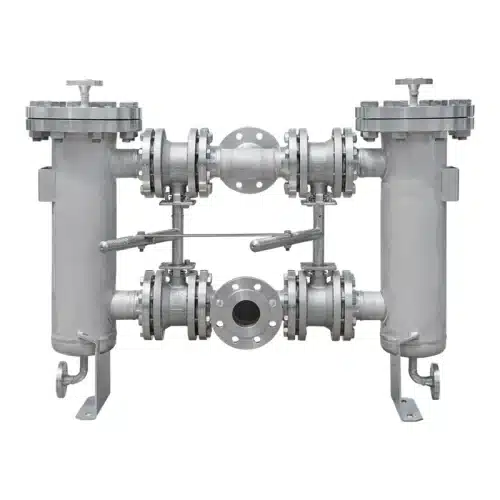
DN50 to DN100 in PN16, stainless steel 1.4571, mesh size 200 µm to 1 mm, changeover unit of four compact ball valves in stainless steel with PTFE seals. Inlet and outlet can be arranged on one side if the installation space requires it.
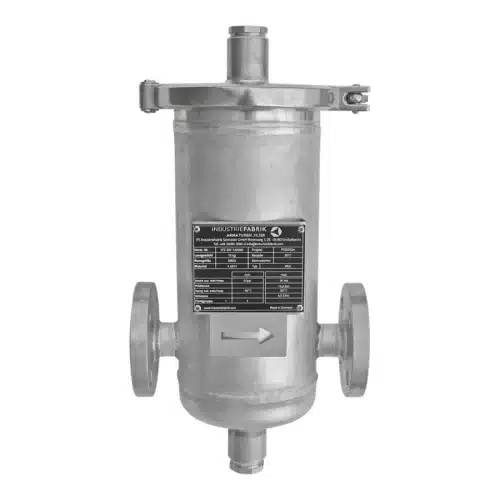
The range from DN25 to DN100 in PN10, stainless steel 1.4571 – in the Viton version up to +150 °C, and thus 30 kelvin above the standard version with EPDM. Ultra-fine screen from 20 µm, aseptic clamp connection as quick-opening closure.
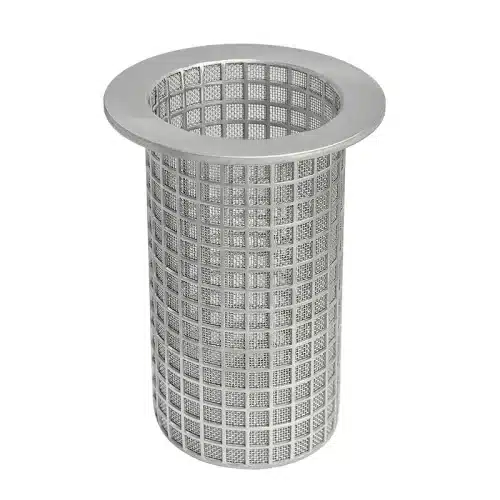
Under vacuum, the pressure difference acts on the basket from the outside. For this we build the element as a double basket and additionally place a fine mesh screen in the bottom – designed from −0.1 bar.
Ranges and examples from our production for chemicals, acids and alkalis.
| Feature or example | Value | Note |
|---|---|---|
Materials | ||
| Standard stainless steel | 1.4571 · 1.4404 | covers many media |
| With chlorides | Duplex | higher pitting resistance |
| Special alloys | Hastelloy · Alloy 20 · Monel | after resistance check |
| Strainer element | 1.4301 · 1.4401 · 1.4404 | selectable separately from the housing |
Simplex strainer for acids and alkalis | ||
| Nominal size | DN50 – DN80 | PN10 · PN16 |
| Mesh size | 50 µm – 1 mm | to suit the protected component |
| Closure | Tri-Clamp · clamp flange | opens without tools |
| Gasket | FKM · PTFE · EPDM | to suit the medium |
| Design conditions | −10 … +110 °C · −0.1 to 10 bar | also vacuum |
Basket strainer for chemicals | ||
| Nominal size | DN50 – DN100 | PN16 |
| Mesh size | 400 – 1,000 µm | coarser for dispersions |
| Gasket | PTFE O-ring · graphite | to suit the temperature |
| Design conditions | −10 … +150 °C · 5 – 12 bar | fluid group 1 possible |
Documentation and safety | ||
| Code | PED 2014/68/EU · AD 2000 | design and manufacture |
| Certificate | Inspection certificate 3.1 | to DIN EN 10204 |
| Pressure relief | Bursting disc | where overpressure can occur |
| Isolation | Line blinds | spade blind, spectacle blind and paddle spacer |
“Sulphuric acid” is not sufficient information for selecting a material. Dilute and cold, it can be handled with austenitic stainless steel; concentrated and hot, it attacks it. In an intermediate range it behaves differently again. The same applies to alkalis, chlorides and solvent mixtures.
We need three pieces of information: medium with concentration, operating temperature and – if available – your company’s material approval. With these we check against the resistance data and tell you which material is suitable and where we do not recommend it.
The question is misleading here – for acids, alkalis and solvents there is no medium-specific recommendation, and that is technically correct. The filtration grade follows the protected component, as everywhere; what matters instead is the material.
1.4571 and 1.4404 as standard, duplex with chlorides, and beyond that Hastelloy, Alloy 20 and Monel. We select housing and strainer element separately – the housing carries the pressure, the element sits in the flow.
It often sets the actual limit of the strainer. Viton, PTFE and graphite cover different ranges; in case of doubt we check the gasket against the medium as well instead of treating it as a minor matter.
Yes. Under vacuum, the pressure difference acts on the strainer basket from the outside – for this we build it as a double basket and additionally place a fine mesh screen in the bottom. Built from −0.1 bar.
Inspection certificate 3.1 to DIN EN 10204 for the pressure-bearing and wetted parts, design to PED 2014/68/EU and AD 2000, plus the classification into the fluid group. Where explosion protection is required, we clarify the requirements for the attachments with you.
Yes. Before production starts, you receive the design drawing for approval – with design data, materials, mesh size and attachments. Only after your confirmation does the order go into production.
Tell us the medium with concentration, operating temperature and pressure – we check the resistance and design the housing, element and gasket accordingly.