Home › Applications › Slurries and solids
Applications
With a solids strainer, what matters is not the filtration grade but the area and the route to cleaning. With a high solids load, we work with coarse perforated plate instead of wire mesh – and plan the opening from the outset.
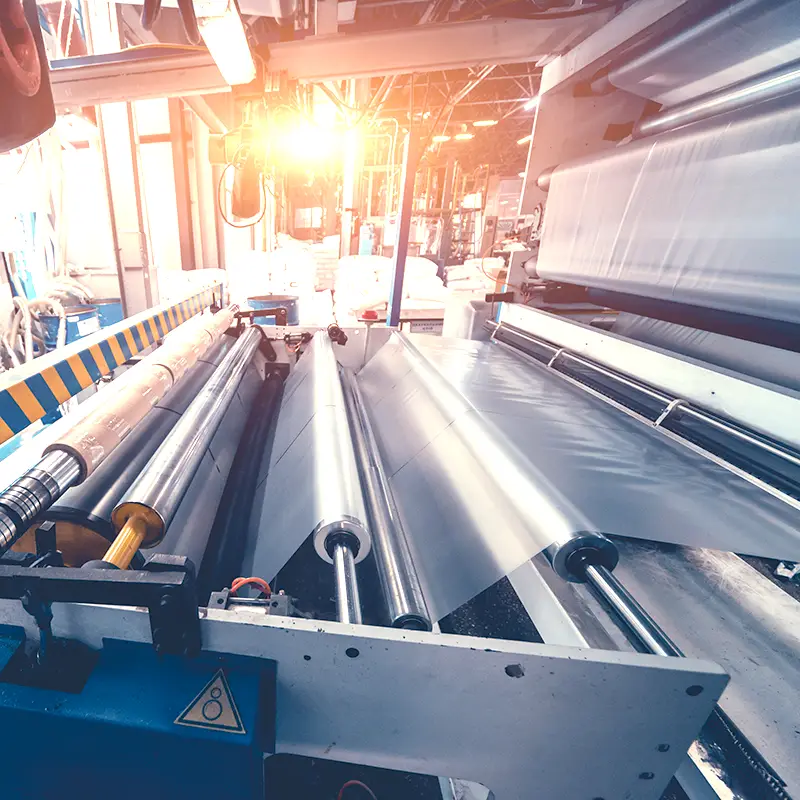
Perforated plate 3 – 10 mm
DN80 – DN300
Vacuum down to −1 bar
short cleaning routes
With slurries, fibrous materials and solids-laden media, the usual order is reversed. The starting point is not the filtration grade but the question of how much solid matter arrives per hour and how long the strainer is to hold it. The dirt load determines the screen area – and the screen area determines the size.
Wire mesh is usually the wrong choice here. It clogs quickly and is difficult to clean, because fibres and sticky residues get caught in the mesh. That is why we work with coarse perforated plate from 3 to 10 mm. It can be scraped off and rinsed out without damage.
The third factor is access. A strainer that is opened often needs a tool-free closure and a cover that stays on the unit. Otherwise cleaning becomes a two-person job and takes place too rarely.
Solids cause damage where gaps are narrow or components run fast.
Area, access and changeover capability are the decision criteria here.
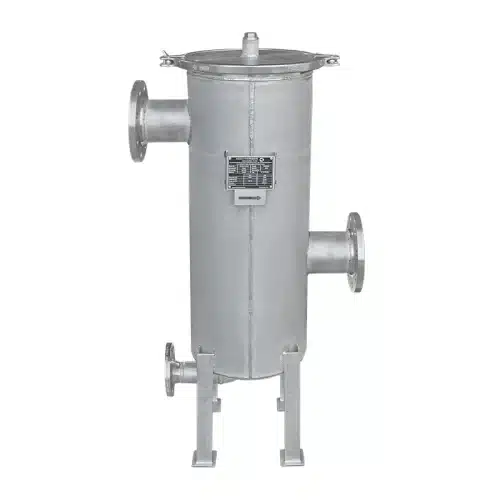
Design range: DN80 to DN300 in PN6 or PN16, stainless steel 1.4571, strainer element as perforated plate with 3 to 10 mm instead of fine mesh screen. Designed for −10 to +60 °C and −1 to 14 bar – the coarse perforation follows a design logic of its own.
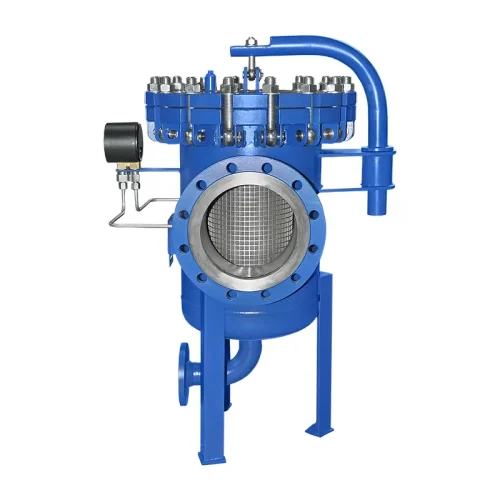
The pot-shaped design holds considerably more solids before the differential pressure rises. With a high dirt load, the larger design is almost always the more economical one: it costs more once and saves on every cleaning.
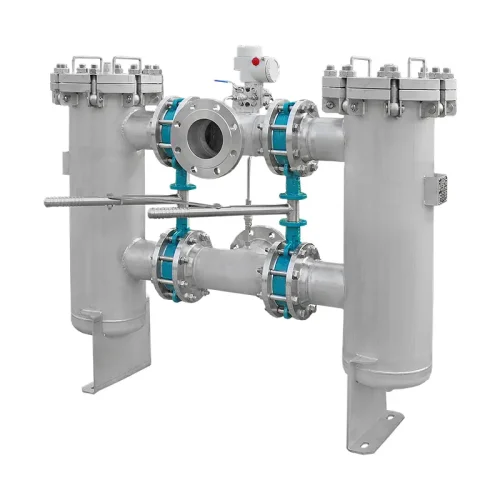
With heavy loads, cleaning is frequent, and every cleaning means downtime. Two chambers with changeover solve this: switch over, open and clear out the isolated side while the plant keeps running.
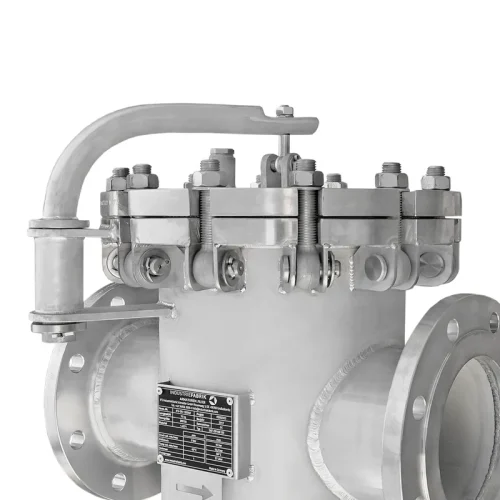
Tool-free closure with hinged eye bolts, a cover that stays on the unit via hinge or swivel arm, and a drain at the lowest point. Only then does a good strainer become a strainer that actually gets cleaned.
Ranges and examples from our production for solids-laden media.
| Feature or example | Value | Note |
|---|---|---|
Simplex strainer for slurries | ||
| Nominal size | DN80 – DN300 | PN6 · PN16 |
| Material | 1.4571 | carbon steel also possible |
| Strainer element | Perforated plate 3 – 10 mm | instead of fine mesh screen |
| Design conditions | −10 … +60 °C · −1 to 14 bar | also vacuum |
Design for high loads | ||
| First parameter | Dirt load per hour | determines the area |
| Second parameter | required cleaning interval | determines the size |
| Screen type | Perforated plate before wire mesh | can be scraped off, does not snag |
| Differential pressure | max. 2 bar | in operation, max. 0.5 bar recommended |
Handling | ||
| Closure | Hinged eye bolts | tool-free |
| Cover | Hinge or swivel arm | stays on the strainer |
| Drain | at the lowest point | socket, flange or ball valve |
| Support legs | for large nominal sizes | operating weight rises with the solids |
With solids-laden media, size is the most economical adjusting screw. A strainer that is sized tightly reaches its limit differential pressure quickly – and every cleaning ties up personnel, often at inconvenient times. A housing selected larger holds many times more solids before it has to be opened, and operates with a lower pressure loss the whole time. The extra cost is incurred once, the saved cleaning every week. Tell us how much solid matter you expect and how often you want to open the strainer – from this we calculate the area.
Because fibres and sticky residues get caught in a mesh and are hard to remove. Coarse perforated plate from 3 to 10 mm can be scraped off and rinsed out and keeps its shape. Where finer separation is also needed, we combine perforated plate as a support basket with a fine mesh screen.
That depends on the dirt load and the required cleaning interval, not on the nominal size of the line. Tell us both – we calculate the required screen area and propose the size.
With high loads, almost always. Cleaning is frequent and takes longer than with clear media; each one would mean downtime. With two chambers, the plant keeps running while one side is cleared out.
Yes, our designs cover the range from −1 bar. Under vacuum, the pressure difference acts on the basket from the outside – the element is reinforced for this.
The differential pressure decides that, not the calendar. With our basket strainers, the permissible differential pressure is a maximum of 2 bar; in operation we recommend no more than 0.5 bar. A gauge above the screen makes the right moment visible.
Yes. Before production starts, you receive the design drawing for approval – with design data, materials, mesh size and attachments. Only after your confirmation does the order go into production.
Tell us the medium, flow rate, expected solids load and the required cleaning interval – you will receive a design with screen area, type and access.