Flow control
For cleaning, the strainer has to be isolated from the medium. How much effort this takes is decided beforehand: which valves the strainer is fitted with and whether they are operated by hand or by an actuator. As fitted valves for flow control, we mount ball valves, butterfly valves and actuators directly on the housing – matched and tested as one unit.

Ball valve · Butterfly valve · Gate valve
Butterfly valves or ball valves
pneumatic or electric
ISO 5211
A strainer is opened regularly. That is not a malfunction but normal operation. What matters is what happens to the plant in the process. Without isolation, the line section has to be drained. With isolation upstream and downstream of the strainer, it is enough to shut off this section and depressurise it via the drain valve.
If the valves are procured later, flange pattern, face-to-face length and material rarely fit straight away. If we design them in, connection dimensions, pressure rating and material are matched from the outset – and the assembly is tested and documented as a whole.
From a simple hand lever to an actuated changeover. What makes sense depends on how often the strainer is cleaned and whether the plant has to keep running in the meantime.
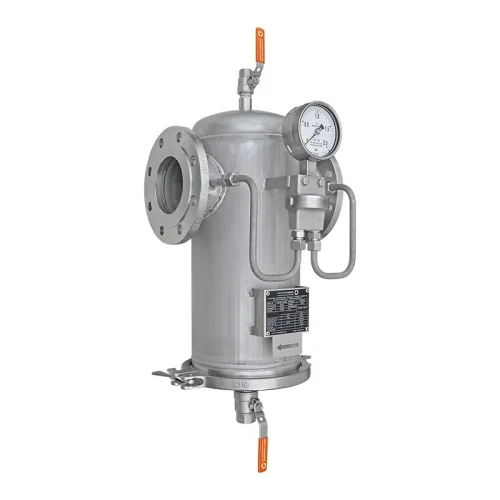
The most common valve on a strainer. As isolation upstream and downstream of the housing, as drain valve on the bottom and as vent in the cover. Full bore, short actuation with the hand lever, tight seat even after many switching cycles.

From about DN150 the ball valve becomes heavy and expensive. Butterfly valves are shorter and lighter, gate valves keep the pressure loss low when open. Both can also be fitted with an actuator. For permanent isolation, spade blinds, restriction orifice plates and spectacle blinds are fitted between the flanges.

The duplex strainer has two chambers: one in operation, one in reserve. Changeover is by four butterfly valves, four 2-way ball valves or – much more compact – two 3-way ball valves. The isolated chamber is cleaned while the plant keeps running.

Where the changeover is not to be done by hand, a quarter-turn actuator takes over – the most common case on the duplex strainer. Pneumatic as a double-piston actuator to DIN 3337, double-acting or single-acting with spring return, so that the valve moves to the safe position automatically if the air supply fails; the end stops are adjustable. Electric for 24 to 240 V with manual override, visual position indicator, two volt-free limit switches, anti-condensation heater and electronic torque limitation, design to DIN EN 15714-2. Both are mounted via ISO 5211.

On the duplex strainer, two butterfly valves can be mechanically coupled. A linkage rod connects the levers so that one movement opens one chamber and closes the other. This saves actuators and rules out incorrect switching – the wrong combination is mechanically impossible. Changeover is by a hand lever, without power and without compressed air.

So that the control room knows whether the valve is really closed: an inductive dual sensor reports the open and closed positions as a volt-free signal. 3-wire technology, M12 plug connection, use from −25 to +80 °C.
The values describe the versions we usually fit. Make and size depend on nominal size, pressure rating and medium.
| Component | Version | Note |
|---|---|---|
Changeover on the duplex strainer | ||
| Butterfly valves | 4 pcs | standard variant, also for large nominal sizes |
| 2-way ball valves | 4 pcs | full bore, tight seat |
| 3-way ball valves | 2 pcs | more compact design, half the number of valves |
| Automated | pneumatic or electric | changeover operation without manual intervention |
Valves | ||
| Ball valve | DN15 – DN150 | full bore, hand lever or actuator |
| 3-way ball valve | T-port ball | changeover on the duplex strainer |
| Butterfly valve | useful from DN150 | short face-to-face length, low weight |
| Gate valve | large nominal sizes | low pressure loss when open |
| Restriction orifice plate | to EN 1092-1 | permanently limit the flow |
| Spade blind and spectacle blind | to EN 1092-1 | permanently isolate the line |
Actuators | ||
| Pneumatic | Double piston, DIN 3337 | single-acting or double-acting |
| Spring return | safe position on air failure | for single-acting version |
| Electric | 24 – 240 V AC/DC | manual override, anti-condensation heater |
| Electric design | DIN EN 15714-2 | electronic torque limitation |
| Valve interface | ISO 5211 | F03 · F04 · F05 · F10 depending on size |
| Actuator ingress protection | IP 67 | polyamide housing |
Feedback | ||
| Sensor | inductive dual sensor | open and closed position |
| Switching output | 2 × normally open, PNP | 3-wire, 10 – 36 V DC |
| Connection | M12 plug connection | ingress protection IP 67 |
| Ambient temperature | −25 … +80 °C | at the sensor, not in the medium |
A simplex strainer forces an interruption for cleaning – with short intervals this adds up. The duplex strainer with changeover costs more to buy but keeps the plant running: switch over, open the isolated chamber, clean it, make it ready again. Whether this pays off depends on two figures – how often cleaning is needed and what an hour of downtime costs in your plant. You know both better than we do; we calculate the strainer side against them.
Yes. Before production starts you receive the design drawing for approval – the drawing also shows the fitted valves and their position. Only once you have confirmed it does the order go into production.
Certainly. Drawings, specifications, parts lists or the data sheet of the previous strainer are the best basis. Our design engineers adopt your requirements and adapt them where manufacturing or the applicable code requires it – we agree any deviations with you beforehand.
All three are standard. Four butterfly valves are the usual solution, especially for larger nominal sizes. Four 2-way ball valves offer full bore and a tight seat. Two 3-way ball valves manage with half the number of valves and are much more compact – the right choice when space is tight.
Up to about DN150 the ball valve: full bore, tight seat, simple operation. Above that it becomes large, heavy and expensive – then the butterfly valve is the better choice. It is shorter and weighs considerably less, but has its disc in the flow path.
If compressed air is available anyway, the pneumatic actuator is simpler and faster. The electric actuator needs only power and comes with limit switches and manual override as standard. A safe position on failure can be achieved pneumatically via spring return.
With the single-acting pneumatic actuator, the spring moves the valve automatically to the intended position – open or closed, depending on the version. With the electric actuator the valve stays where it is; it can then be moved via the manual override.
Yes. The 3-way valve is given an actuator, and its position is fed back. The changeover command comes from your control system – triggered, for example, by the limit value of the differential pressure gauge.
For actuators we work mainly with J+J (electric) and Norbro (pneumatic), for position feedback with ifm. If another make is specified in your plant, we fit it or provide the matching interface for a customer-supplied unit.
Yes, also without a strainer – as an individual valve or as a pre-assembled unit with actuator, mounting bracket and feedback.
All topics at a glance: Strainer options
Tell us how often the strainer is cleaned and whether the plant has to keep running. This determines which valves make sense and whether an actuator pays off.