Home › Applications › Gases and nitrogen
Applications
Gases carry little dirt – but what they do carry is fine and arrives fast. That is why the industrial gas strainer calls for the finest wire mesh, the tightest closures and often the highest temperatures.
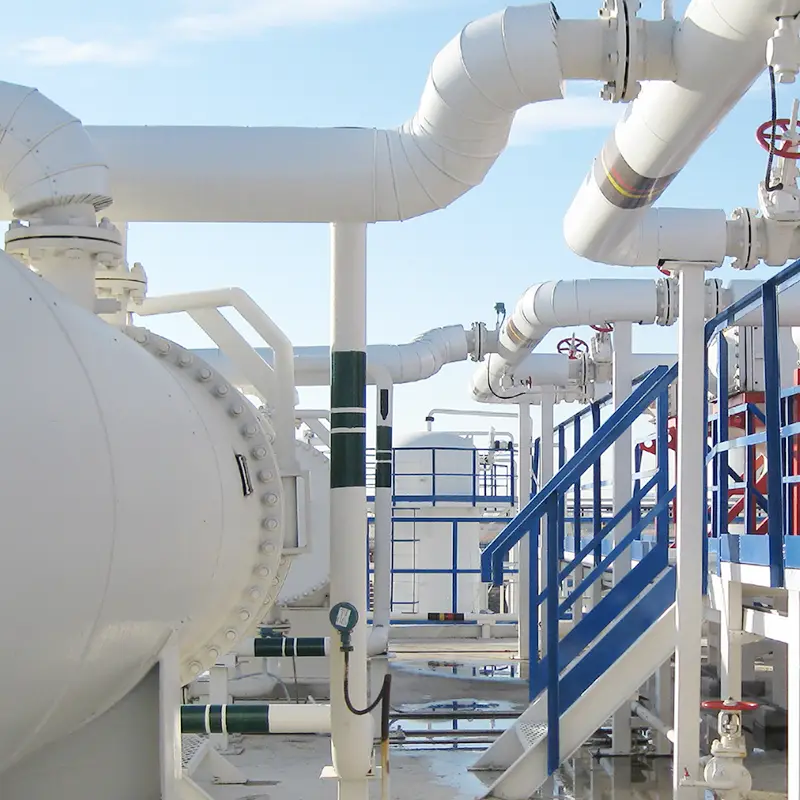
the finest separation
up to +300 °C at 10 bar
tight rather than quick
FDA-compliant gasket
In a gas line the dirt load is low – rust from the line, abrasion from compressors, residues from installation. But because the gas itself has hardly any mass, even the smallest particles act as projectiles: they hit sealing faces, seats and measuring instruments at flow velocity.
That is why separation here is finer than with liquids – and the pressure loss is still usually uncritical, because the density of the medium is low. What does become critical is external tightness: with gas, a leak does not show itself as a puddle.
The third factor is temperature. Process gases often arrive hot – our highest design in this range is +300 °C and 10 bar. This moves gasket, material and closure away from the standard.
Gas strainers sit upstream of components with tight seats and upstream of instruments that are sensitive to particles.
Nominal size, temperature and the question of condensate determine the choice.
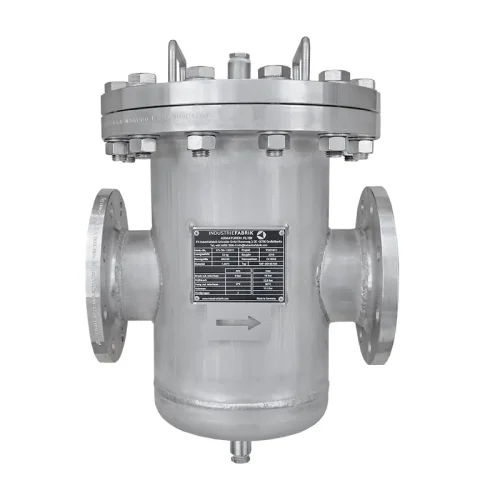
Design range: DN100 in PN16, stainless steel 1.4571, mesh size 250 µm – designed for up to +300 °C at 10 bar. This is the highest temperature for which we have designed a basket strainer of this range; gasket and closure are matched to it.
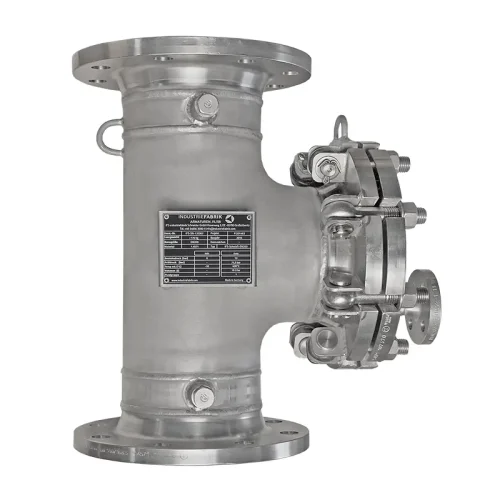
For nitrogen and protective gas lines: DN150 in PN10, stainless steel pickled and passivated, perforated plate 10 mm, AFM 34 gasket with FDA compliance, designed for up to +80 °C and 2 bar. Without drain, because no condensate forms.

Square mesh offers the largest open area with fine separation and is therefore the usual choice for gases. Supported on perforated plate, the element remains dimensionally stable even under pressure surges.
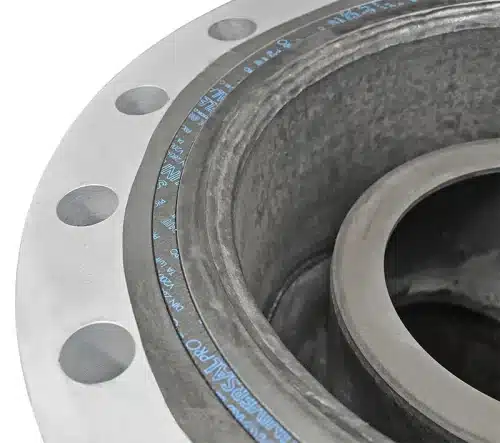
With gas, external tightness counts for more than quick opening. A bolted cover flange with a suitable gasket is often the right choice here – the quick-opening closure comes into consideration where cleaning is frequent.
Ranges and examples from our production for gases and inerting.
| Feature or example | Value | Note |
|---|---|---|
Basket strainer for gases | ||
| Nominal size | DN100 | larger to suit the design |
| Pressure rating | PN16 | higher on request |
| Material | 1.4571 | stainless steel |
| Mesh size | 250 µm | to suit the protected component |
| Design conditions | up to +300 °C · 10 bar | highest temperature in this range |
T-type strainer for inerting | ||
| Nominal size | DN150 | PN10 |
| Material | Stainless steel | pickled and passivated |
| Strainer element | Perforated plate 10 mm | coarse retention |
| Gasket | AFM 34 | with FDA compliance |
| Design conditions | up to +80 °C · 2 bar | without drain |
What belongs with gases | ||
| Tightness | before speed | closure and gasket matched |
| Wire mesh | Square mesh on perforated plate | large open area, dimensionally stable |
| Differential pressure | recommended | clogging is not visible |
| Drain | only where condensate forms | otherwise not needed |
With liquids, a leaking joint reveals itself. With gas, it goes unnoticed until someone measures or smells it. That shifts the design. The cover closure is selected for tightness, not for ease of operation. The gasket is matched to the medium and temperature rather than to the standard case, and with flammable or hazardous gases, documentation is added.
Tell us with your enquiry which gas is involved and whether there are special requirements for tightness or explosion protection.
Finer than in comparable liquid applications, because particles in the gas stream arrive at high velocity and hit seats and sealing faces. The pressure loss usually remains uncritical, because the density of the medium is low.
The highest design in this range is +300 °C and 10 bar. Higher temperatures are a question of material, gasket and closure – tell us your operating temperature and we will calculate it.
Only if condensate forms. In dry gas lines and for inerting, we also build the strainer without a drain. Where moisture is involved, the drain belongs at the lowest point.
For protective gas applications in these sectors, we fit gaskets with FDA compliance – such as AFM 34 – and build the housing in pickled and passivated stainless steel. Tell us the requirements of your audit, and we will match materials and documentation to them.
With gas, the bolted cover flange is often the right choice, because tightness is more important than quick opening. Where cleaning is frequent, we also consider the quick-opening closure – the gasket then has to be selected accordingly.
Yes. Before production starts, you receive the design drawing for approval – with design data, materials, mesh size and attachments. Only after your confirmation does the order go into production.
Tell us the gas, pressure, temperature and the component to be protected – plus any special requirements for tightness or documentation.