Surface
A carbon steel housing leaves our works primed and painted, a stainless steel housing pickled and passivated. Anything beyond that – colour shade, coating thickness, corrosivity category – depends on where the strainer is installed: indoors, outdoors or in salt-laden air.

RAL 5010 blue
pickled and passivated
120 to 320 µm
up to C5-M
Almost every enquiry specifies a RAL shade. Hardly any states how long the protection should last and in what environment. Yet that is exactly what determines the coating system. A blue strainer with a total coating thickness of 120 µm and a blue strainer with 300 µm look the same. Outdoors on the coast, one lasts a few years, the other the planned service life.
The standard DIN EN ISO 12944 classifies environments into corrosivity categories: C4 for industrial atmospheres, C5-I for very high industrial exposure, C5-M for coastal and marine air. The category and the required durability determine the surface preparation, primer and topcoat. The colour shade comes afterwards and can be chosen freely.
The housing material determines first which treatment is possible.
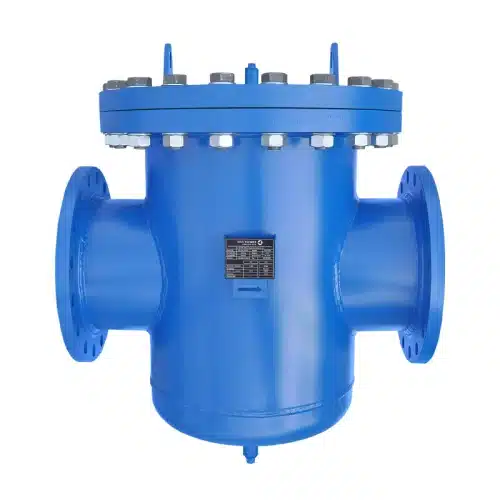
The carbon steel housing is primed and painted – as standard in RAL 5010 blue. RAL 7035 light grey is just as common. Other shades to the RAL industry standard are possible.

Stainless steel is not painted but pickled and passivated. Pickling removes heat tint and scale from the welds; passivation rebuilds the protective chromium oxide layer. This is the standard treatment for pot type strainers and all stainless steel designs.

We apply special shades to match your corporate design through our external paint shop. Tell us the shade, and we will clarify feasibility before you order.

Preparation by blasting to Sa 2.5 to DIN EN ISO 12944-4, followed by a primer and a topcoat. Common systems range from 120 µm (40 µm primer plus 80 µm topcoat) through 200 and 240 µm to 300 µm for C5-I and 320 µm for C5-M. The coating thickness is measured and stated in the report.

Where normal paints fail at the temperature, a heat-resistant paint is applied to the housing. It is carried out by our paint shop and matched to your operating temperature – please tell us the continuous temperature and, if known, the peak temperature. On heated strainers it can be combined with insulation.
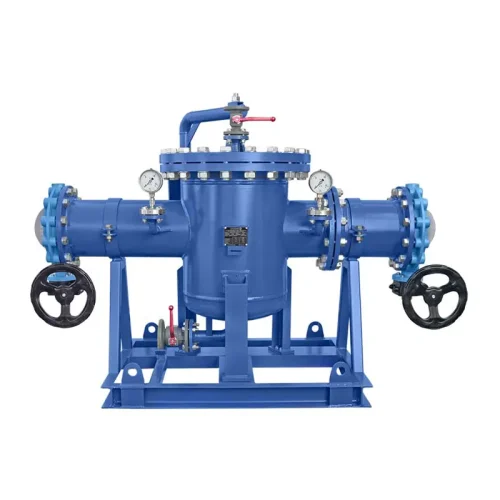
Whatever is attached to the strainer is treated as well: support legs, support brackets, valve brackets and the frame. A frame can also be designed to be forklift-accessible and painted in the colour of the housing. This keeps the assembly a single unit, both visually and in terms of corrosion protection.
Colour shade and coating system are specified for each order. The following details show the standard and common coating systems.
| Feature or system | Value | Note |
|---|---|---|
| Standard by material | ||
| Carbon steel housing | primed and painted | RAL 5010 blue |
| Stainless steel housing | pickled and passivated | no coating |
| Pot type strainers | pickled and passivated | also deep-drawn |
| Colour shade | to the RAL industry standard | other shades on request |
| Coating systems | ||
| Preparation | Blasting Sa 2.5 | to DIN EN ISO 12944-4 |
| 120 µm | 40 µm primer + 80 µm topcoat | RAL 5010 |
| 200 µm | 140 µm primer + 60 µm topcoat | RAL 7035 |
| 240 µm | two 2K coats | RAL 7035, special paint |
| 300 µm | 2K epoxy + 2K acrylic | Corrosivity category C5-I |
| 300 µm | primer + topcoat | Corrosivity category C4, with measurement report |
| 320 µm | primer + topcoat | C5-M long durability, outdoor installation |
| Through partner companies | ||
| Pickling and passivation | in an immersion bath | also for pipework and frames |
| Powder coating | on request | instead of liquid paint |
| Electropolishing | on request | Ra ≤ 0.38 µm to ASME BPE SF4 |
In corrosion protection, a wrong assumption costs the most later on. A standard coating system indoors lasts for decades; outdoors on the coast, the same system can be worn through within a few years. For the design we need three details: the location of the strainer (indoors, outdoor plant, coastal area), the exposure there (chemicals, condensate, cleaning agents) and the required durability. This determines the corrosivity category to DIN EN ISO 12944 and therefore the coating system. You can choose the colour shade independently.
Yes. Before production starts, you receive the design drawing for approval – it also states the colour shade, coating system and required coating thickness. Only once you have confirmed the drawing does the order go into production.
Of course. Coating specifications, your plant’s painting standards or the details of the previous strainer are the best basis. Our design engineers adopt your requirements and adapt them where manufacturing or the applicable code requires it – we agree any deviations with you in advance.
As standard RAL 5010 blue, often also RAL 7035 light grey. Beyond that, we can apply any shade to the RAL industry standard that is available in the selected coating system – simply tell us the number.
Welding stainless steel produces heat tint and a scale-like layer that locally cancels out the corrosion resistance. Pickling removes them chemically; passivation allows the protective chromium oxide layer to form again. Without this step, a stainless steel housing rusts precisely at the welds.
C4 covers industrial atmospheres with moderate salt and chemical exposure, C5-I very high industrial exposure, C5-M coastal and marine air. We carry out the classification to DIN EN ISO 12944 based on your information about the installation site – together with the required durability, it determines the coating system.
Yes, it is measured and, on request, stated in a measurement report – this is common practice for coated assemblies. Let us know in your enquiry whether you need the report for your documentation.
Yes – we apply a special heat-resistant paint through our paint shop. We set the temperature range according to your operating temperature, so please include this information in your enquiry. On strainers that are permanently operated hot or heated, insulation additionally protects the hot surface; details are on the insulation page.
Yes. Blast cleaning to remove rust and a complete new coating system with primer and topcoat are possible on carbon steel components, including a measurement report. The prerequisite is that the housing itself still has the required wall thickness – we check this beforehand.
All topics at a glance: Strainer options
Tell us the installation site, exposure and required durability – plus the colour shade, if you have one. From this we specify the coating system.