Anyone who orders a basket strainer ends up with a painted or pickled housing with cover and basket. What happens in between is rarely seen. Yet this is exactly what decides whether the strainer stays tight, whether it is easy to clean and whether the certificates match the unit.
Here are the stations as they run at our works in Großzöberitz, and what you gain from them as the buyer.
At a glance
Housing
Made from pipe or plate. Up to DN250 a piping component, from DN300 pressure vessel construction.
Welding
In-house, as a welding shop qualified to DIN EN ISO 3834-3, manufactured to AD 2000.
Basket
Support basket with fine mesh screen. It can be exchanged without changing anything on the housing.
Testing
Pressure test with report before the strainer leaves the works.
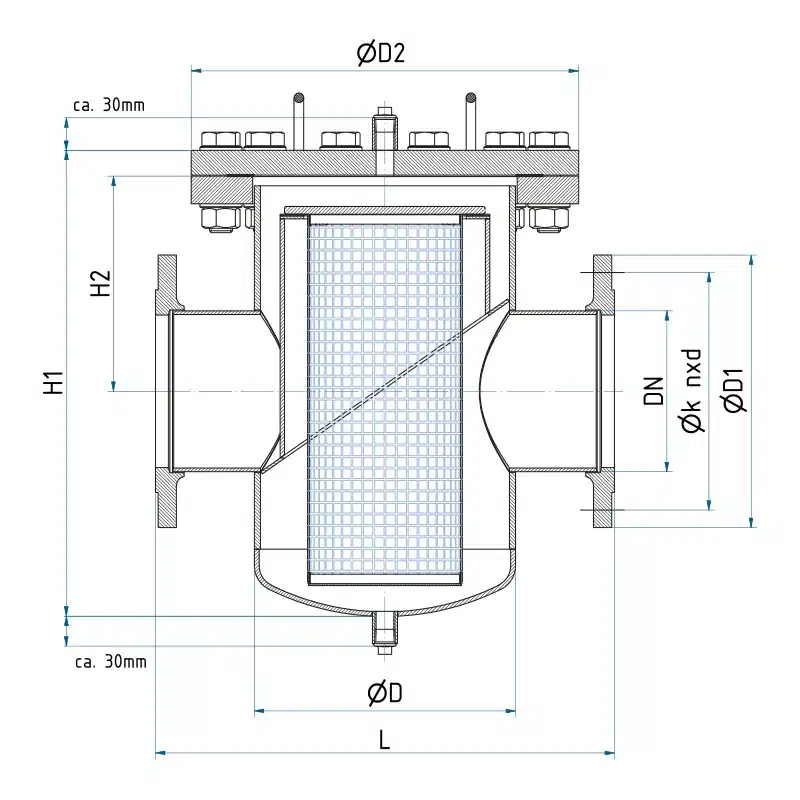
Beforehand
Before a pipe is cut, the drawing is in place. We calculate the wall thicknesses to the code, define the connections and face-to-face lengths and send you the draft. Manufacturing starts only after your approval. How much time this step takes is explained in the article Delivery time for industrial strainers.
The reason for the effort: a strainer housing is a pressure vessel. Every nozzle, every lug and every jacket affects the pressure-bearing wall and must be calculated before welding starts.

Station 1 of 6
Up to DN250 the basket strainer is a piping component. Above that, the task changes: the housing is made from pipe or plate, the cover weighs more than one person can lift, and the basket is later removed by crane. That is why handling is considered as early as the blank: with lifting lugs, support brackets and a cover lifting device.
For you
From DN500 upwards, plates and flanges are no longer stock items. For large nominal sizes, procurement determines the date, not the workshop.
Station 2 of 6
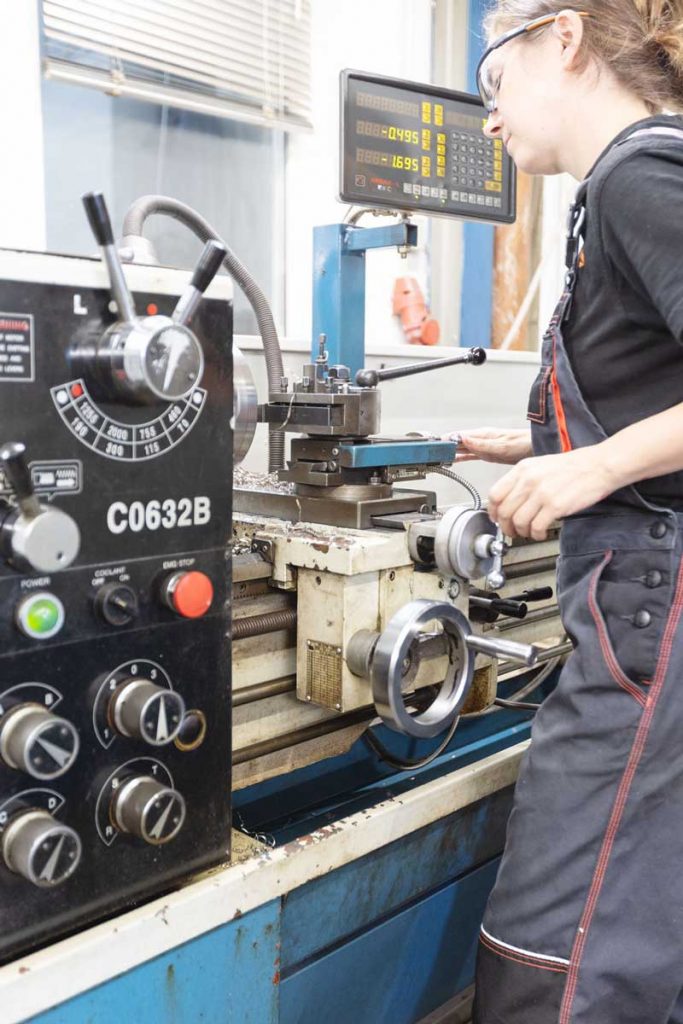
Pipe and plate are cut to size. We machine the flanges to DIN EN 1092-1 in our own turning shop. As standard, the face-to-face length follows EN 558-1, series 1. Dimensions and sealing faces must be right, otherwise the strainer will not fit into your line.
For you
Because cutting and turning are done in-house, a different face-to-face length or an additional nozzle is a change to the drawing, not a special case.

Station 3 of 6
We weld the pressure-bearing parts ourselves: housing, cover, flanges and nozzles. The works is qualified as a welding shop to DIN EN ISO 3834-3, and the manufacturer qualification to AD 2000 Merkblatt HP0 is in place.
As standard, there is a vent socket in the cover and a drain socket in the housing bottom. Depending on the order, nozzles for differential pressure measurement, a heating jacket or fitted valves and instruments are added.
For you
Name everything that is to sit on the pressure-bearing wall in your enquiry. Adding it later means welding on the finished pressure vessel, another test, new documentation and downtime.

Station 4 of 6
As standard, our basket strainer works with a support basket in 1.4301 and a fine mesh screen in 1.4401 with 1 mm mesh size. The support basket carries the load, the fine mesh screen determines the filtration grade. From about 2.5 mm mesh size, the perforation of the basket does the filtering on its own. At the fine end, the range goes down to 0.05 mm.
The medium flows through the basket from inside to outside. The dirt stays in the basket and not on the housing wall. This makes it possible to judge how much dirt has been collected, and the basket can be exchanged for one with a different mesh size.
For you
The right filtration grade follows from the component downstream of the strainer, not from the medium. How this is designed is explained under Mesh size and filtration grade. We make replacement baskets to size or to sample, also for other manufacturers’ strainers.

Station 5 of 6
Stainless steel housings in 1.4571 are pickled and passivated. Carbon steel housings in P250GH are primed and painted, as standard in RAL 5010. Both take time and are partly carried out by outside specialists.
For you
If you need a specific corrosivity category or a special colour, say so early. The coating system depends on it. More under Surface and corrosion protection.
Station 6 of 6
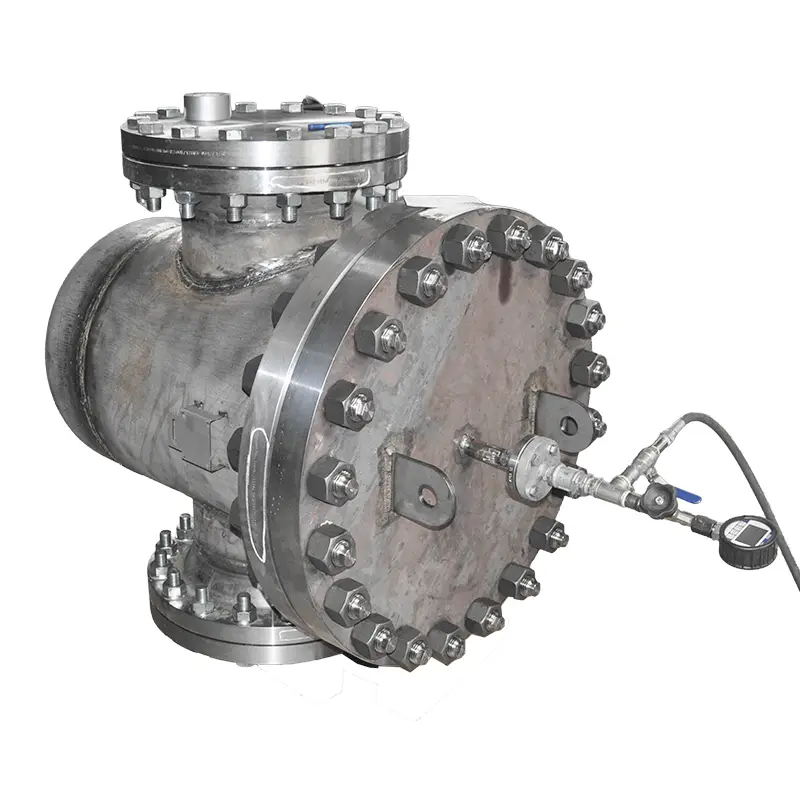
The last station is the pressure test with report. Depending on the order, this includes an inspection certificate 3.1 to EN 10204, a TÜV inspection, the declaration of conformity under the Pressure Equipment Directive, plus data sheet and operating manual.
Two things you should know:
For you
Certificates and inspection belong in the enquiry, not just in the order. What is included is explained under Certificates and documentation.
Checklist
This also applies to strainers from other manufacturers. These are practical notes, not a standard.
Tell us the medium, operating pressure, temperature, nominal size and the component to be protected. From this we design the material, mesh size and options and send you the drawing for approval.
armaturenfabrik.de
Simplex, basket and duplex strainers and pot type strainers